“On Palm Sunday, [the 11th of April] in the year 1568, with the people of the town, we went in procession to the church, in our white mantles and with veils covering our faces. A sermon was preached there, and from that church the Blessed Sacrament was brought to our monastery. This inspired great devotion in everybody”.

In this manner, in chapter 9, paragraph 4 of the Book of Foundations, St Teresa described the foundation of the monastery in Malagon, the third of the Reform. So recently, on the 11th of April, the 450th anniversary of this event was also celebrated with devotion and enthusiasm by the inhabitants and institutions of this village in the Province of Ciudad Real, in Spain.

For some months now, numerous religious and cultural events have been unfolding in Malagon to celebrate this anniversary: the inauguration of a Teresian museum –assisting this project from the frontlines was Fr Ricardo Plaza, a Discalced Carmelite from the Toledo monastery─, a presentation of a video on St Teresa’s foundations will follow.

From the 9th to the 14th of April, dates surrounding the beginning of the anniversary, events of this kind multiplied. Standing out was the presentation of the memorial book for the 5th Teresian Centenary in Malagon, the opening of the “meeting door” in the monastery in which is represented in high relief Our Lady of Mt Carmel, St Joseph, St John of the Cross and St Teresa; also the declaration of Teresa as the honorary Mayor of the locality.

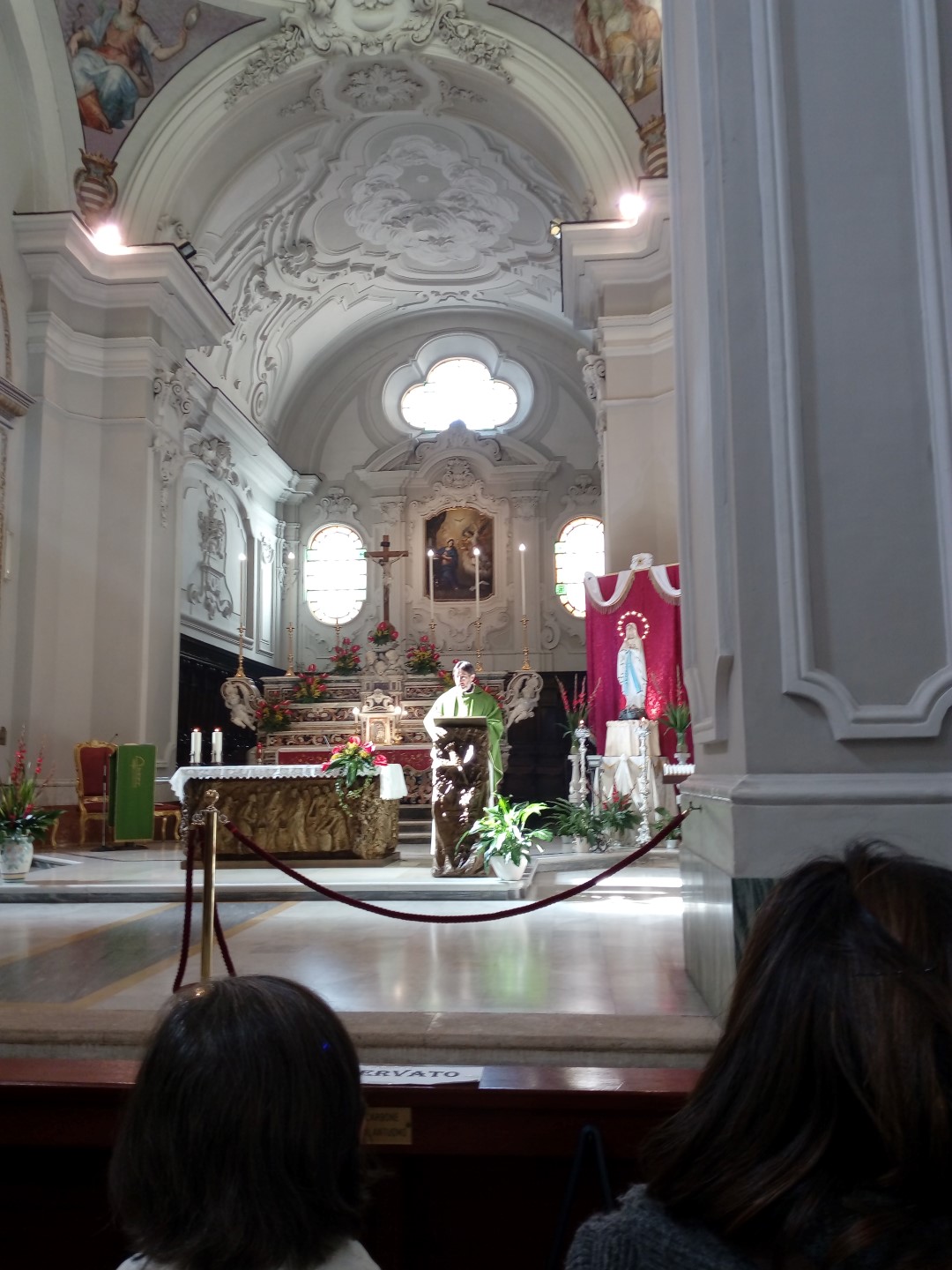
The celebrations came to an end with a procession with the image of St Teresa, writer, which is kept in the monastery and a thanksgiving Mass, which totally filled the monastery square. During the Mass, the Bishop of Ciudad Real, Bishop Gerardo Melgar, gave thanks in the name of all the people for the 450 years of the prayerful presence of the Discalced Carmelite nuns.

In November 2017 the Carmelite friars (O.Carm.) of the American province of the Most Pure Heart of Mary gave an endowment of 5 million US dollars to the Catholic University (CUA) of Washington, DC, for the purpose of establishing a Chair and Center of Carmelite Studies.

https://communications.catholic.edu/news/2017/11/carmelite-gift-to-catholic-university.html

Recently, CUA has begun advertising the position, inviting those who are qualified and interested to apply (see listing on  https://provost.cua.edu//positions.cfm). Let us pray for the success of this intiative, which could be a very important step in promoting advanced Carmelite Studies in the English-speaking world.

As for many years, during Holy week, a group of Brazilian Secular Discalced Carmelites offered their services to the poor and needy communities of Vila São João, Dutra, Várzea da Páscoa and Ribeirão. All of these belong to the Francisco Badaró parish of Our Lady of the Conception, in the diocese of Araçuaí-MG. These communities are taken care of by Discalced Carmelite missionaries, such as Br. Márcio.

During these days, our brothers and sisters visited the sick, had meetings with various Christian groups, helped in the schools and, as well, animated the liturgical celebrations and took part with the communities in paraliturgical celebrations such as the Way of the Cross, meditated rosary, Benediction, and moments of prayer, etc.

In prayer, in the celebrations, in service to those most poor, as well as in music, our brothers and sisters had personal experience of the motto of St Therese of the Child Jesus: “Everything is a grace”.


On the 25th of January 2017, with six foundresses coming from Ecuador, life began in the Teresian Carmelite nuns’ monastery of St Joseph and Saint Elizabeth of the Trinity, in the Panamanian diocese of Colón-Kuna Yala.

As the main work to sustain themselves, the sisters complement the production of bread with wafers for the celebration of Mass. So, the next World Youth Day, to be celebrated in Panama, offers an optimal occasion for the sale of hosts, which would help the sisters face the expenses of daily life, as well as the debts contracted through the work carried out in the monastery, as well as the buying of industrial machines for the production of hosts, etc. For the community, also, it would be a beautiful way of taking part in such an important event.

We can help the sisters financially through this cheque account: Banco General de Panamá, Diócesis de Colón-Kuna Yala (Carmelitas Descalzas), account number: 03-27-01-115350-3. For additional information, write to: carmelitas.panama@gmail.com.

Recently, between the 3rd and the 6th of April, 34 friars from the Venice Province, priests and students, paid a visit to the friars of the Croatian Province. The visit arose from the desire to rediscover the existing ties between the two Provinces. From the 1950s to the end of the 1960s, some Croatian students and theologians carried out their studies for the licentiate and the first years of theological training in the Venice Province. Relations between the two were widened when Croatia declared itself independent in 1991. From Verona and Trieste, much aid was sent to the Croatian monasteries for the thousands of displaced people who sought assistance from our friars. During the same period, various of our Croatian priests, who had to finish their theological studies in Rome, lived in the Santa Teresa monastery.

The first day of sharing together took place in the Spirituality House of the Sisters of St Vincent de Paul of Lužnica, some 20 km from Zagreb. Fathers Rodolfo Girardello (Venice), Jakov Mamić and Srecko Rimac (the second and the present Provincials of Croatia), gave firsthand witness to the historical ties between both Provinces. There was also time to exchange formative experiences (Fr Petar from Graz, and Fr Gianni from Trent), as well as discussing the Carmelite charism and the urgency of transmitting it to the laity (Fr Antonio Sicari).

On the second day, the friars transferred to Zagreb, where they were able to venerate the relics of blessed Alojzije Stepinac in the cathedral, as well as visiting the old city. In the afternoon, after eating at Remete, the Venetian and Croatian friars went to the national sanctuary of Marija Bistrica, [Our lady of Bistrica ─ the Black Madonna], to celebrate Mass at which presided our Brother Monsignor Zdenko Križić, ocd, with whom we also had the opportunity of greeting our discalced Carmelite nuns. It was a rich experience of getting to know one another, in the opinion of all those taking part.

On the 6th of March 2018, the Holy Father, Pope Francis, received in  audience His Eminence, the Most Reverend Cardinal Angelo Amato, S.D.B., Prefect of the Congregation for the Causes of the Saints. During the audience, the Pontiff authorized the Congregation to promulgate the decree relating to the miracle attributed to the intercession of the Venerable Servant of God, María Felicia de Jesús Sacramentado.

Later on, Mons. Valenzuela, Bishop of Asunción, Paraguay, made official the date of the Beatification: the 23rd of June this year, in the “Nueva Olla” stadium of the Cerro Porteño football club. The site was selected so that a greater number of the public could attend.

In order to take part in the preparations for the beatification, Fr Romano Gambalunga, the Postulator General, went to Paraguay where, in Mburuvicha Róga, among other things, he was able to meet again with the President of the Republic, Mr Horacio Cartes. Afterwards, in the press conference, our Postulator stated that he had been able to present to the President all the work that he had been doing with Brother Restituto Palmero, ocd, in the context of this Cause.

In regard to the beatification, he assured that it “is a motive for joy and hope for all the people of Paraguay” and he pointed out the devotion existing among the Catholics of Paraguay for this holy nun who will the first person to be beatified in that nation. “In the two weeks that I have been in Paraguay, I have come to experience that she is a person much loved by the faithful”, stated Fr Romano, who then added that President Cartes had stated to him his availability and willingness to do all he could to make the beatification of María Felicia de Jesús Sacramentado, Chiquitunga, “a celebration for all the people”. The 23rd of June will be a day of national interest.

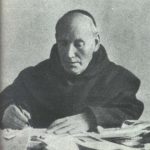
(Escóbados de Arriba, Burgos, Spain) – March 10, 1954 (Mazatlán, Sinaloa, Mexico)

Father Silverio, of the Gómez-Fernández family, was born in the village of Escóbados de Arriba on the high plain of Sedano, south of the district of Villarcayo, in the Spanish province of Burgos, on March 8, 1878.

He was educated by an uncle who was a priest – Don Tiburcio Fernández – in the schoolhouse of Don Manuel Gutiérrez, pastor of Villaescusa de Butrón (a village neighboring Escóbados) and earned a grade of “Meritissimus” in Latin and “Beneméritas” in Geography and History of Spain. From there, he went to the Seminary of Saint Jerome in Burgos to continue ecclesiastical studies for three more years, 1892 to 1895. In July 1895, he entered the novitiate of the Discalced Carmelites of Larrea in Vizcaya, Spain, taking the Carmelite habit on July 4, 1895. He completed his novitiate and studied Philosophy and Theology in the colleges of the province of Saint Joachim of Navarre.

He was ordained to the priesthood on July 27, 1902, by the Archbishop of Burgos, friar Gregorio María Aguirre, future Cardinal and Primate of Spain. That year, he traveled to Rome, where he continued his theological studies from 1902 to 1904 in the Gregorian University. When the General of the Order, Father Reinaldo Maria, assigned him to the theological school of Naples as a professor, he traveled to Germany, Netherlands, Belgium, and England to broaden his studies. In the end, he did not hold the teaching office, but instead was sent to Burgos.

At the behest of the Major Superiors, he devoted himself to researching and publishing the history and bibliography of the spiritual legacy of the Discalced Carmel. In 1906, he was appointed director of the periodical, Revista Monte Carmelo. It is estimated that Father Silverio published about 600 titles, including articles and major and minor works.

His first major work was The Precept of Love (1913, El Precepto del Amor), published in chapters titled, “Legal charity and Christian charity” (La caridad legal y la caridad cristiana) in the Revista Monte Carmelo. After that came “Historical overview of the Restoration of the Discalced Carmelites in Spain” (1918, Resumen histórico de la Restauración de los Carmelitas Descalzos en España). His third major work, lengthy and meritorious, is “History of the Discalced Carmel in Spain, Portugal, and America” (Historia del Carmen Descalzo en España, Portugal y América), spanning 15 volumes and described as “an elegant and loving record of our past” which was undertaken “in conformity with the historical canons of its time, with the purpose of edification.” The first four of the fifteen volumes are dedicated to a biography of Saint Teresa of Jesus; the fifth volume to the life of Saint John of the Cross; and the sixth volume is dedicated to Fathers Gracián and Doria. In the remaining nine volumes, he presents syntheses of the lives of the most notable Carmelites, friars as well as nuns, up to the mid-20th century. He chose persons relevant for their virtue as well as their learning and drew up documentation of the new foundations of convents and monasteries in Spain, Portugal, and America. The first tome was published by Imprenta del Monte Carmelo in 1935. Among other works, we can cite: “The Life of Saint Teresa of Jesus: The epitomized essence of our People” (1939, Vida de Santa Teresa de Jesús, síntesis suprema de la Raza), part of the series of Biblioteca Nueva (Madrid); or the last one: “The Perfect Carmelite” (1948, La Carmelita Perfecta), an edition by the publishing house Monte Carmelo dedicated to his dear Discalced Carmelite sisters.

Among his minor works are: “Poor Children!” (1910, ¡Pobres Niños!); “Memoire of the 22nd International Eucharistic Congress” (1911, Recuerdo del XXII Congreso Eucarístico Internacional); “Through Las Hurdes and Las Batuecas” (1922, Por las Hurdes y las Batuecas); “Saint Teresa: A model of Christian feminism” (1931, Santa Teresa, modelo de feminismo cristiano); “Saint Teresa and her friendships” (1933, Santa Teresa y sus relaciones de amistad); Ana Teresa of the Sacred Family” (1935, Ana Teresa de la Sagrada Familia); “Venerable María of Jesus” (1949, La Venerable María de Jesús); and “The Life of Don Pedro Poveda Castroverde” (1952, Vida Don Pedro Poveda Castroverde).

His work as an editor is even more extensive. We can list: the edition of the devotional book “Carmelite Anthology” (1908, Florilegio Carmelitano); “Dialogues on the death of Saint Teresa”, by Father Gracián (Diálogos sobre la muerte de Sta. Teresa, 1913); “A Book on Recreations and other writings” by Mother María of Saint Joseph (1913, Libro de Recreaciones y otros escritos); “Complete Works of Saint Teresa of Jesus” (1915-1925). It is with this last work that he began the “Carmelite Mystical Library” (Biblioteca Mística Carmelitana – BMC) that “served as a basis for the subsequent, laudable editions of the Complete Works of the two Holy Doctors of the Teresian Carmel, and for the numerous translations edited in other languages. Just this one epic tome of the BMC, by itself,  justifies the title, ‘promotor of the Spirituality’ given to Father Silverio” (Matias of the Child Jesus). The goal of the BMC was to provide a “learned and devout” public with the “mystical and ascetical Spanish [works] with which the Discalced Carmel has proven itself so fruitful.” He published a popular edition of the works of Saint Teresa from 1916 through 1920 and a compendium in 1920 with all the principal works of la Santa. After that would come the “Processes of Beatification and Canonization of Saint Teresa” (1934-1935, Procesos de Beatificación y Canonización de Santa Teresa), a three-volume work also belonging to the BMC.

The BMC would also publish the “Works of Saint John of the Cross” (Obras de San Juan de la Cruz) in four volumes and the “Processes of Beatification and Canonization of Saint John of the Cross” (Procesos de Beatificación y Canonización de San Juan de la Cruz) in one volume. The same year, a compendium edition of the works of Saint John of the Cross was issued. In 1935-1937, he published a “Life of Saint Teresa of Jesus” (Vida de Santa Teresa de Jesús) drawn from the “History of the Discalced Carmel” (Historia del Carmen Descalzo).

Other notable works by Carmelite authors published by Father Silverio are: “Spiritual Canticle and Poetry of Saint John of the Cross according to the manuscript of Sanlúcar de Barrameda,” a phototypographical edition (1928, Cántico Espiritual y Poesías de San Juan de la Cruz según el códice de Sanlúcar de Barrameda); and “Works of Father Jerome Gratian of the Mother of God” in three volumes (1932-1933, Obras del P Jerónimo Gracián de la Madre de Dios).

He attended the 22nd Inter-Eucharistic Congress in Madrid as a press consultant. On May 14, 1915, the Royal Academy of History (Real Academia de la Historia) named him Academic. In 1918, he was awarded the Gold Medal by the Royal Academy of the Spanish Language (Real Academia de la Lengua) for his Teresian bibliography. He represented the Order when the University of Salamanca granted an honorary doctorate to Saint Teresa. He participated in the ambassadorship of Cardinal Benlloch to South America in 1923 and was awarded the Peruvian Order of the Sun. Previously, in 1922 (the 3rd Centenary of the Canonization of Saint Teresa), he competed in several contests and won a prize in Seville’s Floral Games, presided by Princess Isabel. He won the Royal Academy of History’s prize in the  National Teresian Contest with his work, “Primary sources of information for a history of Saint Teresa and critique of the biographies of La Santa predating 1610” (Principales fuentes de información para una historia de Santa Teresa y crítica de las biografías de la Santa anteriores a 16l0). In 1923, he was given an award for his work “Influence of the spirit of Saint Teresa in Catalonia” (Influencia del espíritu de Santa Teresa en Cataluña). In 1924, he was elected Academic of the Hispano-American Academy of Cádiz, and was presented by José María Pemán, renowned poet and native of Cádiz. In 1948, he was appointed member of the Spanish National Research Council. In 1952, Francisco Franco, head of state, awarded him the Great Cross of the Order of Alphonse X the Wise, and it was invested on him by the Minister of Education, Ruiz Jimenez.

As for the offices he held as Discalced Carmelite, in 1909, he was appointed Provincial Definitor; in 1913, Official Historian of the Order; in 1918, Prior of the Carmel of Burgos; in 1933, Provincial of Saint John of the Cross of Burgos; in 1937, the Chapter appointed him Definitor General; in 1946, Vicar General of the Order; and in 1947, Superior General.

As historian, he ached for the old, abandoned Carmels of friars and joyfully witnessed the foundations of Mother Maravillas de Jesús in Duruelo, Mancera, and the Desert of Las Batuecas.

Among the Deserts that were abandoned and in ruins, he felt a preference for Saint Joseph of Las Batuecas and had the most interest in its restoration. He, who was so knowledgeable about the origins and heroisms of the Teresian Reform.

He was at the provisionally restored convent in the Desert of Saint Joseph of the Mountain of Las Batuecas in 1922 to receive, in representation of the Order, King Alfonso XIII during the monarch’s visit to the region of Las Hurdes. The fruit of that visit is “Through Las Hurdes and Las Batuecas” (1922, Por las Hurdes y las Batuecas) published in several chapters in the periodical Revista Monte Carmelo, as mentioned above. Once Mother Maravillas and her nuns were settled in Las Batuecas, he preached the spiritual exercises to the community from July 20 to 30, 1938.

During the Chapter of 1947 in which Father Silverio was elected Superior General of the Order, he expressed his desire to restore the Deserts of the Order. In 1948, with the assistance of Father Silverio, the Desert of Roquebrune was founded in France. In October 1950, he proposed to the provincials meeting in Rome the restoration of eremitical life in Las Batuecas, Mother Maravillas having obtained its transfer to the Order. The restoration of the Desert of Las Batuecas took place on November 28, 1950.

He gave his support to the work of Saint Maravillas de Jesús, noting that anyone “who dealt a little bit with Mother Maravillas de Jesús would see her deep love for the Order, and as a necessary consequence, a firm and constant desire to restore the historic convents of the Teresian Reform.” As Superior General, he presided at the inauguration of the Carmel of Duruelo on July 20, 1947: “What joy – so deep, wholesome, and so classically Teresian – pervaded all our being!… It was a day of great emotion for those suffused with love for the Teresian Carmel; and for me, one of the happiest days of my life.”

The great work of his generalship was the creation of the International College of Discalced Carmelite Friars in Rome; Teresian; founded next to Saint Pancras on the grounds of the Villa Pamphili. On October 15, 1950, feast of Saint Teresa, the foundation stone was placed.

On the 50th anniversary of his ordination in 1952, the General Curia dedicated a book to him titled, Zelo zelatus sum.

“Although unseen by many, his religious bearing was important for many years to the people of Burgos. His modest gaze in one so tall, with a broad and luminous brow, revealed his keen interior life. His brothers in community always saw him barefoot. He was the celebrant in the first mass of Carmel. He was an affable brother, knowledgeable, and equally adept at quick wit and intelligent irony. His participation in Community events – every cloister’s wheel of penance – was unfailing. He achieved a doctorate in prudence in his literary judgments as well as in his practical decisions” (Bruno of Saint Joseph).

While on a canonical visitation to the province of Mexico, he died of an onset of hypotension when he was about to board an airplane to Rome. He was still General of the Order at that time. On March 11th, his remains were interred at the Pantheon of Illustrious Spaniards in Mexico while awaiting transfer to the chapel of the Teresianum, the international institute of learning in Rome, where his remains repose to this day.

After his death, Father Silverio was described as “the consummate Castilian of old and native of Burgos par excellence; a bold man whose many virtues and the constant work of his pen elevated a forgotten village from hidden barrenness to the highest summit of Superior General of the Order of Mount Carmel.”

On 8th March, it was 140 years since the birth in Escóbados de Arriba (Burgos, Spain) of Fr. Silverio of St. Teresa, known in the world as Julián Gómez Fernández.

Fr. Silverio of St. Teresa received the habit of Carmel in Larrea in 1895, after having studied philosophy in the Seminary of San Jerónimo in Burgos. A year later, he made his simple vows and his solemn vows in 1899. He was ordained priest in 1902 and was sent to Rome, where he continued to study for the next two years.

Between 1905 and 1937 he went through a period of intensely rewarding and intellectual activity in Burgos, the fruit of which was the ‘Biblioteca Mística Carmelitana’ (Carmelite Mystical Collection) and the ‘Silverian Archive’, in which a good number of copies of documents of enormous importance have been kept for the Order. The ‘Biblioteca’, for its part was the first attempt to examine the Teresian and Sanjuanist texts, as well as publishing the processes of beatification and canonization of St. Teresa and St. John of the Cross, with the application of serious, historiographical criteria.

It is impossible to give a list here either of his publications or of the documents saved by Fr. Silverio, which otherwise would have been lost.

From 1937 onwards, he served as General Definitor, taking on the government of the Order in the capacity of Vicar General, brought about by the death of Fr. Pedro Tomás de la Virgen del Carmen in an unfortunate motorbike accident, on 28th August 1946, who had been the Superior General. In April, 1947, he was elected Superior General in the Chapter which he himself summoned and would govern the Order carrying out some important initiatives, including the building of the new International College and present seat of the Teresianum on land bequeathed by the Pamphilj family, neighbours of the Parish of St. Pancrazio, inaugurated after his death. With the help of his Definitors, one of whom was Blessed Fr. Marie-Eugene of the Child Jesus, his attentiveness to the Discalced Carmelite nuns should also be highlighted.

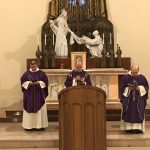
On Saturday, 10th March, the community of the  International School Saint John of the Cross, part of the Teresianum in Rome, celebrated with great joy, the ordination to the diaconate of four of its members: Fr. Arockiaraja Visanthi (Prov. Tamil Nadu, India); Fr. José Andrianmamonjisoa (Comm. Madagascar); Fr. Ranjit Xess (Prov. South Kerala, India); and Fr. Wilibrodus Roja (Comm. Indonesia).

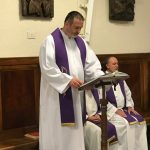
The ordination took place in the neighbouring Basilica of St. Pancrazio and was presided by our brother, Mons. Zdenko Ivan Krizic OCD, Bishop of the Diocese of Gospic-Senj, in Croacia, who, among other services to the Order, held the office of Vicar General and later, Rector of the permanent community of the Teresianum, before being named Bishop by Pope Francis.

The ceremony was followed by a fraternal dinner, prepared by members of the International College, which included different dishes made according to the traditions of the country of origin of our brother deacons.

Let us pray for them and entreat the Lord that his example will be an invitation to others to follow in his footsteps, surrendering themselves wholeheartedly to the following of Christ in the family of Carmel and in the service of the Church.

While Fr. Antoine-Marie Zacharie Igirukwayo was Superior of the Teresianum, the Teresianum community decided a few years ago to celebrate its feast day on 12th March, anniversary of the canonisation of St. Teresa of Jesus.

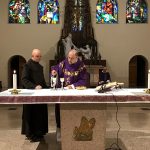
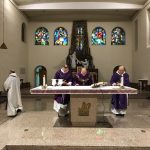
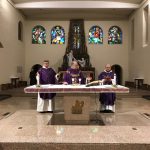
This year, 396th anniversary of this prestigious date, the community met in the chapel for the celebration of Holy Mass, presided by Fr. Saverio Cannistrà.

In his homily, the Father General recalled, in the light of the readings of the day, St. Teresa of Jesus’ passion for life and pointed out how Lent is a time to recall how God always wants to bring us to Life and shows us through the rich signs which are manifested in our lives. We are able to recognise them in the mesure when we live out an authentic conversion based on faith, the source of the fullness of life and not  a life based on our puny human schemes.

‘God offers us a plan for our lives, a plan which is creating new heavens and a new earth, perhaps a new Carmel, a new Teresianum, new communities. May we have the capacity to be aware of it and walk in that direction…’ Fr. Saverio finished by saying that God discomforts us, but he also empowers us to open ourselves up to change.

His whole homily is available in Italian by following our social networks profile on Twitter and Facebook using the following link:  https://www.pscp.tv/w/1kvJpWlkeooGE

The celebration ended with a fraternal dinner, which was attended by the Fr. General, as well as Fr. Vicar, Agustí Borrell and some the members of the Definitory, as well as Carmelite Discalced friars from the diverse communities in Rome who were also at the Eucharist.

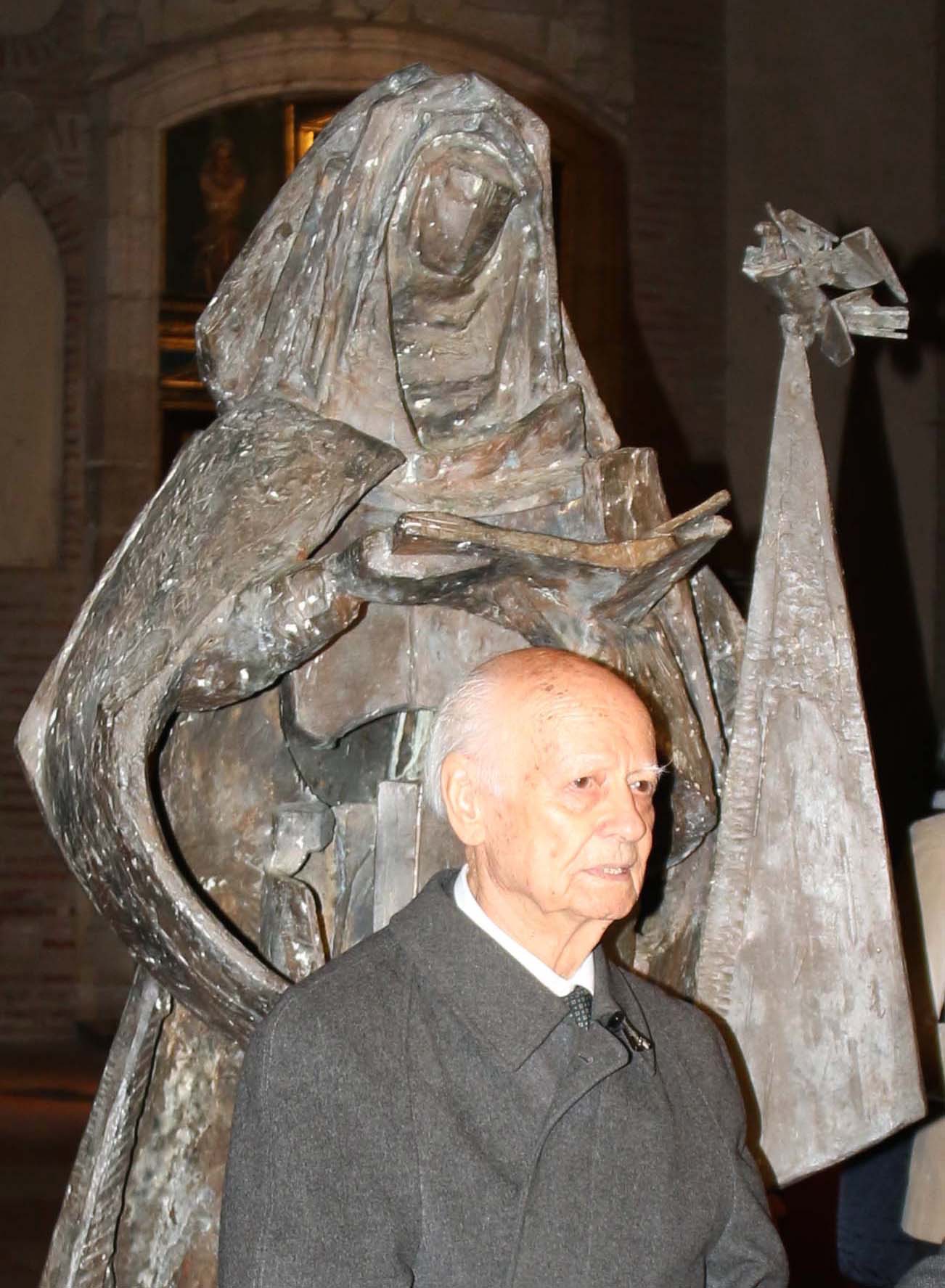
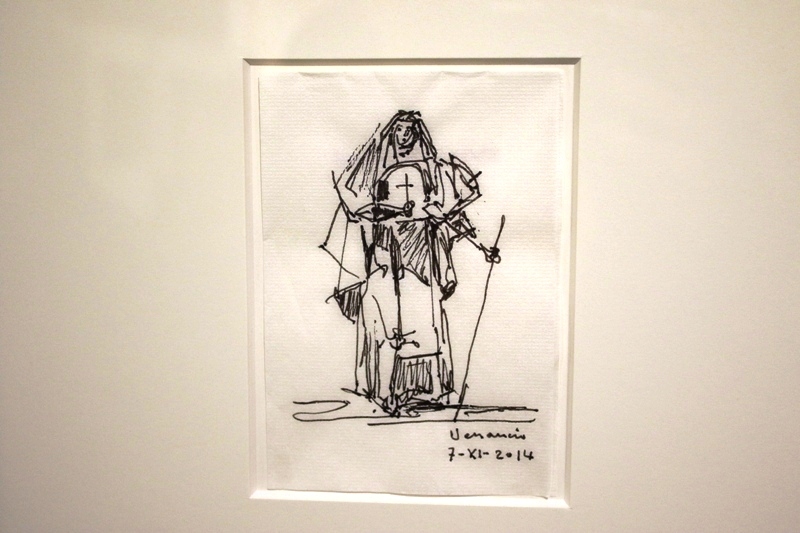
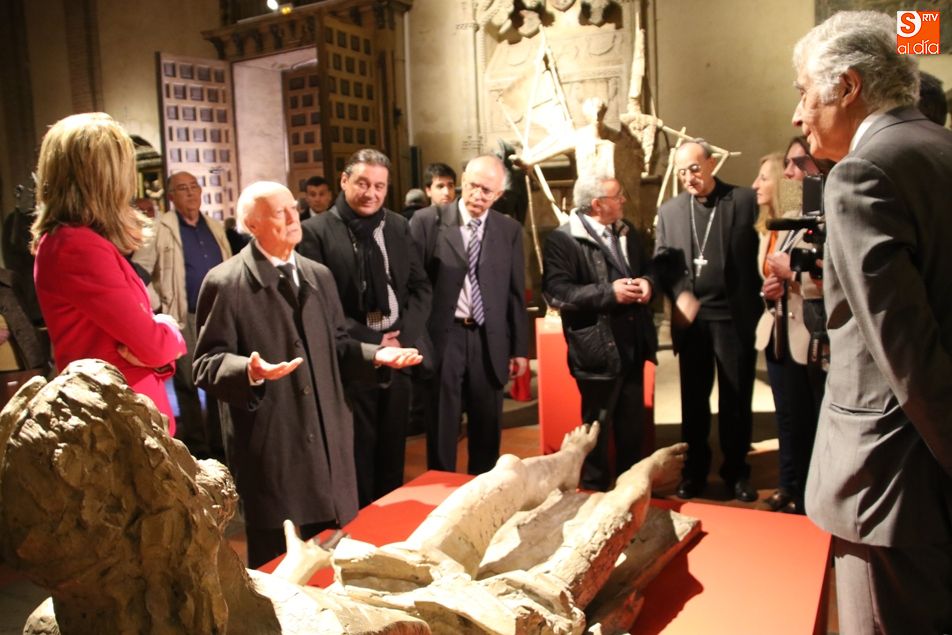
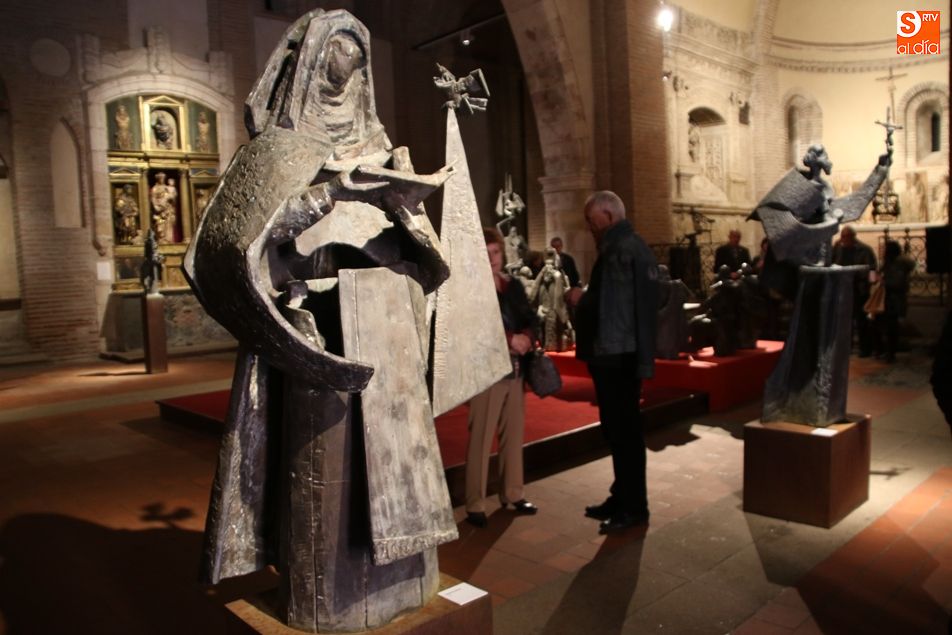
It is very likely that the name of this artist will mean very little to most people. Nonetheless, there would be very few Discalced Carmelites who have not seen (at least in photographs) one of the sculptures dedicated to St. Teresa of Jesus by Venancio Blanco. Born in Salamanca in 1923, a great part of his work was dedicated to the Saint, ‘whom he admired, sketched, sculpted and to whom he spoke, as he himself acknowledged’. On 21st, December, he gave, in a public ceremony, his last Teresian work to the Museum of the Discalced Carmelites nuns in Alba de Tormes: a sculpture of St. Teresa of Jesus entitled Time to set off. Fr. Miguel Márquez, Fr. Provincial for the Iberian Province of the Discalced Carmelites, together with the nuns of the community of Discalced nuns, was present.

Blanco also conversed with Teresa ‘in his drawings. The exhibition: Breakfasting with sketches which the Church of Santiago in Alba de Tormes hosted in March, 2017, brought together a collection of forty paper napkins with drawings by the artist from Salamanca, among which, those connected with St. Teresa and St. John of the Cross stood out. These drawings were the fruit of the artist’s dialogue with Teresa of Jesus, a demonstration of the fusion of literature and art in drawings which come from the heart and from dreams’.

Venancio Blanco died in Madrid on 22nd February. May he rest in peace.

©Roberto Jiménez (passages quoted).


©http://salamancartvaldia.es (photos).

A meeting of OCD Friars of the Italian Circumscriptions took place from 19 to 21 February in the “Santa Maria Annunziata” Spirituality Centre in Maddaloni of the Neapolitan Province.  It was organized by the OCD Major Superiors of the Italian Conference (CISM-OCD).  We had made earlier references to this meeting in our social webs.

The purpose of the meeting was to share the deliberations of the various Italian Circumscriptions on their review of our Constitutions, as well as learning how the process was developing in other geographic regions and what were its prospects for the future.   Four Provincials attended the meeting while Fr. Emilio Martinez, Secretary of the International Commission set up by the Definitory to assist in the Order’s review of our laws, acted as Moderator of  proceedings.

A further meeting, with the same programme, is scheduled to take place in April at the OCD monastery of Bocca di Magra (Genovese Province).  This will allow another group of Friars to attend.

The OCDS Communities of the Naples Province held two Provincial meetings in Bari (27-28 January) and in Maddaloni (3-4 February).  They discussed their Constitutions under the headings:  “Divine Call, Life-Long Commitment and Continuing Fidelity to our Charism”.   Fr. Alzinir Debastiani, General Delegate for the OCDS, facilitated both meetings.  Having heard the suggestions of the Secular Order members, he invited the Provincial Council to take note of all these observations in the preparation of the next Provincial Statute.  The Acts of the Assembly will be published in a special volume being compiled by the Provincial President, Rosanna Sabatillo.

Fr. Alzinir commented on various themes relating to the OCDS Constitutions: their juridical significance and charismatic relevance for lay people’s lives, under the inspiration of St. Teresa.  He also emphasized the vital role of community for a genuine experience of the divine call to the Secular Teresian Carmel.

As well as Fr. Alzinir, the OCD Provincial of Naples, Fr. Luigi Borriello, Fr. Andrew l’Afflitto and other Community assistants were aso present at the meetings.

Recently, on the 31st of January, there arrived in East Timor the last of the missionaries who, for the moment, will be incorporated into this Young Teresian Carmel presence. It is Fr Nuno, a Discalced Carmelite, born in this country, who has just finished his studies in Portugal.

Our missionaries continue their pastoral activities, while they are hoping for the definitive incorporation into the community of the new member who, at present, is spending a few days with his family.

Fr Noé, from Timor, teaches in some diocesan schools and spiritually accompanies seminarians, among many other duties.

For his part, Fr Antonio González, (a Spaniard from the Iberian Province), has joined the formation team of the Preparatory Seminary, as assistant to the spiritual director. He also teaches History of Spirituality and also, this year, Spiritual Discernment. He is also accompanying four formative communities of religious Sisters, by retreat or formation days and accompanies postulants, novices and junior Sisters. We also help out in a couple of parishes. There is an intense task to accomplish in offering this service of spirituality and formation in this Church.

The arrival of Fr Nuno allows us to think about the possibility of going in search of vocations, but the situation continues to be quite precarious. We are praying to the Lord of the vineyard to awaken the call to the missions in some of the friars who could strengthen this nascent presence.

Newsletter from the Carmel in Bangui, 20 –22 January 2018

 Where does it say that we always have to celebrate Christmas on 25 December? On the calendar naturally, as my more observant readers will tell me. You are right, of course. Every calendar, sacred or profane, has 25 December marked in bright red letters to remind us all, from the most to the least observant, that this is the day on which the Most Important Person in history was born. But in the rainforest, with its dearth of calendars and liturgical experts, Christmas tends to arrive when the missionary arrives. And if you have a little time to spare, I will tell you about my second Christmas, one I had not expected which I celebrated in the Congo River rainforest, the greatest rainforest on the planet after the Amazon forest.

Generally speaking, during the days that follow Christmas – which I can assure you we at the Carmel also celebrated on 25 December, as the Church prescribes – we allow ourselves a few days of rest and fraternal fellowship, with perhaps a little trip out somewhere. This year we decided to head for the village of Bambio, where Brother Regis was born, 28 years ago. Bambio is around 180 miles (290 km) from Bangui, in the southwest corner of the country on the fringe of the Congo River rainforest. In order to reach this small sub-prefecture of Sangha-Mbaéré, you have to travel a long stretch of what is known as the Fourth Parallel, 4° north of the equator. Many sections of this road are in extremely poor condition. On two occasions our cheerful ‘caravan’ of 12 friars was obliged to push the car when it got stuck in the sand. We arrived in Bambio as night was almost falling. Just before we entered the village, we realised that we were already expected. The uncle of Brother Regis welcomed us with a smile, delighted at our arrival, and invited us to continue. Welcoming a missionary is something gladly done and generally quite customary. But 12 friars all together, all at once, was something they had never seen before in Bambio.

On arriving at the house of Brother Regis’ parents we realised that not only were we already expected but that our stay there had been organised down to the last detail, with a programme that would have been the envy of the best travel agencies and the most luxurious hotels. The entire village had literally mobilised for us. The proverbial African welcome was seen at its very best in Bambio. No sooner had we arrived that we were ushered into a dining hall built specially for us, a rectangular paillote, covered in bamboo leaves. And the women at once offered us fresh water or a cup of hot coffee to restore ourselves after the long journey. I chose coffee, which is something you do not buy here but which everyone cultivates for himself, just a few metres from the home. I took hold of the large white-enamelled aluminium mug and slowly sipped at the coffee – and could taste in it all the aroma of the forest, all the hard work of those who had grown it and the warm hearts of those who had prepared it. And I thought of the rest of you, anxiously searching for your “premium quality coffee” on the shelves of some boring supermarket…

We had been intending to sleep on the ground, as best we could, in the parish centre. But no way… A wonderful little wooden house had been made ready for us to sleep in, painted in deep blue, looking as beautiful as if it had only just been built. Our “apartment” consisted of four rooms, with mattresses for each person and a comfortable sitting room, which we adopted as a place of prayer and recreation. As the missionary, I got a bedroom all to myself, with a bed larger than the one in the monastery, plenty of mosquito netting and a little bedside table. Needless to say, all these privileges granted to the clergy were a source of envy and barbed comments on the part of my dear confreres…!

But of course, in addition to eating and sleeping, the guests must also have a place to wash in. We had all assumed that for these three days we would have to go without our daily shower, given the difficult conditions of the journey. But on the contrary, the village had prepared a bathhouse specially for us, observing all the niceties. And to the undersigned went the honour of inaugurating the new bathhouse, set up just a few metres from our accommodation. And here was Théophile, the youngest brother of Fra Régis, an impeccable majordomo, ready to supply our every need and to whom I tried to explain that my home town of Monferrato was almost as beautiful as his forest. With a look of firm decision he presented me with a splendid bucket full of water and explained – to a missionary undoubtedly accustomed to rather more refined toiletries – how you wash yourself in the forest. And a little later I can hardly believe that I am able to wash in hot water, with a brand-new block of soap, here in this corner of the Congo rainforest, in a bathhouse of wood and metal sheeting, with nothing but the stars for a roof.

During supper we discover that no priest has been to the village for some months and that as a result they have never celebrated the Christmas Mass. A mutual glance of understanding is sufficient between the brothers and myself: Tomorrow will be Christmas Day! The village was quickly informed. The following morning, all the people, in their Sunday best, began to gather the church and at 9 a.m. sharp Bambio’s belated Christmas celebration began. I discovered with pleasure that even though the priest had not come, nonetheless, the little church had been decorated festively, because the community had gathered there to pray on Christmas Eve and Christmas morning. The head catechist of the village was almost apologetic, saying, “If we had known in time, we could have organised better and had at least one baptism!” During the celebration I thought of these regions, evangelised in the past by intrepid missionaries but still suffering a lack of priests. And I watched my confreres, dancing and singing their way through the entire Christmas repertory of our monastery. There were just twelve of us, like the apostles. If those first twelve men, of whom we are merely the ambitious and imperfect imitators, succeeded in evangelising Galilee, Judaea, Samaria and then Asia and even as far as Greece and Italy, then surely we can at least manage to evangelise our little local area in Bangui, and the local prefectures of Ombella M’Poko, Nana-Mamberé, Ouham-Pendé and maybe even Lobaye and Sangha-Mbaéré as well?

After Mass we went to see the sub-prefect by way of a courtesy visit. We discovered that Bambio had been founded in the 1920s to house the plantation workers on the rubber plantations, the source of the rubber for the soles of the French soldiers’ boots during the Second World War. Then we travelled to Mambelé – a journey of around 25 miles (40 km) and lined all the way by giant trees – to visit one of the biggest sawmills in the country. The manager welcomed us warmly and explained to us every stage of this, one of the few still flourishing economic activities in the Central African Republic and a source of work for hundreds of people. And we were proud to discover that the timber from this forest is among the best in the world, being sold to the United States, China, Germany, France and Italy. It may even be that the furniture in your home is made from hardwood from this area.

Finally, the time came to say goodbye to Bambio, even though we would have been happy to stay there a few days longer. And of course, in the best African tradition, the guests cannot leave empty-handed. So three new passengers were added to our company: a monkey (captured by Brother Regis’ elder brother and already cooked, according to ancestral methods), a fine little piglet and a kid (not yet roasted, but not likely to see many days of 2018). And then some leaves of gnetum africanum – a sort of vegetable that looks almost like an ingredient for a magic potion – and a healthy supply of peké, a traditional drink that will guarantee the quiet inebriation of my confreres.

On the return journey we spent a night in the parish of Boda, a former mission of the Spiritan Fathers, now run by the Comboni missionaries. The parish church is a gem, built in the tropical colonial neo-Romanesque style. This town, which is rich in diamonds, was the scene of bloody fighting between Christians and Muslims during the war. Now however the Christians and Muslims are once more living peacefully side by side. The following day we made a brief visit to the waterfalls and then set out once more for Bangui. We ate lunch among the trees in front of the cathedral of M’Baïki, one of the most beautiful churches in Central Africa, and probably the work of the same architect as in Boda.

As we travelled along, I endeavoured to capture something of the animated discussions of my confreres in the Sango language… Timber, coffee, gold, diamonds… The riches of Central Africa… Bozizé, Djotodia, Touaderà, Seleká, Antibalaká – all the problems of the Central African Republic… Then Real Madrid, Barcelona, Liverpool, Paris St. Germain – the lighter side of Central Africa. Finally, the singing of Vespers uniting all the passions and thoughts, burdens and desires of this monastic community on four wheels. Then they all fall asleep and I think of their dreams – as large as the forest trees.

Back home again, a few days later, Brother Grâce-à-Dieu comes to thank me for the beautiful outing, which enabled him to get to know parts of his country he had never seen before. And then he assures me: “The Christians of Bambio, who were so happy with their belated Christmas celebration, have made me more determined than ever to become a priest.” The tree of Brother Grâce-à-Dieu has put down good roots. And God willing, his dream will indeed come true.

Love and blessings

Padre Federico Trinchero, ocd