Newsletter from the Carmel in Bangui, 20 –22 January 2018

 Where does it say that we always have to celebrate Christmas on 25 December? On the calendar naturally, as my more observant readers will tell me. You are right, of course. Every calendar, sacred or profane, has 25 December marked in bright red letters to remind us all, from the most to the least observant, that this is the day on which the Most Important Person in history was born. But in the rainforest, with its dearth of calendars and liturgical experts, Christmas tends to arrive when the missionary arrives. And if you have a little time to spare, I will tell you about my second Christmas, one I had not expected which I celebrated in the Congo River rainforest, the greatest rainforest on the planet after the Amazon forest.

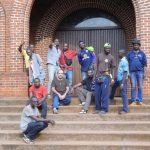
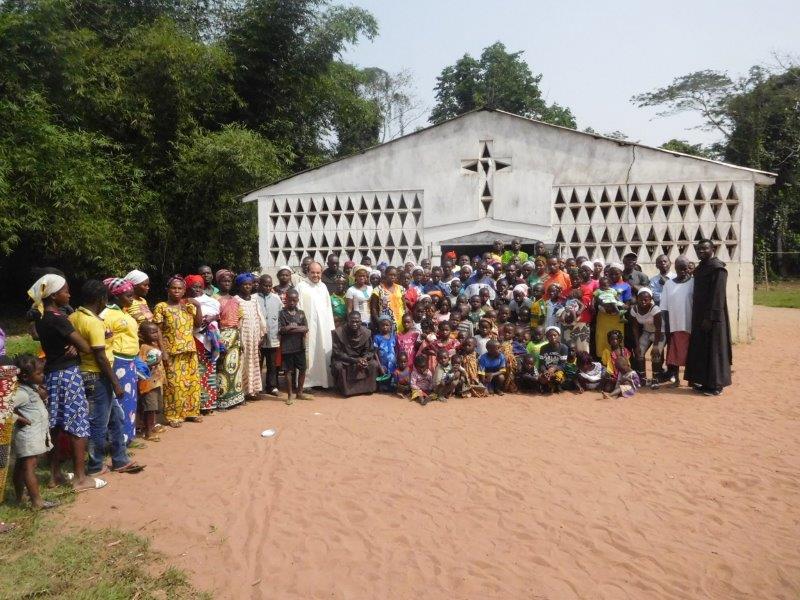
Generally speaking, during the days that follow Christmas – which I can assure you we at the Carmel also celebrated on 25 December, as the Church prescribes – we allow ourselves a few days of rest and fraternal fellowship, with perhaps a little trip out somewhere. This year we decided to head for the village of Bambio, where Brother Regis was born, 28 years ago. Bambio is around 180 miles (290 km) from Bangui, in the southwest corner of the country on the fringe of the Congo River rainforest. In order to reach this small sub-prefecture of Sangha-Mbaéré, you have to travel a long stretch of what is known as the Fourth Parallel, 4° north of the equator. Many sections of this road are in extremely poor condition. On two occasions our cheerful ‘caravan’ of 12 friars was obliged to push the car when it got stuck in the sand. We arrived in Bambio as night was almost falling. Just before we entered the village, we realised that we were already expected. The uncle of Brother Regis welcomed us with a smile, delighted at our arrival, and invited us to continue. Welcoming a missionary is something gladly done and generally quite customary. But 12 friars all together, all at once, was something they had never seen before in Bambio.

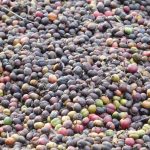
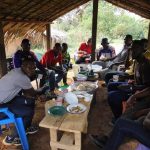
On arriving at the house of Brother Regis’ parents we realised that not only were we already expected but that our stay there had been organised down to the last detail, with a programme that would have been the envy of the best travel agencies and the most luxurious hotels. The entire village had literally mobilised for us. The proverbial African welcome was seen at its very best in Bambio. No sooner had we arrived that we were ushered into a dining hall built specially for us, a rectangular paillote, covered in bamboo leaves. And the women at once offered us fresh water or a cup of hot coffee to restore ourselves after the long journey. I chose coffee, which is something you do not buy here but which everyone cultivates for himself, just a few metres from the home. I took hold of the large white-enamelled aluminium mug and slowly sipped at the coffee – and could taste in it all the aroma of the forest, all the hard work of those who had grown it and the warm hearts of those who had prepared it. And I thought of the rest of you, anxiously searching for your “premium quality coffee” on the shelves of some boring supermarket…

We had been intending to sleep on the ground, as best we could, in the parish centre. But no way… A wonderful little wooden house had been made ready for us to sleep in, painted in deep blue, looking as beautiful as if it had only just been built. Our “apartment” consisted of four rooms, with mattresses for each person and a comfortable sitting room, which we adopted as a place of prayer and recreation. As the missionary, I got a bedroom all to myself, with a bed larger than the one in the monastery, plenty of mosquito netting and a little bedside table. Needless to say, all these privileges granted to the clergy were a source of envy and barbed comments on the part of my dear confreres…!

But of course, in addition to eating and sleeping, the guests must also have a place to wash in. We had all assumed that for these three days we would have to go without our daily shower, given the difficult conditions of the journey. But on the contrary, the village had prepared a bathhouse specially for us, observing all the niceties. And to the undersigned went the honour of inaugurating the new bathhouse, set up just a few metres from our accommodation. And here was Théophile, the youngest brother of Fra Régis, an impeccable majordomo, ready to supply our every need and to whom I tried to explain that my home town of Monferrato was almost as beautiful as his forest. With a look of firm decision he presented me with a splendid bucket full of water and explained – to a missionary undoubtedly accustomed to rather more refined toiletries – how you wash yourself in the forest. And a little later I can hardly believe that I am able to wash in hot water, with a brand-new block of soap, here in this corner of the Congo rainforest, in a bathhouse of wood and metal sheeting, with nothing but the stars for a roof.

During supper we discover that no priest has been to the village for some months and that as a result they have never celebrated the Christmas Mass. A mutual glance of understanding is sufficient between the brothers and myself: Tomorrow will be Christmas Day! The village was quickly informed. The following morning, all the people, in their Sunday best, began to gather the church and at 9 a.m. sharp Bambio’s belated Christmas celebration began. I discovered with pleasure that even though the priest had not come, nonetheless, the little church had been decorated festively, because the community had gathered there to pray on Christmas Eve and Christmas morning. The head catechist of the village was almost apologetic, saying, “If we had known in time, we could have organised better and had at least one baptism!” During the celebration I thought of these regions, evangelised in the past by intrepid missionaries but still suffering a lack of priests. And I watched my confreres, dancing and singing their way through the entire Christmas repertory of our monastery. There were just twelve of us, like the apostles. If those first twelve men, of whom we are merely the ambitious and imperfect imitators, succeeded in evangelising Galilee, Judaea, Samaria and then Asia and even as far as Greece and Italy, then surely we can at least manage to evangelise our little local area in Bangui, and the local prefectures of Ombella M’Poko, Nana-Mamberé, Ouham-Pendé and maybe even Lobaye and Sangha-Mbaéré as well?

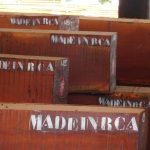
After Mass we went to see the sub-prefect by way of a courtesy visit. We discovered that Bambio had been founded in the 1920s to house the plantation workers on the rubber plantations, the source of the rubber for the soles of the French soldiers’ boots during the Second World War. Then we travelled to Mambelé – a journey of around 25 miles (40 km) and lined all the way by giant trees – to visit one of the biggest sawmills in the country. The manager welcomed us warmly and explained to us every stage of this, one of the few still flourishing economic activities in the Central African Republic and a source of work for hundreds of people. And we were proud to discover that the timber from this forest is among the best in the world, being sold to the United States, China, Germany, France and Italy. It may even be that the furniture in your home is made from hardwood from this area.

Finally, the time came to say goodbye to Bambio, even though we would have been happy to stay there a few days longer. And of course, in the best African tradition, the guests cannot leave empty-handed. So three new passengers were added to our company: a monkey (captured by Brother Regis’ elder brother and already cooked, according to ancestral methods), a fine little piglet and a kid (not yet roasted, but not likely to see many days of 2018). And then some leaves of gnetum africanum – a sort of vegetable that looks almost like an ingredient for a magic potion – and a healthy supply of peké, a traditional drink that will guarantee the quiet inebriation of my confreres.

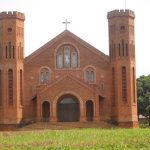
On the return journey we spent a night in the parish of Boda, a former mission of the Spiritan Fathers, now run by the Comboni missionaries. The parish church is a gem, built in the tropical colonial neo-Romanesque style. This town, which is rich in diamonds, was the scene of bloody fighting between Christians and Muslims during the war. Now however the Christians and Muslims are once more living peacefully side by side. The following day we made a brief visit to the waterfalls and then set out once more for Bangui. We ate lunch among the trees in front of the cathedral of M’Baïki, one of the most beautiful churches in Central Africa, and probably the work of the same architect as in Boda.

As we travelled along, I endeavoured to capture something of the animated discussions of my confreres in the Sango language… Timber, coffee, gold, diamonds… The riches of Central Africa… Bozizé, Djotodia, Touaderà, Seleká, Antibalaká – all the problems of the Central African Republic… Then Real Madrid, Barcelona, Liverpool, Paris St. Germain – the lighter side of Central Africa. Finally, the singing of Vespers uniting all the passions and thoughts, burdens and desires of this monastic community on four wheels. Then they all fall asleep and I think of their dreams – as large as the forest trees.

Back home again, a few days later, Brother Grâce-à-Dieu comes to thank me for the beautiful outing, which enabled him to get to know parts of his country he had never seen before. And then he assures me: “The Christians of Bambio, who were so happy with their belated Christmas celebration, have made me more determined than ever to become a priest.” The tree of Brother Grâce-à-Dieu has put down good roots. And God willing, his dream will indeed come true.

Love and blessings

Padre Federico Trinchero, ocd

On 3rd February, Eucharistic was celebrated by Fr. General and the Definitor along with all the provincials and all the Prioresses of Indian Carmel and the office bearers of the three associations in India. Our sisters gathered at Hyderabad to meet Fr. General and discuss on some of the important issues connected to Indian Carmel and to clarify some of their doubts regarding the Vultum Dei Querere. Indian Carmel consists of 34 monasteries of which the latest community at Kolayad in Kerala was inaugurated on 29th January. Hence 34 prioresses and 11 office bearers of the associations were present. Fr. General was present on 3-4 and Fr. Definitor concluded the meeting on 5th evening.

It was really a moment of communion and strengthening of the charismatic identiy of the Indian Carmel. Fr. General’s interventions and words of encouragement to live the charism faithfully were very much appreciated by all the representatives of Indian Carmel.

On 2nd February, Fr. General and the definitor in charge of India met with the IPCI General Assembly consisting of 7 Provincials and one of their councillors, 3 Regional vicars and two provincial delegates. The primary objective was to meet Fr. General who was in India at the conclusion of the pastoral visitation of the province of Andhra Pradesh. There were few communications from the part of the General administration and there was a discussion on the Indian members present outside their territories and about the forthcoming extraordinary Definitory in India in 2019.


Recently, between the 29th of January and the 2nd of February, a meeting of Discalced Carmelite formators took place. This year it was celebrated at the Teresianum in Rome. Its central topic was: “The world of the youth of today”. This topic was developed by means of three conferences, after each of which we then worked in groups and, finally, shared our conclusions in the Assembly.

Giving the conferences were Fr Gianni Bracchi, Professor Dr. D Antonio Belleringreri, from the University of Palermo and Fr Maximiliano Herráiz.

During their stay, the formators also had the opportunity to get to know what the Teresianum had to offer academically as well as how the St John of the Cross International College functioned.

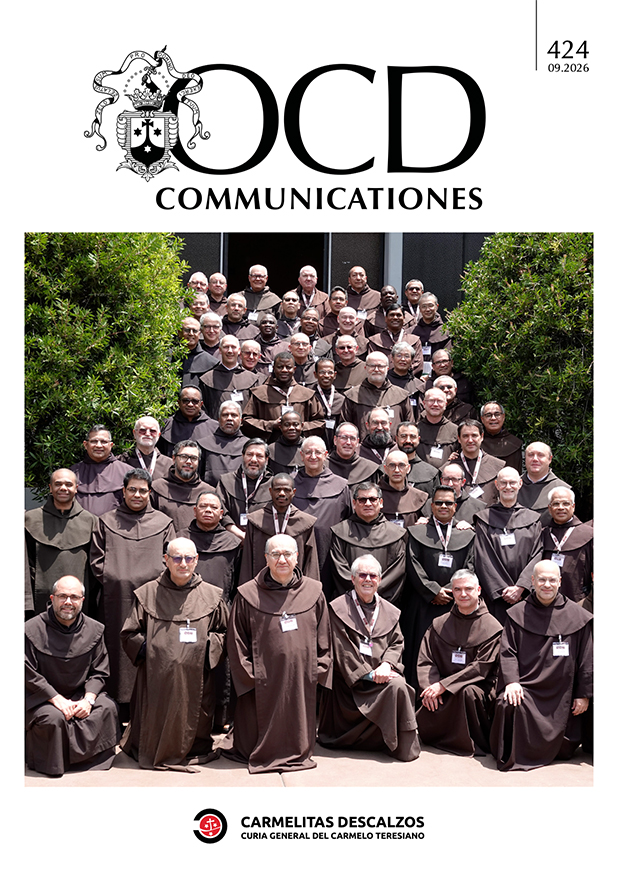
Taking part in the meeting were the Provincials who are members of the Steering Committee of the European Conference of Provincials, as well as Fr Agustí Borrell, Vicar General, and Fr Lukasz Kansy, Second Definitor, who discussed with the formators about the possibility of establishing a stage of “second novitiate” in Spain for Discalced Carmelites, to take place at the finish of theological studies, by means of which to encourage mutual knowledge and their training in the charism handed down to us from St Teresa and St John of the Cross.

Father Eduardo Sanz de Miguel, Discalced Carmelite of the Iberian Province (Spain), delivered a series of conferences on Saint John of the Cross in the Shrine of Saint Thérèse of the Child Jesus (Hadayek Shoubra, Cairo, Egypt) during the last week of January.

In the mornings he delivered a complete course to the Discalced Carmelites in Egypt, who were joined by the Carmelite Sisters “of Florence” and the Carmelite Sisters of Saint Joseph.

In the evenings he had the opportunity to meet with diverse groups of religious, families, and also had a meeting with priests.

The conferences were well attended and were a unique opportunity to transmit the Teresian charism and Sanjuanist doctrine to many Christians in Egypt.

“An extended provincial council meeting took place from January 12th to 15th with the participation of the OCDS Delegate General and the OCDS Provincial Delegate of the France-Sud province, fr. Jean Sebastien. The chosen location was the convent of the Poor Clares in Nîmes.

“The meeting enabled a clearer awareness of the state of the Province which was presented by the President, Mrs. Claude Garabiol, as well as the communities, whose councils provided information to the attending regional councillors and the provincial Council.

“The OCDS Province of France-Sud covers a wide region of the French territory and includes three communities in Switzerland (two French-speaking and one German-speaking) and the island of Guadeloupe in the French Antilles.

“Each region has a Councillor in charge of organizing formation meetings, retreats, and other events per the requirements of the communities. The Councillor also visits the different communities in his or her region to assist and accompany them.

“During these days, the confreres have been able to fraternally share thoughts about their lay vocation in the Order and how to contribute to spreading the charism despite the few vocations, small size of the communities, and high median age. The Father Provincial, Fr. Henri, was also present in the meeting on the 13th, helping to solve some questions that arose regarding the main theme of the meeting: discerning the vocation to the OCDS.”

Fr. Alzinir Francisco Debastiani OCD

On January 13th, Holy Father Francis appointed Father Silvano Giordano, Discalced Carmelite, as a consultor to the Congregation for the Causes of the Saints.

Father Silvano is from the Province of Genoa, has a doctorate in ecclesiastical history (Gregorian University, 1992), and is a professor at the Teresianum in Rome, where he also holds the office of Vice Dean (“Vice Preside”). Additionally, he is a guest professor of modern history in the Faculty of History and Cultural Heritage of the Church of the Pontifical Gregorian University in Rome.

Professor Tiziana María di Blasio, who also teaches in our Faculty, was appointed consultor to the same congregation on that day as well.

Father Eulogio Pacho Polvorinos – Fr. Eulogio of Our Lady of Mount Carmel – died during the evening of February 1st in Burgos.

He was born on July 27, 1926, in Calaveras de Arriba (Leon) and made his profession on August 15, 1942. He was ordained to the priesthood on April 23, 1950.

Let us give thanks to God for the life of our brother, who served the Order and the Church with his intellectual work and tireless teaching activities in Rome, Burgos, and many other places. His efforts were always accompanied by a humble, unaffected, and welcoming demeanor.

His editorial and doctrinal work on notable persons such as Father Palau and, above all, Saint John of the Cross, was outstanding and remains a testimony of great value for the Church, the Order, and society.

Funeral rites were celebrated on Sunday, February 3rd, in the Church of Carmel in Burgos.

We request a prayer to commend him to the Church Triumphant. May he rest in peace.

(Source: www.ocdiberica.com)

Fr. Attilio Ghisleri, ex-General Bursar of the Order of the Discalced Carmelites, on January 13, 2018, after the Saturday chant of the Salve in Stella Maris, he has taken possession of his new position as Delegate General of the Delegation of Israel. Then all the present religious have done the act of obedience, in order to walk together during the new triennium 2018-2021.

We wish him a fruitful service in charge of Stella Maris, Muhraqa and Wadi-EsSiah, emblematic places where our Order was born and it is still present, inspired by the zeal of the prophet Elijah and under the protection of Our Lady of Mount Carmel. Congratulations and a lot of encouragement!


Some days ago, we reported the naming of Man of the Year in Sweden by the “Fokus” magazine of our brother Cardinal Arborelius. Today arrived the news –which we happily share with you– of the naming of Monsignor Silvio Báez, a Discalced Carmelite, as the Nicaraguan Man of the Year by the “La Prensa” daily.

As can be seen in the link below, which reports the interview given by our brother, the “La Prensa” newspaper appreciates his commitment to democratic values and to liberty, which have earned him some disagreement with the regime that currently governs the country.

Monsignor Silvio, well prepared theologically and biblically, does not wish to enter –as he explicitly states– into political questions but to defend human values tied to the Gospel of Jesus. His simple and approachable spirit, his desire to give a voice to those who lack it are the values standing out in the speech granting him the prize.

A great communicator, Silvio Báez evangelizes also by means of the internet and has recently produced a pocket book titled #EvangelioDeHoy: Tuits de la Buena Nueva de Jesús de Nazaret, [Today’sGospel: Tweets about the Good News of Jesus of Nazareth] which gathers together evangelizing tweets taken from his personal Twitter account which has thousands of followers.

https://www.laprensa.com.ni/2017/12/31/suplemento/la-prensa-domingo/2353427-monsenor-silvio-baez-dificil-sacar-ortega-esquemas-politicos

The community of Discalced Carmelite Nuns in Tangiers have sent us some news which we wish to share with you.

During 2017, two Sisters arrived to build up the community by their presence: Sister Sidioly, originally from Bolivia, who came from the Telde Carmel (Canary Isles, Spain) and Sister Julia, who came to Tangiers after spending one year in her community of origin in Pescara (Italy). In May, Sister Elizabeth returned for good to Peru. After her departure, Sister Alice was elected as Councilor.

The Sisters continue to learn French and Arabic, thanks to the helpfulness of Father Joël Colombel, ofm, and the generosity of the Sisters of Vals Près le Puy in France. Sister Mary Anne, after improving her French, was able to obtain her Moroccan driver’s license, essential for the community in that situation.

Thanks to the generosity of some benefactors, they were able to carry out necessary works in the house.

Some of the Sisters were able to take part in formation courses as well as receiving support from the friars of the Iberian Province, who came right to Tangiers to preach retreats to the community, give courses, be chaplains and, finally, to share fraternally the Teresian charism held in common.

In this information service, we frequently receive enquiries about the situation of our Discalced Carmelite sisters in Tolentino, who, as we informed you on the 3rd of November 2016, had to abandon their monastery after severe damage caused to it by an earthquake on the 30th of October that year. The earthquake happened just as the community had begun to celebrate Mass, at which was presiding the then Provincial of Central Italy, Fr Gabriele Morra.

They were taken in on that very day by the Sisters in Fano and, right from the beginning, the nuns began to look for alternative solutions in order to liberate the monastery and community of Fano from the material overload implied by the added presence of nineteen extra nuns, even though the good will and fraternal love were greater than any difficulty. By finding a suitable place, the Tolentino community could also recover a certain autonomy, always necessary.

Finally, on the 22nd of July 2017, thanks to the interest taken by the Augustinian Fathers and the generosity of the Augustinian Sisters of St Rita of Cascia, the nuns were able to transfer to the “Saint Augustine” vocational discernment house close by. Since this date they have been there, hoping to be able to restore the Tolentino monastery. The effort they must make is by no means small and they must still gather a lot of help. Already, some supportive efforts have been initiated, which we have reported in our social sites, but the community lives through the journey they have taken on, with hope and abandonment to God’s will, after that painful day of the 30th of October 2016.

On this site you can download, in Italian, a written chronicle by the sisters themselves, which we have synthesized in this news item: http://www.sannicoladatolentino.it/files/Bollettino-luglio-settembre-2017–DEF.pdf

Recently, on the 3rd of January, we received the sad news that Monsignor Adeodatus Micallef had died. He was a Carmelite Bishop, born in Birkirkara, Malta, on the 17th of December 1928.

Mons. Micallef entered the Order on the 15th of August 1947, was professed a year later and took the religious name of Brother Adeodatus of the Assumption. On the 15th of October 1951, he made his solemn profession and was ordained priest on the 9th of May 1954.

In his Province of Malta, Mons. Adeodatus held many offices: Prior of Birkirkara, Master of novices and, for one year (1972-1973), Provincial. In 1973 he was elected Definitor in the General Chapter, being mainly in charge of the missions of the Order. When this period finished in 1979, he became Rector of the Teresianum, an office he held for two years, when he was appointed Vicar Apostolic of Kuwait and was consecrated Bishop by Pope St John Paul II on the 6th of January, 1982.

During the first Gulf War, Mons. Adeodatue refused invitations to abandon the country and remained in Kuwait during the whole conflict.

When his retirement was accepted on the 14th of July 2005, he was farewelled by the Christian pilgrim community on the 20th of October that year, in a Eucharist in the Cathedral of the Holy Family, at which a multitude attended. When he retired, the Holy See decided to withdraw care of the Apostolic Vicariate from the Order, so Mons. Adeodatus was the last Discalced Carmelite Bishop of Kuwait. This decision particularly saddened Mons. Adeodatus who, despite showing his disagreement truthfully and sincerely, finally accepted it with humility and love for the Church.

Returning to his Province, he sought to live as a friar once again, placing himself at the service of his Superiors, with special care for the very sick, happily accepting whatever office entrusted to him, including barber for the friars who required his services.

After an illness lasting two months, which he accepted with great serenity, our much-loved brother died in great peace, surrounded by a goodly number of friars from the Province, who then accompanied him, together with a large number of the faithful, at the funeral at which presided Mons. Scicluna in the Valeta cathedral in Malta.

The funeral was transmitted live by means of YouTube and can be seen at this site:

https://www.youtube.com/watch?v=dHKfED7AjGM

From the Carmel in Bangui we have received some news from Fr. Federico Trinchero this past month of December about the Republic of Central Africa and the situation of the Teresian Carmel there. Unfortunately, the situation is still very difficult, despite the fact that there is scant coverage in the social communication media in the the rest of the world. Eighty percent of the land is occupied by rebel groups and the State has not managed to curb them and has been unable to reestablish its authority in much of the country.

Furthermore, according to the statistics of the UN, the Republic of Central Africa occupies the  the 188th place out of 188 countries in the Human Development Index, therefore the poorest country in the world.

As to our brothers, two from the Republic of Central Africa and five Cameroonians began their novitiate in September in the monastery of St. Elijah of Bouar. Three other young men, two Cameroonians and one from Central Africa, made their simple vows after completing a year in the novitiate. Two of them have become members of the community of the Carmel in Bangui.

A solemn profession and priestly ordination were celebrated and as part of a programme of collaboration with the mission in Cameroon, which is dependent on the Province of Lombardy, some young Central African students will continue their theological and pastoral studies in that country.

The prestigious, Swedish news magazine ‘Fokus’ has named our brother, Cardinal Anders Arborelius, OCD, Swedish citizen of the year, taking into account his unwavering and inclusive character as the most visible head of the Catholic church in Sweden, where everyone is able to find a space in which to share faith, hope and love.

In an interview on the Spanish web page www.religionconfidencial.com, the priest, Andrés Bernar states that Monsignor Arborelius has always been a voice which is a reference point not only for Swedish Catholics, but who is also forthright when it comes to explaining the doctrine of the Church with simplicity and clarity, always placing himself on the side of the most vulnerable.

On Vatican Radio, Anders Arborelius stated: ‘Sometimes I ask myself if I am a true Swede, because people think that it is impossible to be one, when one is a Catholic priest, bishop and cardinal, all at the same time. I am happy for this recognition and consider that the magazine has been courageous in making this choice. It shows that the Catholic Church is becoming more and more of a Swedish reality and is part of the fabric of the society of our country’.

For their part, the panel recognised that our brother, Cardinal Arborelius, OCD, is a courageous man, when it comes to representing the Catholic Church with dignity in a country whose identity is mainly secular or Lutheran. He also plays a crucial role in the integration of Swedish people and immigrants who have come from other countries. In conclusion, ‘Focus’ states: ‘The Swede of the year for 2017 is Anders Arborelius, Discalced Carmelite, priest, bishop and cardinal’.