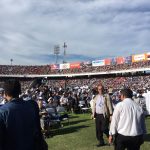
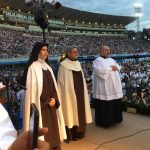
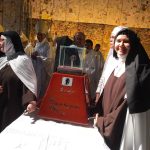
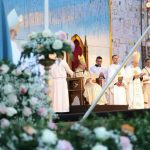
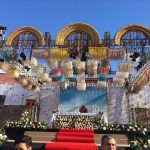
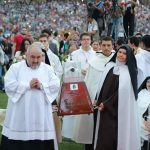
The 23rd of June was a great day for Paraguay and Carmel. At last arrived the hoped-for day and the stadium of the Cerro Porteño Club was packed with worshipers who began to arrive from midday to applaud their blessed Maria Felicia of Jesus in the Blessed Sacrament (Chiquitunga). The ceremony began punctually at 4.30 in the afternoon and presiding was Cardinal Angelo Amato, the Prefect of the Congregation for the Causes of the Saints. Concelebrating with him were all the Bishops of the Episcopal Conference and some 200 priests. The ceremony was solemn, lively and cheerful, with a mixture of hymns that were classic and catchy Paraguayan folkloric. It was moving to see an assembly of 50,000 people (we also know that thousands were unable to get into the stadium) who joined in each moment of the ceremony with their applause.

Some 60 Discalced Carmelite nuns were present as well as around 40 friars from Paraguay and neighboring countries. On the next day, there were thanksgiving Masses in various places for the beatification of this Carmelite whom, from yesterday, the people acclaimed as a saint.

In his homily, Cardinal Angelo Amato presented the new blessed (fondly known as Chiquitunga) as “an educated young woman, holy and enthusiastic about her faith and her vocation to the consecrated life”; a saint who, “today invites her sisters to feel proud of their vocation and happy in their daily commitment to the Lord”; a saint who “invites us all to live truly our Christian existence and inspire the Paraguayan youth to remain faithful in loving Jesus”.

Paraguay, Carmel and Heaven itself are filled, then, with rejoicing. May we all join in this happiness.

On Pentecost Monday (May 21, 2018), the brothers of the Province of Avignon-Aquitaine celebrated the 70th anniversary of the foundation of their Holy Desert. The project was discussed during the General Chapter of 1947, and Blessed Father Marie-Eugene of the Infant Jesus was charged with carrying out this foundation, which also occurred on a Pentecost Monday, at that time (1948), May 17th. This is the date of the annual pilgrimage in honor of Our Lady of Mercy, venerated since the 17th century in the shrine of the new Desert. For approximately 50 years, the Holy Desert of Roquebrune (in the department of Var in Provence) was attended by the four Franco-Belgian provinces: Avignon-Aquitaine, Paris, Flanders, and Brabant.

From 1996, the house became exclusively dependent on the Province of Avignon-Aquitaine. There are seven hermitages on site built by Camaldolese monks around 1925 and a large, Provençal-style building (originally a stronghold) from the beginning of the 19th century. It also includes an ancient Marian shrine rebuilt in the 17th century. The property, encompassing more than 60 hectares (two hills), is located in the isolated Massif des Maures. It offers a beautiful view of the Mediterranean and the Bay of Saint-Raphaël.

On Pentecost Monday, the hermits organized a meeting to commemorate the event, which coincided with the celebration of the first liturgical feast of Mary, Mother of the Church, now, precisely, celebrated on the day after Pentecost. A beautiful and providential event, highly symbolic and pertinent to Carmelite spirituality. Father Henri of the Infant Jesus, Provincial of Avignon-Aquitaine, presided over the ceremony this year, in which he celebrates his Silver Jubilee of religious profession.

On the 450th anniversary of the reformation of the male branch of the Teresian Carmel (1568-2018), young Discalced Carmelites – postulants and religious of the two Polish provinces of the Order (Krakow and Warsaw) – met in Czerna to prepare a disc with the Mass and Vespers of Saint John of the Cross as well as other hymns and antiphons about the Saint. The album will be ready next fall.

From an artistic point of view, the responsibility to carry out the initiative was taken on by specialists Ewa and Robert Domagała Rekiel, directed by Father Mariusz Wójtowicz ocd, already known for his previous work (the disc, “Sancta Mater Teresia”: https://soundcloud.com/dumanie/sancta-mater-teresia-chora-y; polyphonic chants “Solo Dios basta” (“God alone suffices”): https://soundcloud.com/dumanie/bog-sam-wystarcza-vol-1 or “Twoje Niebo” https://soundcloud.com/dumanie/twoje-niebo-dzien-po-dniu).

We invite you to visit the Web page of the Krakow province, where all the recordings are available: www.karmel.pl.

Newsletter 21 from the Carmel in Bangui – 8 May 2018

«At the most difficult moments heroes arise, and I do not doubt that these heroes exist here too in the Central African Republic, willing to rise up as one and say ‘no’ to violence, ‘no’ to barbarity, ‘no’ to destruction of their own selves.” This was the appeal addressed by Cardinal Dieudonné Nzapalainga, the Archbishop of Bangui to the people of the capital and of the entire nation, during these critical days, so fraught with tension and sadness.

So what happened in Bangui? On the morning of 1 May, during the celebration of Holy Mass in the church of Our Lady of Fatima, just a short distance from our own Carmel, a group of armed men from the Km5 quarter of the capital (a majority Muslim enclave which for years has been the main focal point of the tensions in the capital) opened fire on the people praying there, leaving many dead and wounded. The attack happened in reprisal for an attempt on the part of the forces of law and order to capture some of the members of this armed group, which in practice is holding the capital to ransom, including even some of their own fellow Muslims in the quarter.

The faithful in the church has just finished proclaiming their faith and were about to begin with the Offertory. But instead, the Mass continued with the sacrifice of 16 Christians, among them a priest, Abbé Albert Tungumale Baba. The clashes then continued – for several days – in other parts of the city, leaving more people dead, others wounded and two mosques destroyed. Moreover, the attack on Our Lady of Fatima church, which has wounded the entire city and left it stunned and incredulous, came just a few weeks after the murder in Séko, in the centre of the country, of another priest, Abbé Désiré Angbabata, along with 11 of his parishioners.

Abbé Albert, aged 71, was one of the oldest members of the clergy in Bangui and was a priest well known and admired for his simplicity and kindly manner, and above all for his quiet but indefatigable efforts for reconciliation between Christians and Muslims. During some of the most critical moments of the war, in his parish, which is extremely close to the Km5 enclave, he took in thousands of refugees from the surrounding quarters. Abbé Albert was moreover known to everyone for his great love of the Sango language, the national language of Central Africa, which is not particularly rich in its vocabulary. Abbé Albert managed to translate every single word – without using French – by using ingenious solutions or amusing turns of phrase. On one occasion, as we were travelling by car together, he translated my name quite simply, declaring that I should call myself Bwa (which in Sango means priest) Federiki

In an interview, Abbé Albert once said that only God can save Central Africa. He was not so far from the truth. So many of us have tried, and are still trying, to save Central Africa – the national army, the troops of the African Union, the French mission (which at least has had the great merit of preventing the conflict from degenerating into a massacre), the soldiers of the European Union, then MINUSCA, the major UN mission (which, despite all its limitations, remains the only possible solution for the moment), and now even the Russians are on the horizon. Even Pope Francis has tried, with his visit in November 2015, which at least secured us a truce sufficient to enable us to democratically elect a new president. But with time, however, the effects of his visit seem to have evaporated and the opportunity to turn a new page has been squandered for the umpteenth time. The clashes have increased throughout the country, and the peace, which we had barely begun to touch, now seems almost further away than before.

Why did this war come about? And why does it seem impossible to stop it? Wars are always complex matters, started for so many different reasons and evolving over time. Even for people who have been living here for years it is difficult to explain the real reasons behind the conflict, and still more difficult to suggest the right method to put out the fire, while at the same time preventing it from breaking out again here and there – just like the fires in the savanna, so to speak – leaving nothing but death, destruction, fear and despair. At the present time the two opposing factions are not even as easy to tell apart as they were in the early years of the war – with the Seleka (the majority Muslim coalition of militias, which also included foreign mercenaries) and the anti-balaka (the self-defence militia which arose in defence of the people of the country – nominally majority Christian, but from which the bishops have always kept their distance). The Seleka have been officially dissolved. Every rebel group has its own leader, its own goals and its own area of influence. There is no longer the fighting house-to-house, and quarter by quarter, which Bangui witnessed in 2013 and 2014. Now the battles involve self-defence groups, UN soldiers and the Armed Forces. Three quarters of the country is effectively out of control and beyond the authority of the state.

The war in Central Africa, which in reality began in 2012, is not a religious or ethnic conflict. Rather it is yet another of the umpteen conflicts for power and the exploitation of the abundant mineral riches beneath the soil. Sadly, however, the denominational element has become a violent part of it, poisoning that peaceful coexistence between Christians and Muslims which made of Central Africa – in a time that now seems long ago – an example of peaceful coexistence. Seko and Fatima are confirmation that we still have a long way to go before we can return to that earlier situation.

During his homily for the funeral of the murdered priest and for some of the other victims, the Cardinal of Bangui had some tough words for everyone, denouncing the inertia of the government, the slowness of the UN and the risk that Christians might give way to despair or, worse still, to the logic of violence and vendetta. There is an insidious enemy who is trying to destroy Central Africa. And this enemy, as the Cardinal spelled it out, is the devil. Only the weapons of faith can defeat him.

Bangui, although wounded to the heart of its faith, has not become angry with God. Rather, it is angered by those men do not want peace and seem almost to obey a hidden agenda, determined to paralyse the country as though it were ineluctably condemned to poverty and war. Bangui and all of Central Africa are in need of heroes – among our rulers, our soldiers, our young people. May they rise up as one man and say ‘no’ to war and ‘yes’ to peace.

Bwa Federik, P. Federico Trinchero, ocd


The World Day for Youth will take place between the 22nd and the 27th of January next year [2019] in Panama. The Discalced Carmelites of the Province of Central America, invite us to the World Day for Carmelite Youth, which will be celebrated, God willing, on the 28th of January. To facilitate participation by the youth from throughout the world, they have set up this web page in eight languages: Spanish, Portuguese, French, Italian, English, German, Russian and Latin:

 http://jmjcarmelitana.org/

This IV World Day has as its topic: “God is infinite joy”. Fr Marco Antonio Durán, the Provincial, begins his letter of welcome in this manner:

 Very dear young people of the Family of Carmel,

In the context of the coming World Youth Day, to be held in Panama in January 2019, our Teresian Carmelite Province of Central America is filled with much joy and hope in hosting our IV Carmelite Day for the Youth.

As the Provincial of the Discalced Carmelites, and in the name of my brethren, the Discalced Carmelite friars, the Discalced Carmelite nuns and the Secular Carmel of Central America, I give you the warmest WELCOME to this website, which aims to be “a window to meet each other, to get to know one another, to encourage each other and to get organized”, in view of the Carmelite Youth Day, which we will hold, God willing, on the 28th of January 2019”.

On the 28th of May, Fr. Mauro Jöhri, OFMCap, President of the USG, gave Cardinal Lorenzo Baldisseri, the Secretary General of the Synod of Bishops, the names of the Superiors General, elected during the recent Assembly of the Union of Superiors General, as members of the XV Ordinary General Assembly of the Synod of Bishops.

Among the ten elected is our Father General, Saverio Cannistrà, ocd.

The XV Assembly will take place between the coming13th and 28th of October and the topic of discussion will be: “The Youth, faith and vocational discernment”.

Adelrich Benziger was born on 31 January 1864 as the fourth child of Mr. Johannes Adelrich Benziger and Anna Maria Koch Von Boswayl at Einsiedeln in Switzerland. As a young boy, he received primary education in Einsiedeln abbey of the Benedictine fathers. At the age of 14 Adelrich was sent to the most outstanding business school in Frankfurt, Germany, the Kaufmanishe Meistershule in 1878 to have a technical training in the business field to take up the family business. He also studied various languages and music etc. in the Institute Saint Louis at Brussels, Belgium and also in St. Gregory’s College, London, England. Then he studied philosophy and theology in the University of Eichstat in Germany.

When Adelrich was studying in Belgium he had the opportunity to come into close contact with the Discalced Carmelites and after his studies in Eichstat on 18 May 1884, he joined the Carmelite Order of Flanders Province. He was admitted to the novitiate on 26 May, 1884, made his simple profession on 28 May, 1885, solemn profession on May 22, 1888, and ordained priest on 22 December, 1888 in the Cathedral of Ghent. Due to his ardent desire to become a missionary he left Carmelite Monastery of Ghent on 28 August 1890, reached India on 9 October 1890. In India, he was sent to teach in the seminary of Puthenpally in Malabar and also as its spiritual director.

When the Apostolic Delegate of East Indies, Msgr. Ladislaus Zaleski, visited the seminary of Puthenpally in the year 1892, he took Benziger as his secretary on 16 July 1892. He continued in that office until his nomination in 1900 as the Coadjutor bishop of Quilon. As a bishop, he took the motto “per crucem” to show his love for the Cross, like St. John of the Cross, the great reformer of the Carmelite Order and a great saint. When Msgr. Ferdinand Ossi died in 1905, Msgr. Benziger took charge of the diocese on 14 September 1905, on the feast day of the exaltation of the Cross. He governed Quilon diocese 31 years, five years as the auxiliary bishop and 26 years as the bishop. When he celebrated the silver jubilee of his episcopal consecration in 1925, the Holy See conferred on him the titles Assistant to the Pontifical Throne, Domestic Prelate and Roman Count for his meritorious service as the bishop of Quilon. He retired from his office on 10 August 1931 and in the same year he was made the Titular Archbishop of Antinoe for his various contributions.  He then retired to the Carmel Hill Monastery of Trivandrum where the Flanders province had started its novitiate. Benziger died on 17 August 1942 at 5 a.m.

Benziger was instrumental in taking the local vocations to the Carmelite First Order in India which he began to request to the Superiors of Carmelite Order in different times from 1892, even though the first concrete step started only in 1900. He condemned the negative attitude of many Carmelites towards Indians while other Orders and Congregations had numerous priests and brothers. To give a great credibility to it, he visited very often the monastery; he himself retired to the Carmel Hill Monastery and lived an exemplary life as any other religious, not accepting any exemption offered by the Superior of the house.

As a bishop, he brought in rapid progress to the Diocese of Quilon in all aspects so that the people called him as the “Architect of modern diocese of Quilon”. The statistics speaks for itself. In 1900, the number of Catholics in Quilon diocese were 87,000, but in 1930 it became 226,665; in some years in fact more than 10,000 conversions took place. In many years, Quilon stood as the first diocese of India in the largest number of conversion. In 1900, there were 167 Churches while in 1930, there were 283 Churches and 52 Chapels. He gave importance to the indigenous clergy and he founded the minor seminary in 1904 at Quilon and rebuilt the existing major seminary with more facilities. As a result in 1900, there were only 32 indigenous diocesan priest but in 1930, their number increased to 86 with 78 Seminarians in formation. Number of Schools increased from 93 to 227 with two training colleges for the teachers. He brought different Congregations of sisters to work in the schools, hospitals, orphanages and other institutions of the diocese and therefore their number increased from 23 in 1900 to 264 in 1930. He made frequent pastoral visits to animate the parishes, established Secular Order of the Carmelites, published various pastoral letters for the devotion to Sacred Heart, Blessed Virgin Mary and various saints. He also worked for reuniting Jacobite people and priests from the year 1914. He also collaborated with Mar Ivanios for the reunion movement and its culmination took place when a faction of Jacobite Church reunited to Catholic Church under Mar Ivanios and Mar Theofilos in 1930 forming the Syro-Malankara Oriental Church.

Benziger was considered as a saint even when he was alive by many, due to his simple life style, hard work, life of prayer and penance, which made even the king of Travancore to call him a “Saint of my Kingdom”. Though he was offered money to buy a Car, he spent that money for the construction of the Churches. He always travelled in public transport such as train, bus, boat and bullockart. He worked for hours continuously, ate little and slept on the floor. During his lifetime, some miracles, such as calming the sea, stopping the fire, healing the sick etc. were attributed to him. At present, the province of Malabar and the archdiocese of Trivandrum are waiting for the “nulla osta” from Vatican to constitute the diocesan tribunal to go ahead with his cause.

A few days ago, we received from Fr Daniel Rodríguez, the General Delegate of Venezuela, a letter bearing the significant title “Venezuela, a country to mourn”. In it, Fr Daniel informed us of the emergency situation the country is going through at the moment and how the Carmelites are trying to be of help to those who have suffered the most from the crisis.

In the letter, Fr Daniel has highlighted the moral and spiritual foundation of the political and social “night” into which the country has plunged. In our brother’s opinion, the situation can be described as a “voracious anarchy”, in which crime and delinquency are spreading through an increasingly impoverished society, in which no exit is seen from a situation in which so many lack a dignified sustenance, while necessary foods and medicines are scarce, as well as other means for developing a dignified life.

Faced with this bleak panorama, our brothers and sisters try to multiply themselves in order to help others, even when they too have to endure hardships: even the minimum of fuel necessary for cooking is lacking; the outages of electricity are continuous and prolonged causing, for example, our sisters in Maracaibo to suffer temperatures of 42 to 50 degrees centigrade [108 – 122 F] without electric fans.

From the Curia General, as well as from the Teresian Carmelite family of Colombia, Brazil, Panama, the Dominican Republic, Peru, Chile, Spain, Argentina and CITeS (Avila), among others, they receive various kinds of help, that has allowed them to distribute food and medicines to the most disadvantaged. The Secular Carmel keeps open a dining room in Mérida in the “El Salado” slum, but they can only offer one dish of weekly food.

The letter, of which we have made a very short resume, can be read in full in Spanish in the Spanish news section.

The 28th of April was an historic day for the Discalced Carmelite Order in Portugal, since on this day was officially presented in the monastery of our Fatima friars, the Commission for Historical Studies and Cultural Patrimony of the Teresian Carmel in the said province (CEHOC-OCD, is its acronym in Portuguese).

The presentation, at which Fr Pedro Ferreira the Provincial presided, was also graced by the presence of the President of the commission, Fr Joaquim Teixeira. This presentation day was opened by two lectures, one by the architect Teresa de Campos Coelho and the other by the engineer, Miguel Portela. Proceedings were brought to a close with a conference by Fr Renato De la Cruz, ocd, concerning the two essential figures contributing to the shaping of the Teresian charism in Portugal: María de San José and José del Espíritu Santo.

The assistants ─members of the commission and invited researchers─ were able to visit the Commission’s facilities (in Fatima’s Domus Carmeli) and to enjoy a concert of Gregorian chant performed by the novices who live there.

Some resources of interest concerning the Commission are accessible on the internet, at the following site: www.historia.carmelitas.pt (which contains the magazine Studia Carmelita).

Concert video: https://youtu.be/hc9Xmniad_c

http://www.carmelitas.pt/site/noticias/noticias_ver.php?cod_noticia=502

On the 12th of May last, the solemn blessing of the monastery of Our Lady of Mount Carmel took place in Mwanjawanthu, Zambia, in the diocese of Chipata, where the Manjummel Province established a mission five years ago. This is the second house of the Order in the diocese, together with that of Saint Teresa in Chamilala.

Fr. Jacob Paxy Alumkal, ocd, coordinator of the mission, informed us that the Bishop of Chipata, Mons Benjamin Phiri, presided at the ceremony together with our brother, Mons. George Tambala, Bishop of Zomba in Malawi, who had enthusiastically urged the creation of the mission during his time as Definitor General in Rome (2009-2016).

Also present was Fr Augustine Mulloor, ocd, Provincial of Manjummel.

NB: the photos are of the original group of missionaries in 2014 and of the blessing of the foundation stone of the monastery of Saint Teresa.

The Discalced Carmelite nuns of Chile recently published a text titled, “The daughters of Saint Teresa in Chile,” in homage to Holy Mother Teresa in the context of the celebration of the fifth centenary of her birth.

The book begins with a Teresian biography emphasizing her relationship to America. As in any book, the narrative is accompanied by beautiful graphic selections of colonial paintings with representations of the life of Saint Teresa.

The middle part of the book is dedicated to a visual and narrative presentation of Chilean monasteries arranged chronologically, beginning with the first foundation in Santiago on January 6, 1690, by nuns from Bolivia, and ending with the monastery of Mount Carmel founded in 2003 in Puerto Montt.

The care and beauty of the text, and most of all, of the images, permits the reader to approach the reality of the feminine Teresian Carmel in Chile, recognize Christ as the center of the life of each monastery, and perceive fraternal life and surrender for all people in prayer and work, which is the essence of existence of each Carmelite in the way Mother Teresa wanted and lived.

The book ends with an array of commentaries sent by each monastery.

Inicio

“A formation seminar for members of the Secular Order was held in the Mount Carmel spirituality center of the Discalced Carmelite friars in Sicily from April 27th to 29th.

“Representatives from the Commissariat’s 15 communities attended. The theme was: ‘Formation: Getting to know the wealth of the vocation to the OCDS to live it with increasing fullness.’ The goal of its subject matter was to help participants become aware of the need to take care of personal formation in all the stages of membership in the OCDS. The conferences greatly stimulated the interest of the participants.

“It ended on the afternoon of Sunday, the 29th, with a lively dialogue among those present. It produced some fundamental ideas to reinforce and continue the formative path of the communities. Among those, we highlight the need for each individual to own the responsibility of witnessing to the Teresian charism personally through an authentic life of prayer joined to effective, active participation in the Order.

“We thank the provincial Counsel of the OCDS in Sicily for taking the initiative of organizing the seminar and the friars for their hospitality at the spirituality center.”

– Father Alzinir Debastiani, ocd, General Delegate for the OCDS

From April 16 to 20, the German Province OCD met at the retreat house Birkenwerder for their annual ongoing formation week. As it has become an appreciated tradition by now, this yearly event is dedicated to fraternal encounters and the presentation and discussion of a topic relevant to Carmelite religious life. For some years already, it has proved a good practice to invite to this week not only the members of the Province but also members of the other Provinces working in Germany and of the different branches of the Teresian Carmel. Thus, this year nine members of the German OCDS communities, three Carmelite sisters and eight friars belonging to the Malabar Province took part in the week together with sixteen participants (15 friars and a postulant) from the German Province. Moreover, since Fr. Łukasz Kansy’s Pastoral Visitation of the German Province was scheduled for April 2 to 20, the last phase of his tour coincided with this provincial event so that he could also be present at some meetings, at the Eucharistic celebrations, the community prayers and the meals. On April 20, he presided at the Eucharist that closed the week before meeting with the members of the German Province in order to present his visitation report and have a final exchange with the confrères he had visited.

To prepare this year’s formation week, the Provincial Council had chosen “Heimat und Heimatlosigkeit” as the guiding topic. To render these very German terms in English, one might suggest for “Heimat”: being and feeling at home/rootedness/sense of belonging; and for “Heimatlosigkeit”: inner homelessness/ rootlessness/being/feeling a stranger. Fr. Michael Jakel OCD had been entrusted with the task to give the talks that provided the input for the week. He first unfolded the subject in general terms and went on to apply it to the biographic and spiritual itineraries of Thérèse of Lisieux, her parents Louis and Zélie Martin and her sister Léonie. Drawing on his profound knowledge of the historical and spiritual implications concerning the Martin family, he shared with the participants the rich contribution this family has made to the heritage of the Church and invited them to reflect on where and how they personally experience “Heimat” and “Heimatlosigkeit” and deal with it in the concrete circumstances of their lives.


With the sending of Study Guide 12 to those in charge of the Circumscriptions and entities of the Teresian Carmel throughout the world, which took place at the end of April, we are approaching the end of the first phase of the plan for rereading our Constitutions, which was approved by the General chapter celebrated in Avila in 2015. The Study Guide can also be found on our Web page.

The Commission created by the General Definitory, over which presides Fr  Agustí Borrell, the Vicar General, has been sending material in the individual Study Guides, to encourage a coordinated reading of our Laws as well as a systematic response to the questions posed by rereading them.

Besides promptly informing Fr General and his Definitors of the replies received from the various Circumscriptions and entities, the Commission gave some first impressions to the Major Superiors present in Ariccia in September last year.

With the Vicar General presiding, the commission will meet in Rome at the end of June. Afterwards, at the end of August, there will be a new meeting at the General House, to enable the presentation of the definitive conclusions of their work to Fr General and the Definitory. All this will be reported in more detail to the entire Order.

We urge all those in charge, as well as the Major Superiors, to verify the progress of the rereading of the Constitutions in their respective areas, in order to stimulate this last phase among the religious, by completing the outstanding tasks and by sending the material to the Commission by the planned dates.

Fr Saverio Cannistrà  is visiting the Discalced Carmelite Iberian Province of St Teresa of Jesus from the 3rd of April to the 15th of May. This visit will be completed later on (towards the end of this year) by Fr Agustí Borrell.

Fr Saverio began his visit in Madrid with a permanent formation week given to the religious of the Province, taking as a basis for his reflection the document on the State of the Order which he presented to the Ariccia Extraordinary Definitory, celebrated last September. Then Fr Saverio began visiting the monasteries of the Province in the regions of Aragón, Cataluña, Murcia, Andalucía and Extremadura, where he finished the visit. As well as meeting all the friars and speaking with them, Fr General will visit some of the Discalced Carmelite nuns’ monasteries and he will meet with the nuns of the various geographic areas in joint encounters. There are also meetings with the sisters and brothers of the OCDS and other lay groups who work alongside our communities. On the 5th of April, Fr. General visited the student community, located on Calle Triana in Madrid.

The visit has echoed outside the Order and Fr. General has given interviews to some public and diocesan media.

PHOTOS:

©www.ocdiberica.com

©@ocdpuzol