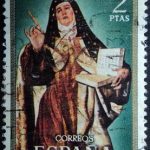
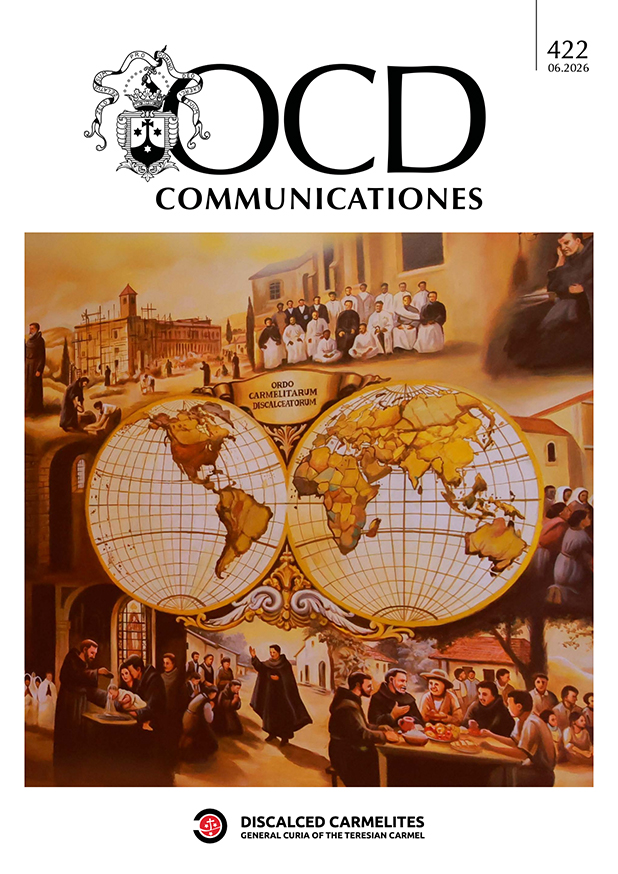
A book with the title “La presencia de la orden del Carmen descalzo en la Nueva España” [“The presence of the Discalced Carmelite Order in New Spain”], has been published in Mexico concerning our order and the figure of Teresa of Jesus in that country. The volume also seeks to identify the artistic, historical, and largely cultural heritage that Carmel’s presence has marked on Mexican society, visible in today’s urban spaces, not just religious ones.

Edited by the National Institute of Anthropology and History (INAH), the book which was coordinated by Yessica Ramírez Méndez and Mario C. Sarmiento Zúñiga, derives from an academic meeting that took place in 2015, on the occasion of the fifth centenary of the birth of Saint Teresa of Jesus, a fundamental figure of the order of Carmel, and 430 years after the arrival of this congregation in what was then called New Spain.

https://www.lajornadadeoriente.com.mx/puebla/inah-publica-libro-nueva-espana/

The 27th of September this year marked the 50th anniversary of St Teresa’s declaration as a Doctor of the Church by Pope Paul VI. On this website is available the Apostolic Letter containing the declaration, in Italian, Spanish and English. The General Curia has also echoed this event through various publications on all our social networks and the Teresianum website presented, on the same day, some documents of interest for a deeper understanding of the content of the Doctorate.

We also received news of the exhibition of “Sacred Teresian Art” that, from Sunday the 25th of  September until the 25th of October, can be visited in the St John of the Cross church of the Discalced Carmelite Friars in Alba de Tormes, who also scheduled a Mass of thanksgiving and a lecture on the Teresian doctorate by Fr Manuel Diego Sánchez ocd. In the photos that accompany this news you can see some of the pieces of great value present in the exhibition.

For their part, the Discalced Carmelite Friars of the La Santa monastery in Avila, in addition to a series of four reflections on the dimension of the doctorate given by Fr. Daniel de Pablo Maroto ocd, which can be consulted on the Facebook page of the Curia, have organized a course for the 23rd to 25th of October, with the title: “Central Elements of Teresian Spirituality”, to be presented by Fr. Secundino Castro, ocd.

On Sunday the 27thof September, the first event of the congress on the fiftieth anniversary of Teresa’s doctorate took place in the Cathedral of Avila. We made note of the content of this event some weeks ago. The session can be viewed on this YouTube link:

https://www.youtube.com/watch?v=nd6hC_70u04&feature=youtu.be

Recently, on the 4th of September, Fr José Luis Ureta, a Discalced Carmelite from the Navarre Province, died in Bilbao. Even though limited by illness in recent years of his life, he always put his experience, wisdom and knowledge in Law and Economics at the service of his sisters and brothers of the Teresian Carmel. The Discalced Carmelite General Curia, as she has already done through her social networks, sends her deepest condolences with this news to her brothers and sisters of the Province and his relatives, together with thanks for so many services performed in an absolutely selfless way for the Center of the Order and so many religious. Deserving particular mention is his enthusiastic collaboration with the Teresa-St John of the Cross International Center (University of Mysticism). In the following link you can consult the beautiful review prepared by the Province of Navarre:

https://www.ocdnavarra.com/single-post/2020/09/09/p-jos%C3%A9-luis-ureta-izurieta-descanse-en-paz-goian-bego

May he rest in Peace, this notable son of Saint Teresa.

To mark the first centenary of the death of St. Teresa of the Andes, the Discalced Carmelites of the Monastery of the Holy Spirit of the Andes are making available a website with the Saint’s complete, original writings.

This community, located in the Diocese of San Felipe in Chile, this is the place where Chile’s first canonized saint professed her vocation.

The texts are divided in letters, writings from her diary, and literary compositions. Each of these works allows us to discover the family and monastic life of St. Teresa of the Andes, as well as to ponder her mystical dimension.

Archives with unedited writings, correspondence, and personal testimonies from those who knew St. Teresa de los Andes will also be added with the objective of creating a digital library that will serve as the primary point of reference for the study of Chile’s first canonized saint.

©:

https://www.aciprensa.com/noticias/publican-sitio-web-con-escritos-originales-de-santa-teresa-de-los-andes-72129

Más información:

https://santateresadelosandes.org/

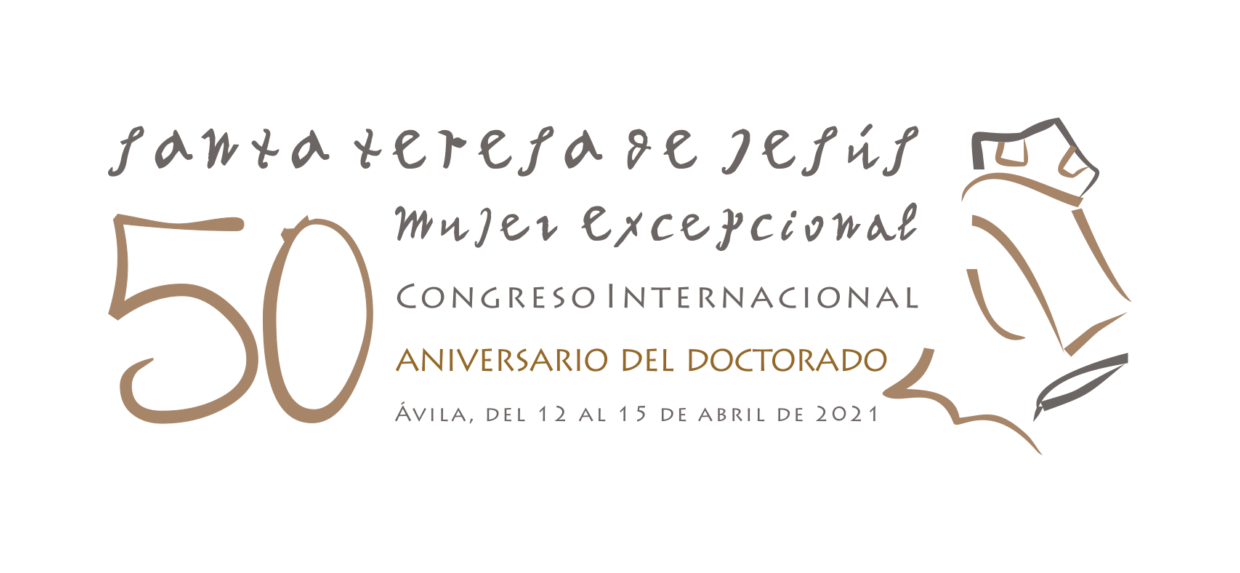
The 50th Anniversary of the Doctorate of Santa Teresa of Jesus will be celebrated on September 27, 2020.  In commemoration, the Bishopric of Avila, the Discalced Carmelites, and the Catholic University of Avila (UCAV), along with collaboration from the Catholic University of Eichstätt-Ingolstadt, have organized the International Congress “Exceptional Woman. Fifty years of the Doctorate of St. Teresa of Jesus.” The opening act of the Congress will take place this coming September 27, the anniversary date of the first woman recognized as Doctor of the Church. The Congress itself will take place April 12 – 15, 2021.

The Congress will include the presence of Cardinal Aquilino Bocos, Rev. Dr. Emilio Martínez, OCD, Rev. Dr. Silvano Giordano, OCD – of the “Teresianum,” Rome –, and Rev. Dr. Rómulo Cuartas Londoño, OCD – of CITeS, Ávila. Other participants in the Congress include: Cardenal Dr. Ricardo Blázquez Pérez, Dr. Beatriz de Ancos Morales, Dr. Marianne Schlosser, Dr. Lothar Wehr, and Dr. Burkard M. Zapff who will cover the life and work of St. Teresa from different perspectives.

On September 27, 2020, the presentation of the Congress will be celebrated with Holy Mass and a talk that will take place in the Cathedral of Avila, transmitted live via internet. The program for this event is as follows (CEST):

  • 30 h Presentation of Congress
  • 17:00 h Talk by Dr. Juan Antonio Marcos, “Teresa of Jesus: an irregular verb (Why does she continue to captivate us?)”
  • 18:00 h Holy Mass in Cristo Salvador Cathedral, Avila

For more information:  http://congresosantateresadoctora.es/


Our Order’s presence in the Democratic Republic of the Congo and the Republic of Congo – or Congo Brazzaville – is an impassioned history that spans more than 50 years and that now reaches a new milestone with the creation of the Commissariat of San Jose del Congo by the Father General, Saverio Cannistrá and his Definitory through the decree published on March 10th, 2020. The Commissariat will be formed by the houses of the previous General Delegation.

To mark this joyous occasion, our web page and our information bulletin will offer in the French language section a brief history of the presence of the Order in these African nations that we summarize here.

From 1965 to 1969, the first Discalced Carmelites from the Provinces of Castille, Flanders, and Rome established themselves in various ways in the west and the center of Congo. They set up pastoral, evangelical, and social initiatives. Soon, the first youths answered the call to vocational discernment and as a result, a novitiate was built in Kananga in 1979 so that the candidates could begin their Carmelite formation. The first Carmelites responsible for the novitiate community were Fathers Marcellino Forcellini (Rome), Sebast Vanderstraaten (Flanders) and Miguel Gutiérrez (Castille) assisted by the Polish missionaries who were already established in Burundi. Over time, coordinated and assisted by then Father General Felipe Sainz de Baranda, the new missionaries in the Congo expanded the structures for receiving and forming vocations with help from the already-established Congolese Carmelites. The Delegation’s growth spurred the building of a center for pastoral and spiritual initiatives, the “Teresianum” of Kinshasha.

As years passed, the veteran, European missionaries gave way in their governance and formation roles to Congolese religious, initiating a period of maturation that now gives fruit with the creation of this new Commissariat.


In recently, cybercriminals have contacted many of our brothers and sisters. Introducing themselves as Father Luis Arostogui Gamboa, they contact their victims to offer them financial assistance for various reasons (depending on the case). They use email addresses that include one or all of Father Luis Arostogui Gamboa’s names. One of the most used email addresses by these criminals is luisagocd@gmail.com

We invite you all to be more vigilant about the emails you receive. Always check if the sender’s e-mail address is the usual one … Pay more attention to the content of e-mails and check their veracity before providing any data relating to your location, bank details etc.

If in doubt about the origin or content of an email, it would be safer not to reply to the email.


Attention, Attention, attention ! Des cybercriminels : ne soyez pas victime !

Ces dernières semaines, des cybercriminels ont contacté beaucoup de nos confrères et sœurs. Se présentant comme Père Luis Arostogui Gamboa, ils contactent leurs victimes en leur proposant une aide financière pour des raisons diverses (selon le cas). Ils utilisent des adresses emails incluant l’un ou tous les noms du Père Luis Arostogui Gamboa. L’une des adresses e-mails plus utilisées par ces criminels est luisagocd@gmail.com

Nous vous invitons tous à plus de vigilance devant les emails que vous recevez.  Vérifiez toujours si l’adresse e-mail de l’expéditeur est l’adresse habituelle… Faites plus d’attention au contenu des e-mails et vérifiez leur véracité avant de fournir n’importe quelle donnée relative à votre localisation, coordonnées bancaires etc.

En cas de doute sur la provenance ou le contenu d’un e-mail, il serait plus prudent de ne pas répondre tout simplement.


An article in the Spanish Biographical Dictionary (of the Spanish Royal Academy of History) reminds us that Fr. Jerónimo Gracián’s 475th birth anniversary (b. June 6, 1545) was celebrated this past June. The article, written by Fr. José Vicente Rodríguez, OCD, was published on the Royal Academy of Spanish History’s website:

http://dbe.rah.es/biografias/18443/jeronimo-gracian-dantisco

The Dictionary has many other articles on persons connected with the Teresian Carmel, starting with St. Teresa herself. The articles were collected two years ago on the blog of the Discalced Carmelites of Puçol, Valencia, Spain, De la Rueca a la Pluma (From the Spinning Wheel to the Pen). The complete list is available at this URL:

https://delaruecaalapluma.wordpress.com/2018/05/14/diccionario-biografico-espanol/


The convent of The Saint (the family home of St. Teresa of Jesus) in Avila, Spain, was the location of the ordination to the diaconate of Avila’s native son, Luís Carlos Muñoz on Saturday, June 27.

The same day in Lebanon, our brothers Marcos, Jorge (of the Semi-province of Lebanon), Juan, y Zacarías (of the General Delegation of Egypt) were also ordained.

Good news also comes from Egypt regarding the reopening of the churches for the celebration of Mass. Fortunately, our Sanctuary of St. Therese of the Child Jesus in Cairo never closed to visits from the faithful who sought the protection of St. Therese throughout the pandemonium. The Sanctuary remained open for personal prayer, taking all the security precautions required by the municipal and government authorities.


Living Flame of Love, the title of one of the most well-known works of St. John of the Cross, is also the name of the International Congress of the International Center of Teresian San Juanista (CITeS), University of the Mystic, organized each year in Avila. This year, the fourth convocation of the Congress will take place as scheduled, between August 31 and September 6. As usual, people may attend in person or online according to the director of CITeS. If circumstances prohibit personal attendance, the Congress will still take place online.

Admirable efforts have been made by the CITeS community to adapt the conference space to the preventative measures required by sanitation authorities. Consequently, the Congress as well as other activities that will take place in the Center this summer will be celebrated with absolute security.

Fr. Francisco Javier Sancho has indicated that this world congress will include highly renowned specialists who “will help us enter into the most profound center of the soul’s work in order to understand the depth and breadth of St. John of the Cross’s experience and doctrine. A congress in which we will come close to St. John of the Cross, his artistic and literary creation and his doctrine, discovering new arenas of reading and interpretation as well as interreligious and interdisciplinary dialogues.”

For more information on this and other activities: https://www.mistica.es/

Therefore two truths are evoked by the sign of the Scapular:  on the one hand, the constant protection of the Blessed Virgin, not only on life’s journey, but also at the moment of passing into the fullness of eternal glory; on the other, the awareness that devotion to her cannot be limited to prayers and tributes in her honour on certain occasions, but must become a “habit”, that is, a permanent orientation of one’s own Christian conduct, woven of prayer and interior life, through frequent reception of the sacraments and the concrete practice of the spiritual and corporal works of mercy. In this way the Scapular becomes a sign of the “covenant” and reciprocal communion between Mary and the faithful:  indeed, it concretely translates the gift of his Mother, which Jesus gave on the Cross to John and, through him, to all of us, and the entrustment of the beloved Apostle and of us to her, who became our spiritual Mother.

http://www.vatican.va/content/john-paul-ii/en/speeches/2001/march/documents/hf_jp-ii_spe_20010326_ordine-carmelo.html

Through a happy coincidence, this Sunday falls on 16 July, the day when the liturgy commemorates Our Lady of Mount Carmel. The slopes of Carmel, a high ridge that runs down the eastern coast of the Mediterranean Sea at the altitude of Galilee, are dotted with numerous natural caves, beloved by hermits.

The most famous of these men of God was the great Prophet Elijah, who in the ninth century before Christ strenuously defended the purity of faith in the one true God from contamination by idolatrous cults. Inspired by the figure of Elijah, the contemplative order of Carmelites arose. It is a religious family that counts among its members great saints such as Teresa of Avila, John of the Cross, Thérèse of the Child Jesus and Teresa Benedicta of the Cross (in the world: Edith Stein).

The Carmelites have spread among the Christian people devotion to Our Lady of Mount Carmel, holding her up as a model of prayer, contemplation and dedication to God.
Indeed, Mary was the first, in a way which can never be equalled, to believe and experience that Jesus, the Incarnate Word, is the summit, the peak of man’s encounter with God. By fully accepting the Word, she “was blessedly brought to the holy Mountain” (cf. Opening Prayer of the Memorial), and lives for ever with the Lord in body and soul.

Today, I would like to entrust to the Queen of Mount Carmel all contemplative life communities scattered throughout the world, especially those of the Carmelite Order, among which I recall the Monastery of Quart, not far from here, that I have had the opportunity to visit in these days. May Mary help every Christian to find God in the silence of prayer.