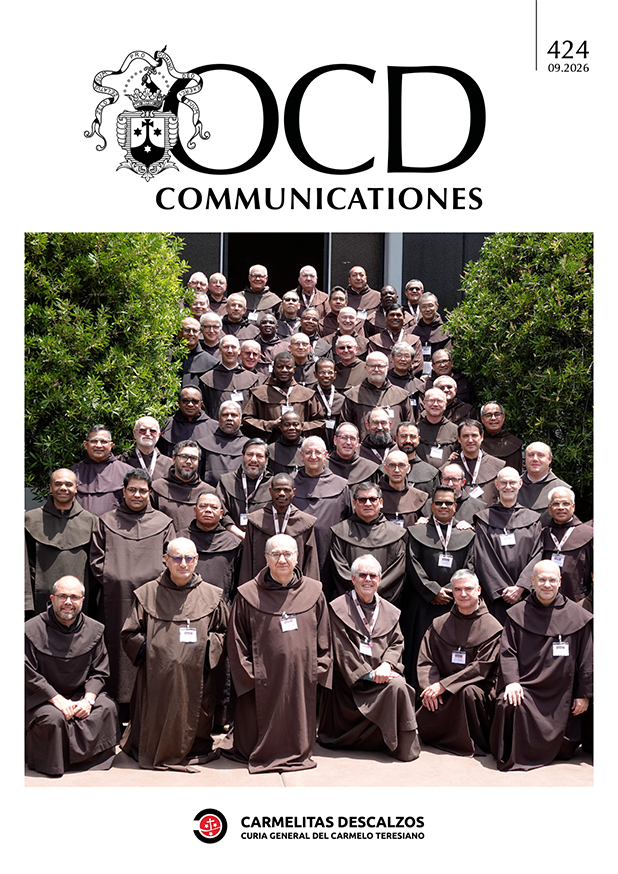
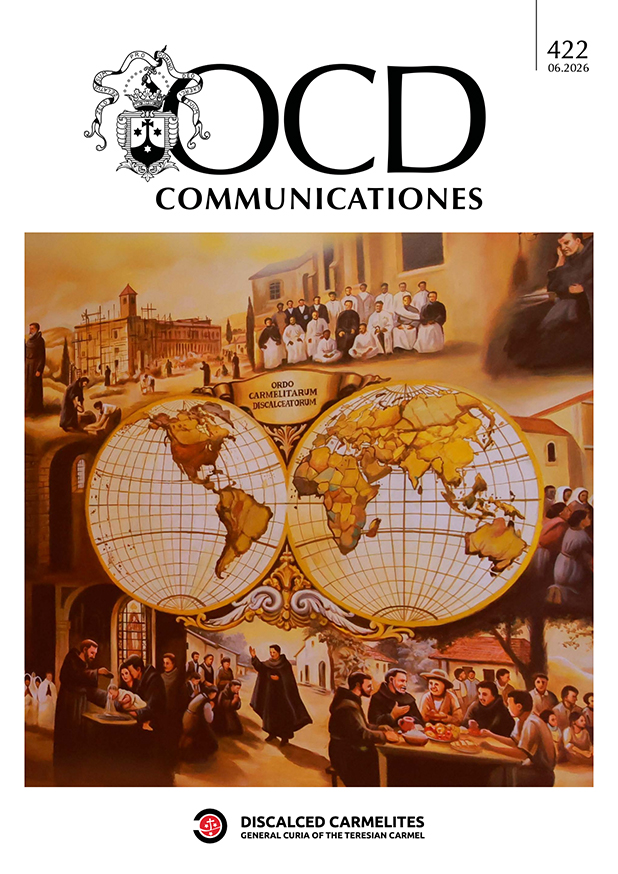
Dear brothers, the particular circumstances that our Community has been experiencing have prevented us from printing and sending the usual greetings card. However, we have prepared a digital version, with a special reference to St. Joseph, who this Jubilee year will introduce and accompany us in the welcoming and generous contemplation of the Mystery of the Incarnate God.

We ask you to kindly forward this message of good wishes – a sign of fraternity and gratitude – to all the communities in your Circumscription.

United in prayer

       Fr. Angelo Lanfranchi

      Secretary General


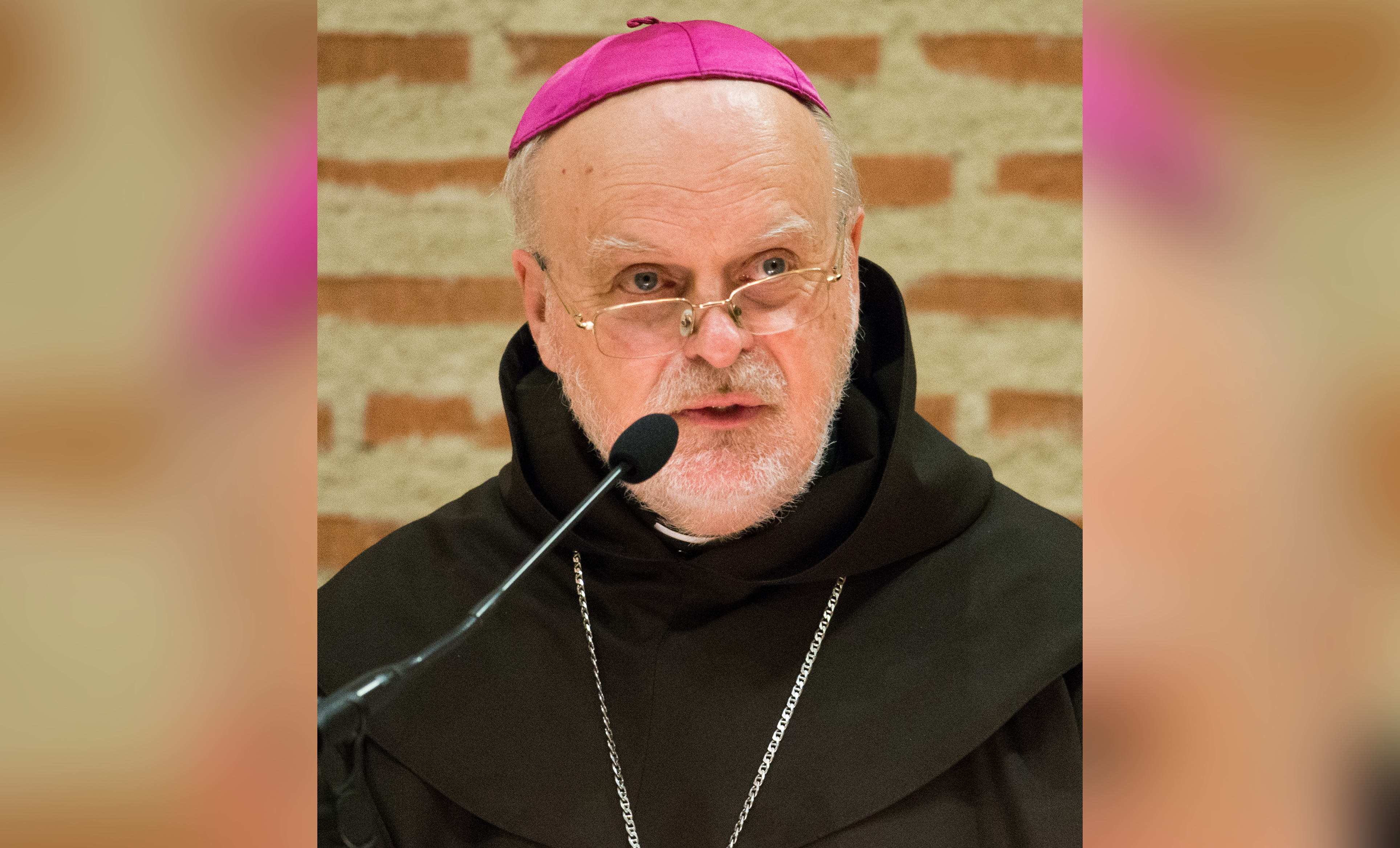
On 16th November 2020, around 105 people gathered, via Zoom, to participate in the Spirituality Summit ‘Teresa of Avila: Teacher and Guide’ convened by the Centre for Applied Carmelite Spirituality (CACS), Oxford, UK, (oxcacs.org) to celebrate the 50th Anniversary of the Doctorate of Santa Teresa of Jesus. Bishop David Oakley OCDS offered welcoming remarks; Cardinal Anders Arborelius OCD and Sr. Jo Robson OCD gave keynote addresses and an expert panel (comprising: Fr. Matt Blake, Mark Courtney, Annette Goulden, Dr. Susan Muto, Sr. Jo Robson and Prof. Peter Tyler) considered what Teresa might offer us today.  What follows gives a flavour of some of the discussions and reflections that unfolded in the context of the Summit.

Ordinariness

At the heart of the Summit was an invitation (extended by Sr. Jo) to experience Teresa’s generosity (and spiritual solidarity) in openly sharing with us her ‘ordinariness’ – namely, her flaws, struggles and sinfulness. We were encouraged to set aside our established tendencies to regard Teresa’s self-deprecating characterisations of herself (for instance, as ‘base’, ‘low’, ‘wretched’, ‘mean-spirited’) either as false-modesty or else as self-effacing literary devices (deployed as she crafted her writings so as not to provoke the wrath of the Inquisition).  Instead, we were invited to recognise how Teresa, through these self-characterisations, is purposefully reaching out to us.

Sr. Jo suggested that Teresa wants us to understand the commonalities and connections between Teresa’s lived experiences and our own. For, it is by understanding that Teresa starts with the same frailties as us, we can be assured (though we may be ‘a mess’) that we can proceed with courage, and in humility – trusting that God will bring about our deepest desire for Union, which is our common destiny.

We were also encouraged to recognise that our ordinary, everyday lives are potent crucibles of transformation. Teresa asks us to engage with, what Sr. Jo characterised as: ‘the radical ordinariness of it all’ – the struggles in prayer, the challenges encountered in relationships and the experiences of living in community. Indeed, Sr. Jo reminded us, true mystical union ‘looks’ unremarkable – lying beyond locutions and ecstasies and entailing a quiet unshakeable awareness of Christ’s continual presence, which powerfully shapes service in the world.

Right Here, Right Now

Cardinal Anders’ contribution also highlighted the importance of attentiveness to the seemingly mundane. He encouraged us to participate in the ‘sacrament of the present moment’ – opening up to God, and His glorious eternity, in the everyday and the here and now.  He cautioned us regarding the perils of living outside our current reality (daydreaming and wishing for things to be other/different) and squandering the possibilities inherent in the preciousness of the present moment. Wistful ‘If onlys…’ do not serve us, Cardinal Anders noted, rather they detract us from: meeting God in his creation; encountering Him in each other and from finding the ‘traces’ of God that surround us. Thus in the midst of our complex lives the call is to simplicity – the repeated turning of our eyes to God such that a loving attentiveness to God becomes the atmosphere of our lives. Even a small uplifting of our heart is pleasing to God and we must make a chapel of our heart, right here and right now.

Wisdom For Today

Through the panel discussion, participants in the Summit were invited to consider Teresa both as a Doctor of the Church and a physician of the soul. Through the reflections that unfolded we considered anew her genius – which is to teach from her own lived-experience, grounded in her formative knowledge of the human condition.

It became clear that this is why Teresa still speaks so powerfully to us today. Teresa understands the afflictions of the soul (and offers apposite guidance), challenging us to enter into the fullness of our own lives and humanity through prayer and in relationship.  It is in the midst of such radical ordinariness we find that our souls are extraordinary palaces, in which dwells the divinity of God.  Renewed in Teresa’s presence, through the Summit, we must go and find Him.

Recently, on December the 14th, as we communicated through our social networks, the inaugural conference of the Chair of Carmelite Studies at the Catholic University of America took place.

The problems generated by the COVID-19 pandemic had significantly delayed the inauguration, which was able to be carried out by means of a video-conferencing program.

The Discalced Carmelite, Fr. Steven Payne, in charge of the Chair in which the two branches of Carmel collaborate, delivered the opening conference, titled: “The Dark Night of the Soul Yesterday and Today. Revisiting the famous text and symbol of St John of the Cross”.

May the new Chair produce positive, new fruits.


On December the 3rd, the feast of Saint Francis Xavier, we received exceptionally good news in the General Curia: molecular tests for the detection of coronavirus gave a negative result. Thus, was overcome the COVID-19 contagious situation that lasted in the General House for one month. None of those infected have had, thank God, severe symptoms and are currently in good health.

After this time of contagion and isolation, normalcy in the curia is gradually resuming. On the 5th of December, the first Community Mass was celebrated, in which we remembered especially the sick who still suffer from the pandemic and its consequences, their families and health professionals, as well as those in other areas who help to combat it.


Recently, on the 6th of November, there died in Paris Bernard Sesé, the professor of Spanish literature and French poet. A member of the Royal Spanish Academy in France since 1996, he devoted much of his life to the study of Spanish poets and writers which, in 1980,  earned him the first prize of the Antonio Machado Foundation for a work on that remarkable Andalusian poet.

He dedicated many of his works to the study of the poetry and prose of St Teresa of Jesus and, above all, of St John of the Cross. He had several books and articles published in different journals about our saints and is the author of a biography on Madame Acarie. Bernard Sesé also actively participated in several congresses about the mystics of Carmel.

He had reached 91 years of age and was emeritus professor of Spanish Literature at the University of Paris X-Nanterre. May he rest in peace.

The Archbishop of Jakarta, Ignatius Cardinal Suharyo presided over the Solemn Mass on October 15, 2020 where the decree of erection issued by the Cardinal was read. It was an Online Mass since Jakarta is the worst affected zone from the corona virus. It turned out to be God’s Providence since the Online Eucharistic celebrations allowed more people to participate, so much more than what the tiny monastery’s chapel could contain. In fact till now 5400 have followed the Mass.

Archbishop Suharyo has greatly desired that in the Archdiocese there is a contemplative monastery. God has finally granted his heart’s desire and this foundation is also God’s own desire. It is amazing how God arranges everything through many people whom we did not know before.

In the past, a contemplative monastery in a hot, hedonist, noisy and polluted capital city like Jakarta was unthinkable. But now everybody is happy that there is a contemplative monastery in the most important city in Jakarta and also the most harassed by radicalism.


The Pontifical Theological Faculty Teresianum announced on 27th October that the Congregation for Catholic Education of the Holy See has nominated Fr. Christof Betschart OCD as Chair of the same for the triennium 2020-2023

Together with the academic community we would like to wish the new incumbent of the Faculty and Institute of Spirituality Teresianum every success in his undertaking of the new office.

Equally, we wish to thank the previous Chair, Fr. Denis Chardonnens for the work he has carried out over the past six years. We accompany both of them in prayer.


The outstanding hispanist, Joseph Pérez, died in Bordeaux, France on 8th October. He was an outstanding scholar specialising in the History of Modern Spain and was awarded the Prince of Asturias Prize for Social Sciences in 2014. He was eighty-nine years old.

A specialist in the historical period which covers the reign of the Catholic Monarchs up to the time of Phillip II and the formation of the modern state of Spain and the Ibero-American nations, he carried out noteworthy studies on the figure of St. Teresa in the form of articles, books and talks in Congresses.

May he rest in peace.

©elespanol.com


The first Chapter Congress of the new Commissariat of St. Joseph of the Congo took place from 24th – 29th September, presided by Fr. General, Saverio Cannistrà, who was accompanied by Fr. Daniel Ehigie, the Definitor for Africa.

Apart from dealing with topics of consequence to the life of the Commissariat, the Congress elected its first Commissioner, as well as three counselors who will help him in this enterprise. below are the results of the elections:

Commissioner: P. Albert Tampwo, que era consejero de la Delegación General.

Counselors:

  1. Gilbert Mubengayi Kayembe
  2. Germain Kalonda Kaya
  3. Jacques Mutimanwa Furaha

May we entreat the Lord to accompany and enlighten the new superiors and all members of the Commissariat.


Our communities of brothers and sisters have not been left out of the pandemic affecting all of humanity. Right from the beginning we have tried to accompany and help those closest to us in various ways and joining the pope and the Church in prayer for all mankind.

As in the “first wave”, this second wave has also directly affected some religious, infecting them with the diseases associated with the coronavirus. We entrust them to your prayers and we will seek to follow their progress.

At this particular moment, most of the infected friars and nuns who have informed us of their situation are asymptomatic or do not have excessively severe symptoms. We have heard of a community in the Veneto area of Italy, –Trento to be precise– which suffered a grievous blow a few days ago when one of their friars of advanced age, who had been suffering from other illnesses for some time, was not able to overcome the virus.

Unfortunately, the virus has also entered the General House. We want to inform you that most cases are asymptomatic and friars who do have some discomfort are under control. Thus, life in the Curia continues normally, although all recommended protective measures have been accentuated. We thank very much those who, knowing the news, have taken an interest in the sick and assured us of their prayers.

If there is anything new, we shall let you know immediately. For the time being, let us continue to pray that the sick be restored to health. Precisely to avoid work and thus facilitate their recovery, it is preferable to limit messages and phone calls.

Thanks in advance.


Fr. Marie Joseph, ocd, of Karnataka Goa Province, has been appointed Episcopal Vicar for Religious Life in the Archdiocese of Cape Town, South Africa. He will also be a member of the College of Consultants. We congratulate Fr. Marie Joseph and send him our best wishes with our prayers.

The Archdiocese of Cape Town began as the Apostolic Vicariate of the Cape of Good Hope in 1818 and was elevated to the rank of Metropolitan Archdiocese in 1951, having as suffragan dioceses Aliwal, De Aar, Oudtshoorm, Porth Elizabeth and Queenstown. The mission of the Discalced Carmelites in South Africa is in the care of Karnataka Goa Province (India).


Our brothers from Australia-Oceania have completely revamped their website, with a new design and content that can be seen in: www.carmelite.com.

The website is titled Carmelite Spirit and has been associated with the social media channels already active for some time, managed by the Carmelites of the region.

The main objective of the page is to take advantage of the means offered by new technologies and digital media to share the richness of the spirituality of the Teresian Carmel, by offering spaces for dialogue – at least virtual – and knowledge of the wisdom of our saints.

It is a very visually appealing website, which also offers the possibility of performing a process of vocational discernment, making known the lives of the friars and nuns of the region.

The Major Superior of the Discalced Carmelites in Australia-Oceania said: “This is a very exciting project for Carmelites. It is an important way through which we can share the treasures of our spirituality with all.”


In September last year, a group of Discalced Carmelite nuns from Italy began a course of permanent formation in collaboration with ISFO (Higher Institute for Trainers: http://www.isfo.it/) and the Teresianum. As a result of the COVID-19 pandemic, the face-to-face meeting scheduled for this year had to be suspended. However, on September 23rd, a digital meeting was held to share among the participants some of the materials that have been studied and worked on this year by the participating sisters. In the videoconference were present religious from Verona, Ferrara, San Quirico (Lucca), Pescara, Venice, Fano, Bologna, Crotone, Arezzo and Turin, in addition to Frs. Christof Betshart and Emilio José Martínez from the Teresianum and D. Luca Garbinetto of ISFO, who is responsible for the organization of this course, together with Fr. Christof and Sister Maria Manuela of the Lucca convent.


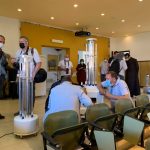
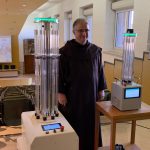
Recently, on the 18th of September, the Theological Faculty and the Teresianum Pontifical Institute of Spirituality presented to the public, in the Aula Magna, the products of the Raybotics brand that have been acquired by the Curia General in order to provide the Faculty with the necessary means to disinfect classrooms and other academic environments, in order to combat the new coronavirus and protect, as far as possible, teachers, Teresianum employees and students.

Attracting attention, were two screens for temperature measurement first presented, which also check if the person wears a mask, vetting access by locking the doors to those who have a high fever or do not wear adequate protection.

Secondly, several lamps were presented for the purification of enclosed spaces, called PHS (Pro Health System), capable of destroying 99% of pathogens in a noticeably short time, thanks to a double system of ultraviolet rays and ozone. One of the lamps is attached to a moving robot, allowing it to move through different environments without the presence of an operator.

In another order of things, on October 15th, the feast of St Teresa of Jesus, the academic year was inaugurated with a Eucharist at which presided Fr. Agustí Borrell, Vicar General. Within the framework of the fiftieth anniversary of her proclamation as a doctor of the Church, Fr. Augustine recalled that, although Teresa acquired theological science through love – mystical theology – she was always friends with lawyers and lettered people as well as theologians held in very high esteem, especially if experts in Scripture. The traditional refreshment did not follow Mass, as the regulations decreed by the Italian government two days earlier prevented it.


Recently, a new translation of the Works of St John of the Cross has been published in Italian, using as its basis the Spanish edition published by Editorial de Espiritualidad (EDE).

This edition offers a good critical apparatus, as well as a set of introductions and notes that help the reader to understand better the content of the writings of St. John of the Cross. The translation was carried out by Fr. Silvano Giordano OCD, and the volume has been published by “Edizioni OCD”, publisher of the Italian provinces of Discalced Carmelites:

https://www.edizioniocd.it/libri/opere-complete