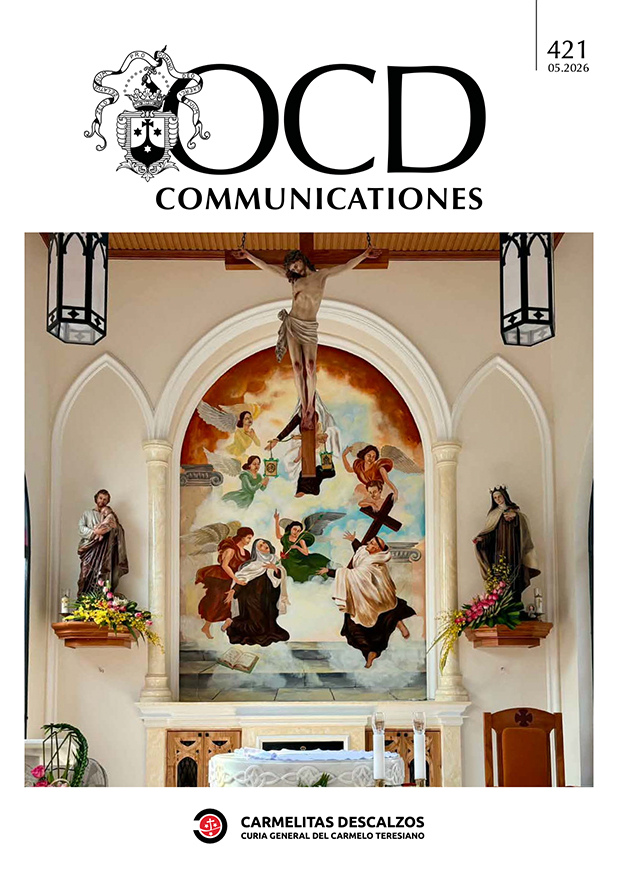
From April 12 to 15, Avila welcomed the International Congress “Saint Teresa of Jesus, an Exceptional Woman” on the occasion of the 50th anniversary of the proclamation of Saint Teresa of Jesus as a Doctor of the Church. At the beginning of the congress, a message from Pope Francis was read in which he greeted all the participants and affirmed that “the flame that Jesus lit in Teresa continues to shine in this world that always needs courageous witnesses, capable of breaking down any wall”.

The Congress took place in two ways: with participants attending in person or online. Over four days, the Teresian doctrine for the world and the Church of today was presented in different themes.

At the end of the congress, participants received a new surprise: a video message from Pope Francis. This was the highlight of Congress. The Pope took the opportunity to recall that one of the characteristics of the Saint of Avila was her union with Christ and her determination to be with him in prayer. She encouraged everyone to find their own path to holiness and pointed out that “Saint Teresa teaches us that the journey that made her an exceptional woman and a figure of reference through the centuries, that journey, that of prayer, is open to all those who humbly open themselves to the action of the spirit in their lives”.

Here is the link for the complete text of the video message:

https://www.osservatoreromano.va/en/pdfreader.html/ing/2021/04/ING_2021_017_2304.pdf.html

In addition, the Congress has raised funds, through the congress’s website (http://congresosantateresadoctora.es ), to help the Monastery of the Annunciation in Alba de Tormes (Salamanca), where the tomb of St Teresa is preserved. As well, the organizors have also decided to donate the profits from the Congress to help alleviate the difficult financial situation through which the monastery is going.


We learned on March 12 that Pope Francis has named Mother Elsa Campa, prioress of the Carmelites of Alba and Villagarcía de Campos (Spain), and president of the Federation of the Discalced Carmelites, as consultor to the Congregation for Institutes of Consecrated Life and Societies of Apostolic Life.

Mother, for those who do not know you, can you introduce yourself?

EC: My name is Elsa Campa Fernandez (Elsa del Corazon de Jesus) and I was born in the north of Spain, in a small village in the Principality of Asturias. I entered the Carmel of Oviedo on 10 July 1982; I made my first profession on 12 January 1985 and my solemn profession on 10 January 1988.

What does this nomination mean to you as a woman and as a Carmelite?

EC: As a woman, it is important that the Church gradually trusts us and considers us; that it wants to hear our voice; and that it recognises all that, generation after generation, we women do in the Church and in society.

As a Carmelite sister, for me it is more work and more worries, because I already have a very busy day. However, over and above myself, it is a small recognition and an honour for the whole Order. And that fills me with joy.

Then, on the 11th of April, we were informed that the Holy Father had also appointed Father Denis Chardonnens, O.C.D., as a consultor of the CIVCSVA. He is from Switzerland, and member of the Province of Avignon-Aquitaine (France). He is the former deancon of the Pontifical Faculty of Theology and of the Pontifical Institute of Spirituality Teresianum in Rome. There, he teaches Trinitarian theology, dogmatic theology and fundamental spiritual theology.

Congratulations to both of you! We keep you both in our prayers.


Father Teófanes was born in Gajates (Spain) in 1936. He dedicated his whole life to History. He was a professor of modern history at the University of Valladolid until 2001 and was the official chronicler of the city of Valladolid (Spain) for 17 years. He is one of the most recognised experts on the 18th century.

The jury unanimously decided to award him this prize “for his permanent and brilliant dedication to teaching and historical research, which has provided the historiography of the Spanish 18th century with avant-garde lines of research, with a particular impact on the history of mentalities. (…) The studies carried out by Father Teófanes Egido were decisive in identifying the Judeo-converted origins of the family of Teresa of Jesus, or in the critical approach to the work of Martin Luther, of which he made the first translation into Spanish. In this way, he opened up new areas of study and interpretation of Baroque religiosity. All this makes him one of the great historians of Castilla y León.”

The award ceremony took place on Wednesday 21 April 2021.

Congratulations to Father Teófanes for this recognition.


In 2005 there were 4000 members in the Catholic Church of the Latin Rite, or 0.6% of Christians in Iraq.   Carmel has had a presence in the country since 1623 in Bassora.  Another monastery of the Friars was founded in Baghdad in 1721.   Their missionary activity concentrated on assisting local Christian communities.  The present situation of the mission is very precarious, as is true for the whole country.  Christians, and particularly Religious, are subjected to intimidation from extremists.  We have one Iraqi native Religious, Fr. Ghadir.  He resides in Baghdad and is assisted by friends of the monastery.  Since October 2018, Sisters of the “Carmel of St. Joseph” run a school in Baghdad.

You can consult  “The Family of Carmel of Iraq”  on Facebook :

https://www.facebook.com/carmeliraq/photos

Pope Francis’ visit to Iraq, so ardently longed for by the Holy Father but so frequently postponed, finally took place from March 5-8, 2021.  It has been seen unanimously as an historic event.  It has certainly been the first visit of a Pope to Iraq.  But, above all, it was a visit to the men and women of an immensely rich country that has been at the mercy of the most selfish and destructive international conflicts.  It is a visit that will be inscribed in history as an heroic gesture of the Holy See against war and as being an effort to promote human rights and religious freedom of conscience.

In the footsteps of Abraham, the Holy Father wishes to reawaken true faith in God in a predominantly Muslim country.  It is a country where fanaticism remains a constant danger, where Jidad, especially that of the Islamic State, has uprooted a 2000 year old Church, condemning over a million of its faithful to exile, leaving the future in doubt and shrouding the present in fear and trepidation.

The visit was short and rapid.  The Pope met official authorities and representatives of various religions.  He managed to dedicate about 30 minutes to reciting the Sunday Angelus in a large Christian village in the Plain of Ninive, a region that has been humiliated, vandalised and emptied of its inhabitants by the Islamic State.  Shortly before this, he spent a while  recollected in prayer in the heaet of the city of Mosul.  This city has also been  ravaged and destroyed by the same Islamic State which had eliminated many Muslims as well as persecuting Christians and Yazidis.  The Holy Father concluded his visit with Papal Mass at a stadium in Erbil, capital of the Kurd region.

The visit was indeed historic because the Pope presented himself as humble and loving, a witness to truth and hope.

+ Jean Benjamin Sleiman,  Latin Archbishop of Baghdad


On January 13, 2021, yet another failed coup plunged the population of the Central African Republic into panic.  2,385 persons, the majority of them women and children, fled from the rebel military and sought sanctuary in our Monastery of St. Elias.  With the assistance of some ONG and agents of the United Nations, the friars were able to cope with the most urgent needs of the refugees.

So for 40 days it was necessary to reorganise the whole life at St. Elias.  We had to live and share:  the Friars with the refugees, the refugees with their fears and hopes and everybody with insecurity and uncertainty.  During this tragic period seven babies were born in the monastery.  On February 5, the Bishop of Bouar, Mons. Mirek Guewa, paid us a visit and, with the refugees, took part in some moments of prayer guided by our Friars.  Then on February 9, Cardinal Dieudonne Nzapalainga, the Archbishop of Bangui also visited, accompanied by the “Religious Platform” of Bangui which included Catholic members and some Protestants and Muslims.  These all offered words of encouragement and support to the refugees.  All the members of the Platform wanted to bless the new mothers and their infants, before concluding their visit with shared prayer.  On that very day Bouar was liberated y the Central African Republic army with Russian assistance.

From February 13, all the refugees were able to gradually return to their homes.  At our Sunday Nass on February 14,  one lady, speaking on behalf of all the refugees, expressed their gratitude to the Carmelite Community.  Since then only the Central African soldiers and some Russians remain here.  These come to get water and to have showers.


On March 19, 2021, the Feast of St. Joseph, the Metropolitan Archbishop, Mons. Mzarek Jedraszewski, presided at Mass in our Church in Cracow.  During the celebration, he read the Decree by which he designated the Carmelite Church as a Diocesan Shrine dedicated to St. Joseph.  In his Decree, the Archbishop began with the observation that it was due to the influence of Carmelite devotion and popular secular tradition that the city of Cracow had chosen St. Joseph as its Holy Patron. In 1715 during a Swedish invasion, and again during a period of great epidemics, the city entrusted itself to the protection of its Holy Patriarch in front of the Saint’s picture.  This pictue was eventually preserved  in the Carmelite Church.

To this day, the Carmelites continue to foster and encourage devotion to St. Joseph among the city’s population.  The Church of the Immaculate Conception of the Blessed Virgin, situated a short distance from the railway station, is a favoured destination where so many of the faithful, from the simple passer-by to students concerned about their future, can come to entrust themselves to the intercession of the Guardian of the Holy Family.  In his Decree, the Archbishop confirmed the Carmelite Friars in their mission as promoters of devotion to Joseph, through Sacramental ministry and popular devotions.

Fr. Damian Sochacki OCD is Rector of the new Shrine.


The meeting of the assembly of the Conference of the Major Superiors of the african francophone zone took place in Abidjan from 24 to 29 January 2021. The following were present: Fr Daniel Ehigie (Definitor), Fr Jerome Paluku (Secretary for the Missionary Cooperation Office), Fr Albert Tampwo (Commissario of Congo), Fr Jacque Mutimanwa (Councillor, Commissariat of Congo), Fr Federico Trinchero (Provincial Delegate, Central Africa), Fr Domenico Rossi (Provincial Delegate, Cameroon), Fr Jean-Fabrice Delbecq (Provincial, Avignon-Aquitaine), Fr Emile M’Bra (outgoing President of the Conference form the Provincial Delegation of West Africa) and Fr Jean-Baptiste Pagabeleguem (Provincial Delegate, West Africa).

The assembly discussed the preparation of our candidates for Solemn Profession (Second Novitiate), a program which is done in common annually. A decision was made that from next year (2022), the responsibility of planning and implementation of the program will be passed on to the circumscriptions such that each one will take its turn to organize and host the event.

In October 2019, the fourth African Teresian Congress was held in Yaoundé in Cameroon as a joint project of the Conferences of the Major Superiors of our 2 language zones (francophone and anglophone). The project was evaluated. They underscored the importance of the joint project as an effective instrument of communion between the two zones. Efforts will be made to contact the anglophone Conference so that planning towards the next Africa Teresian Congress can commence soon.

The issue of the situation of the mission in Senegal was raised. There are currently 2 Friars in each of the 2 houses in Senegal – the house in Kaolack and the other one in Dakar. This number of Friars is not sufficient to sustain the normal Carmelite life in the houses. Appeals for assistance were made by the mother Province (Avignon-Aquitaine). At the end of the discussions, the Provincial Delegation of West Africa confirmed that a Friar will be sent there as soon as possible, and the Commissariat of Congo also offered to send a Friar.


After almost six years, Fr Emilio José Martínez has left the secretariat for information and internet at the General Curia. He will be replaced by Fr José Pereira, ocd, from the Province of Avignon-Aquitaine.

We are thankful to Fr Emilio for his years of service. We welcome Fr José Pereira, and also thank his pProvince for this sign of communion and collaboration with the General Curia. We pray St. Teresa and St. Joseph for the success of the mission entrusted to Fr. José Pereira.

Fr. José Pereira was born in Bayonne (France) in 1974. He made his first profession in the Order in 2001, and was ordained priest in 2007. He was graduated in Spiritual Theology from our Faculty “Teresianum” in Rome. In this past years, he worked at the “Editions du Carmel” in Toulouse (France) as director.


Fr. Marco Chiesa, from the Province of Genoa, has been designated as new Postulator General. He replaces Fr. Romano Gambalunga, whom we warmly thank for his years of dedication to the General Curia.

Fr. Marco was born in 1976 in Crema (Italy). He made his first vows in 1996 and was ordained a priest in 2002. He obtained a degree in Liturgy from the Pontifical Institute of St Anselm. For several years, he was an educator and teacher at the “Seminario di Gesù Bambino” in Arenzano, as well as at various ecclesiastical Institutes and Faculties.

We welcome him and entrust his work to Saint Joseph.

Recently, on February 21st , the first Sunday of Lent, the blessing and reopening of the monastery of Discalced Carmelite nuns in Vijayawada took place, after completion of the restructuring work, undertaken with help from the OCD General Curia.

As well, a spirituality symposium, at which presided the Archbishop of Hyderabad, Archbishop Dr. Anthony Poola, was held on 22nd  February in the city of Secunderabad, with more than 300 people attending.

Speakers at the symposium were the Bishops of Warangal and Vijayawada, as well as the provincial of Karnataka-Goa, Rev. Fr Pius D’Souza, ocd and the Definitor in charge of the geographical area, Rev. Fr Johannes Gorantla, ocd.

After a general presentation of topics concerning spirituality and mysticism, Fr. Johannes gave a conference on the main features of the Teresian Carmel’s spirituality.

The event also featured the presentation of the Telegu edition of some books by Carmelite authors, in particular the latest translation into this language of the “Way of Perfection“, – with introduction and notes – carried out by Fr Johannes himself.


The Teresian School of Spiritual Promotion (ESTEPRE) is a formation program of the Discalced Carmelite friars of the Province of Central America. The School has been operating for more than 20 years and is specifically designed for formation in the field of Christian mysticism and spirituality.

As we can read on the ESTEPRE website: “Today more than ever, our Christian life, to be consistent, requires a real experience of encounter with God. The God who dwells in our hearts and wants to communicate his presence to us. This is what ESTEPRE is, a space of formation and inner encounter.”

The program is 100% virtual. For additional information you can visit this website:

Inicio

The Discalced Carmelite Missionaries from the Anglo-Irish Province who brought the Carmelite Ordre to Nigeria, as soon as they arrived in the Country embarked on a prison apostolate in the Diocese of Enugu whose Bishop had invaded them. One may ask: how or why did they engage in prison apostolate? The answer is simple: “A Carmelite is a man/woman who prays and acts for the transformation of the world” while responding to the needs (spiritual and social) of the local church he is ministering in.

Thus, it is to responds to the social needs of the local Church that the Anglo-Irish Discalced Carmelite Missionaries initiated the “Carmelite Prisoners’ Interest Organization” (CAPIO) as a formalized way of their intervention in Nigeria prisons.

Carmelite Prisoners’ Interest Organization (CAPIO) works as a not-for-profit, change-development organization advocating and promoting genuine justice and correctional sectors reforms and contributing to improve the general welfare of inmates in Nigeria. Over the years, CAPIO is committed to the call for justice through advocacy for legal reforms and penal codes’ reviews; through provision of free medical and legal services; and through compassionate obligation in helping inmates while in and out of custodial centres. CAPIO’s interventions continues to focus mainly on the provision of basic needs of inmates; free legal and medical services; rehabilitation of inmates; and cooperation with other Human Rights Organizations to advance the course of justice. CAPIO executes her work under the five program components of Legal, Medical, Social welfare, Advocacy and Rehabilitation.

CAPIO was birthed following the deplorable conditions of the custodial centres (prisons) by the Discalced Carmelites in Nigeria over thirty years ago. Unfortunately, over ninety percent of the incarcerated persons are youths who are in their prime and are accused of committing one crime or another. While in custody awaiting trial, they are constantly subjected to inhuman and degrading treatment contrary to United Nations Universal Declaration on Human Rights (UDHR), African Charter on Human and People’s Rights, 1999 Constitution of Fedral Republic of Nigeria as amended, and other extant laws.

What is even more disturbing is that inmates, while in the custody, practically learn nothing to improve themselves or get rehabilitated. Thus, these custodial centres have become, as it were crime universities. The more years they stay in custody, the worse they become. And so, upon release from custody, the vicious cycle of in and out of prison continues (recidivism).


Idea became a reality

To ameliorate this dangerous trend, CAPIO conceived the idea of a Centre of Hope (Rehabilitation Centre) where “returned citizens” (ex-offenders) and vulnerable youths will be rehabilitated for safe re-entry into the society. The Centre of Hope Program remained an idea until the Conferenza Episcopale Italiana (CEI) generously accepted to fund the program. The Centre of Hope when completed will serve as a-half-way home for returning citizens with the relevant legislations put in place. At the Centre, candidates will undergo a rehabilitation program on a wide range of educational, vocational and agro-based skills that will help them to be self-reliant. The Centre of Hope promises to produce candidates that are well equipped to become productive in the society. The rehabilitation program will be holistic: economical, mental, physical, psychological, social and spiritual.

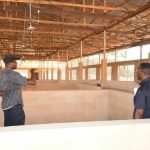
In this Centre, a large portion of land is allocated to animal husbandry: piggery, fishery, and poultry. The poultry farm consists of broilers and layers with the capacity of ten thousand (10,000) in each. There is also a chick brooding house and egg store building. The piggery farm has a capacity of seven hundred and fifty (750) heads. Included in the farm are three batteries of fish ponds with a total capacity of fifteen thousand (15,000). A Farm Store and Abattoir are not left out. There is also farm office building that has a reception and four offices for veterinary doctors. In addition to the animal husbandry, the Centre also has a skill acquisition building that includes carpentry, tailoring, and other skills. There will be an administrative building that will house clinic, offices for doctors and psychologists.


Benefits of the centre of hope program

One might be wondering why Discalced Carmelite Friars in Nigeria are venturing into this unique and challenging project. It is worth noting that this is the first of its kind in Nigeria and it has lots of benefits to the society.

The first benefit that this Centre will provide to the society and Nigeria as a country is that it will address the gap that exists in the criminal justice system in Nigeria. There is no centre in Nigeria where victims of crime can be treated or rehabilitated. The Centre of Hope thus becomes a place where this gap is filled. Secondly through the services that this Centre will be rendering, it will greatly reduce recidivism that is found in the country today. It must be noted that there are many people in the society who are not as privileged to have a good family background or a good level of education. Hence the society cannot expect the same moral standard from them. So, with the services that this Centre will render, people who have nowhere to go upon release will now have a place they can fall back on, that will cushion the effect of prison and crime in their lives.

Thirdly, the wide range of skills that will be available for acquisition will make the Centre a hub for various highly sorted skills in this part of the country, such as tiling, mason, tailoring. Hence it will provide a lot of employment for people who would otherwise not be employed and also reduce crime in the society to the barest minimum. Finally, most of the candidates that will be in the Centre are those who are really vulnerable, those who have no one to take care of them. The Centre is meant for the poor and all the services that will be rendered will be free while the candidates work hard to make the Centre self-sustainable. Hence it is hoped that the Centre will provide a lot of employment opportunities and skills for those that will encounter the Centre.


A word of thanks

It is crystal clear that the Centre not only benefits returning citizens but also provides employment for experts in different fields of study. Indeed, CAPIO team and the entire Discalced Carmelite Friars in Nigeria are happy to embark on this singular project and waits eagerly to see that it comes to completion and operational. Immense thanks to CEI for their funding support.  We also express our immense gratitude to the people of Italy who give their 8Xmille taxes to CEI to support initiatives as this throughout the world.

We are also grateful to Father General, Saverio Cannistra, OCD and his Definitors for their unalloyed trust and support.  We cannot thank enough Fr Jerome Paluku, OCD, the General Secretary for the Missionary Corporation Office, for his maximum support and guidance. CAPIO team remains grateful to the Discalced Carmelite Vicariate in Nigeria for their unmitigated support. The Centre of Hope is also made possible by the support from other donors. To these donors we say thank you. Finally, to others who, reading this article, will want to support the CAPIO apostolate, or collaborate with CAPIO in this work, our doors are widely open and we thank you immensely in advance.

As we informed you some time ago, the Saint Teresa of Jesus Catholic University of Avila, together with the Diocese of Avila, the Discalced Carmelites and the Eichstätt-Ingolstadt Catholic University (Germany), have organized the International Congress “An exceptional Woman. Fifty years since Saint Teresa of Jesus declared a Doctor of the Church “.

The Congress will be held simultaneously in face-to-face and virtual mode and will take place between April 12 and 15, 2021. In addition, given the international nature of the meeting, you will be able to follow it live in Spanish, English and German.

Detailed information about the Congress, including the program, information about speakers, and steps to take to enrol, can be found on the Congress website: http://congresosantateresadoctora.es/


triptico_congreso_santa_teresa_doctora

DOWNLOAD PDF


On December 11, 2020, the church of our parish in Varapuzha, belonging to the Province of St. Pius X of Manjummel, was declared a Minor Basilica by the Holy See. The news was communicated to our Provincial, Fr. Thomas Marottikaparambil, OCD, on January 28th of this year.

A celebration is anticipated for the public declaration on March 13 and Mons. Joseph Kalathiparambil, Archbishop of Verápoli, will preside.

Varapuzha is in the periphery of the city of Kochi, which belongs to the Indian state of Kerala. Our presence there dates to the year 1673 and the community is formed currently by five brothers. The first Carmelite missionaries who arrived there called Varapuzha “the little Rome of the Orient.”

The patron saint of the parish is St. Joseph. The “Carmelite Welfare Center,” founded on August 15, 1974, is attached to the parish. This social assistance center serves women from poor families in the region. Since its foundation, the CWC has supported an enormous number of families offering work and stable salaries to women who are received by the center and who work in sewing.

At this time as we congratulate the Manjummel Province, we also pray for the presence of Teresian Carmel in India and we hope that this declaration will be spiritually fruitful.