Each linguistic group takes its turn to preside at the eucharist. Today It was the turn of the French group. The president was Fr. Christophe-Marie ocd, Provincial of the Paris Province. His homily offered three words for us to reflect upon: listening, conversion and communion. This synodal process should lead us to the fulfilment of Christ’s prayer: “That we all be one”.
Today concentrated on Fr. General’s report of the state of the Order. The morning was dedicated to the listening to this report of the state of the Order by Fr. Saverio Cannistra. In the afternoon, the chapter members met in various language groups to discuss the report. At 17.30 we came together in the Chapter room to discuss together with Fr. General.
His report, more than an observation, was an expression of someone who for twelve years has dedicated himself to the service of the Order. Father Saverio highlighted four changes in the Order:
We Carmelites are becoming more apostolic and less contemplative.
Community life is losing its central importance.
The formation of our young friars is more orientated to priesthood and to pastoral ministry than to religious growth.
The present differences between the regions and the circumscriptions are really testing the unity of the Order.
After these observations Fr. General presented the present challenges that the Order must face and to which it must reply concretely; not only rhetorically: interculturality, formation, communion between the three branches of the Order.
The complete report has been published on our website.
Today’s eucharist was presided by our Father General. Here are some elements from his homily: the interior man looks towards a horizon. He goes directly towards the interior. But this is the fruit of a journey. The interior man is naked and experiences the joy of God. He is loved by Christ and by the Father. He is also someone who loves community.
The entire day was given over to listening to some of our young confreres, that is to say, who are under forty. The challenge put before us today was to listen. To have these young Carmelites was new, it has never happened before at a Chapter. The General Definitory invited nine friars from all over the world to come to the Chapter for one day with the goal of sharing with us, in a concrete way, two challenges or problems proper to their geographical area, and to give two suggestions for the renewal of the Order. Thus three brothers came from Europe, two from Asia, two from Africa and one from North America and one from Latin America.
Each of our young brothers had twenty minutes to share their desires and aspirations with us, as well as their difficulties and questions. They did this with trust, sincerity and with a good heart. After each one spoke there was a period of dialogue with the Chapter members. The assembly took seriously the words and ‘provocations’ of our young friars and replied with the same trust and goodness …. and ‘provocation’.
A noteworthy element from this day was the profound unity among all the speakers, no matter where they came from. We cite three hopes that were at the same time challenges: an intimate life with God, community life and initial and on-going formation.
At the end of the day, Fr. General thanked our young confreres for their ‘visitation’ and their words. It was good to speak with them and not only with them. At the beginning of this Chapter, we recalled the beauty of our vocation and the fact that we also here in Rome are working for these young friars.
The mass this morning was presided by our confrere, Mgr Oswald Escobar OCD. His homily can be summed up in these words: a spirit of discernment and to listen attentively to the Lord.
At 9.00 a.m., we met in the large Chapter meeting room where we had a morning of spiritual renewal. We began by listening to Mgr. Libanori, SJ, auxiliary Bishop of Rome. His meditation was based on 1 Kings 19, in which the prophet Elijah fled into the desert and walked for forty days and forty nights until he reached the mountain of the Lord. We recall these phrases: the fact of being chosen and invited by God gives us the capacity to return to Him who invited us. However, we must go into the desert, where God speaks, where God made an Covenant (with Moses). Mgr. Libanori made these practical conclusions: we must keep hope alive for the sake of our world. To this end, it is perhaps the time to adopt the position of the Apostles who were together in the Upper Room with Mary, as they waited for the coming of the Holy Spirit. Only the true contemplative can discern and announce the ways of the Lord.
In the second part of the morning, our confrere, Mgr. Oswald Escobar, OCD, shared with us something important, along the lines of Pope Francis, “Going out from Carmel”. He mentioned the many anniversaries and centenaries that will occur during the next sexennium, he then spoke of two unique events in the history of our Order which took place during the last sexennium: for the first time, the Order in its diverse branches read together and on a worldwide scale the writings of our Mother, and then all the friars have reread our Constitutions. Mgr. Escobar sees three challenges for our Order today: to commit ourselves to the new evangelization, to move away from self-reliance to solidarity with others and to look after those whom God has put into our care (sheep or friars).
This afternoon, the friars met again in small groups to discuss what had been said in the morning. Then at 5.30, in the Chapter meeting room, every group shared the questions raised from the reports of the various structures linked to the central Government, as well as specific questions from some geographical areas.
The day concluded at 7.00 pm. We then prayed vespers together.
The Chapter members met at 7.00 in the morning in the chapel to where they recited morning prayer together, followed by a time of quiet prayer. Then at 9.30 Fr General, Saverio Cannistra, formerly opened the General Chapter.
Fr General began by referring to the Chapter Assembly (those present and those absent). Our brothers from India are at the Teresianum where they are completing their quanrantine, but were able to join the Chapter using Zoom. It was noted that for the first time more than half of those present are attending a General Chapter for the first time.
The Chapter carried out a number of elections regarding the way the Chapter is run:
Secretary to the General (P. Angelo Lanfranhi) and his assistent (Fr. Grzegor Firszt);
Four moderators of the sessions (Fathers Javier Meno Lima and Johnnes Gorantla, who are Definitors and Frs Fausto Lincio, Provincial of Lombardy and Lazaro Iparraguirre, Provincial of Navarre.
The Assembly approved the Norms for the celebration of the General Chapter, the daily timetale and the programme for the Chapter.
Fr General then spoke about some of these matters. In particular, he explained that this year the Definitory wanted to give more space to the group meetings and to the working groups, be they languague groups (english, french, spanish, itlalian) or geographical groups.
At 12.00 we celebrated the Eucharist. It was presided by Mgr. Jose Rodriguez-Carballo, the Secretary to the Congregation for Institutes of Consecrated Life and Societies of Apostolic Life. In his introduction to the Mass he pointed to the Holy Spirit, and insisted on the fact that during the Chapter we must put the Holy Spirit into our minds and hearts and also in our votes. His homily concentrated on three principal ideas: joy, to be profets of hope and reciprocal support.
This afternoon the chapter members met in working groups.
It is with the words of Father General’s video message of 9th August that we would like to begin this Communication, slightly different from the usual. As you know, the General Chapter will be held in Rome from Monday 30th August. A total of 95 Carmelite friars from 5 continents have been convoked. To these friars, we must add some invitees: 4 non-clerical friars, who will have a day to testify about their daily life, and 6 young friars (whose dates of birth fall between 1982 and 1993), who will share with the Capitulars their joys, aspirations and their vision of Carmel and its future. In addition, there are 11 other friars who will be at the service of the Chapter: secretariat, translations, liturgy, communication, canon law, etc.
It is indeed the entire Order, in its international dimension, coming together to celebrate this great ecclesial event of the Chapter. It will be a matter of listening to “what the Spirit says to the Churches” (Rev 2:7), in order to “discern the signs of the times” (Mt 16:3) and then “to become witnesses [of Christ] in Jerusalem, throughout Judea and Samaria, and to the ends of the earth” (Acts 1.8). That is, using the words of our Holy Mother Teresa: “I was thinking about what I could do for God, and I thought that the first thing was to follow the call to religious life” (Life 32.9).
The Covid-19 pandemic and its various restrictions have made the preparation for the General Chapter a little more complicated this year. Some friars, unfortunately, will not be able to make the trip. As for others (Brazil and India), it took a lot of energy and appeals to obtain the necessary clearance. ”La paciencia todo lo alcanza.” Some of the Capitulars are already in Rome (or in Italy) in order to carry out the quarantine required by the Italian Ministry of Health before the opening of the Chapter. The friars of the Teresianum have made available to them 40 rooms in one wing of the building.
The evening of 29th August, everyone will gather at La Salle House. As the name implies, this is a facility that belongs to the Brothers of the Christian Schools. It is a 25-minute walk from the Vatican, on the Via Aurelia. It can accommodate 180 people and has the necessary facilities to host a General Chapter. It is in this place, with its beautiful 5-hectare park, that the friars will celebrate the 92nd General Chapter.
To foster communion with all of you, we would also like to inform you that you will be able to follow the proceedings of the Chapter through three means:
The information will be available in 4 languages: English, Spanish, French and Italian. Each day (at the end of the day), we will provide you with a report of what went on during the day. We will inform you about the results of the elections as soon as they are available. NB: if you do not have Facebook or Twitter, this is not a problem. On our website, at the bottom of the page, you will find two windows that will enable you to consult all the contents.
Let us therefore continue to pray for this General Chapter and for the whole Order, that we may fully live out these words from the Acts of the Apostles: “The Church was at peace: it was being built up and walked in the fear of the Lord, and with the consolation of the Holy Spirit it grew in numbers” (Acts 9.31).
On Sunday, June 6, at the Carmel of Peace (Mazille, France), Buddhists, Jews, Christians of various denominations, Muslims and non-believers met to reflect on the theme of forgiveness. Because of health measures, the assembly had to be significantly reduced. The topic of this year’s meeting, forgiveness, was born in 2018 after the various terrorist attacks that have marked France in recent years.
The Carmel of Our Lady of Peace, inaugurated in 1971, is the work of the Catalan architect José Luis Sert (1902-1983), a disciple of Le Corbusier. José Luis Sert was also the architect of the Maeght Foundation in Saint-Paul-de-Vence and the Joan Miró Foundation in Barcelona.
The first interreligious meeting at Carmel in Mazille was held in 2006. It was born from the desire of the Diocese of Autun to engage in this journey of dialogue according to the example of the Assisi meetings. The first meeting began with a time of prayer, at the same time but in different places, and was followed by an exchange of what is prayer. Already engaged in ecumenical dialogue, the Carmel of Peace immediately became the natural place for these interreligious encounters. The nuns are fully committed to it.
This agreement of the Mazille Carmelites finds its source in prayer, especially in the Liturgy of the Hours: “The Liturgy must be a school of peace, because it is a school of authenticity of life. It only makes sense in relation to daily life, otherwise there is no reason to gather so many times during the day to pray. The Liturgy is a necessity, a spur, otherwise it is a sleeping pill! At the heart of the Liturgy is a Word, that of Christ who killed hatred and conquered peace.”
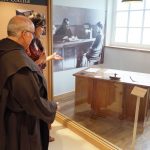
On the 2nd of June, 2021, the Memorial to Fr Jacques was inaugurated in the Avon monastery (Paris, France). The day began with Mass, at which presided Monsignor Nahmias, Bishop of Meaux. Also present were our Father General and Monsignor Follo, permanent observer of the Holy See at UNESCO.
Afterwards, an outdoor meal was shared in the monastery gardens. It was a time of sharing and conviviality. There were around one hundred people representing all the “nuances” of Father Jacques: Carmel with its friars, nuns, members of the Secular Carmel and the Carmelite family; the Jewish world through various associations (Yad Vashem, Holocaust Memorial), the local Jewish community and a representative of the Embassy of Israel; the political world with the Mayor, his Deptuty. Senator Ouzoulias, whose grandfather came to meet Father Jacques about the Resistance, and other officers; Father Jacques’ family, descendants of people who knew him well, former students of the Petit Collège; people from the worlds of education, the local military and civil society.
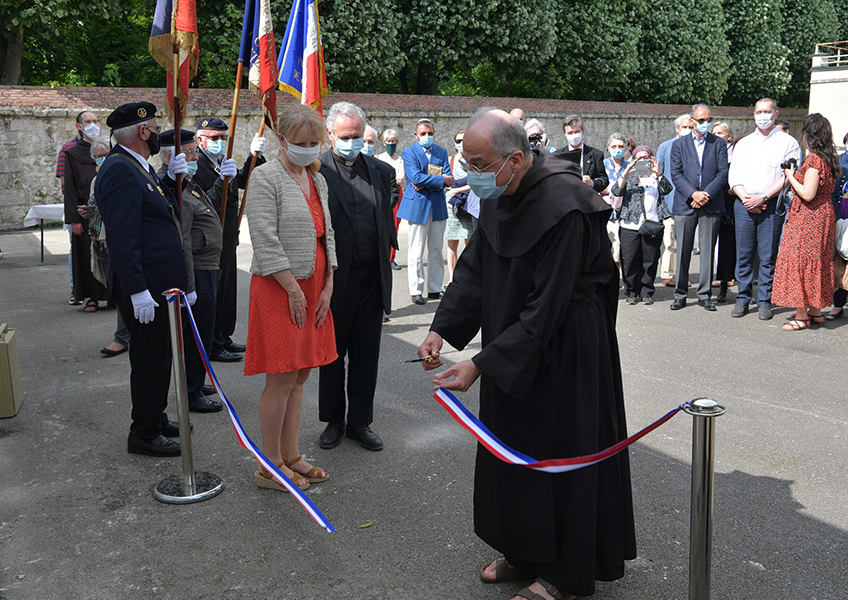
At the cemetery of the Avon monastery, where Father Jacques is buried, the Father Provincial, Christophe-Marie Baudouin, gave a welcome speech to the 150 people present. There was the laying of a wreath of flowers from the town hall and a moment of recollection accompanied by the musical group NoteSolidaires. Then, in the courtyard of the monastery, the Mayor of Avon, the representative of the Embassy of Israel, the representative of Yad Vashem, as well as a former student of the Petit Collège of Avon, who was present on the day of the arrest of Father Jacques and the three Jewish children (January 15, 1944), each took turn in speaking. Finally, our Father General cut the ribbon to signify the official opening of the Memorial. The first visits could then begin while an honorable wine was served for all participants.
The Memorial is open during the week, with free access, from 2:30 pm to 5:00 pm on Wednesdays, Thursdays, Fridays, and Saturdays.
Father Jacques de Jésus (1900–1945) joined the Discalced Carmelites in 1931. In 1934, he founded the Petit-Collège Sainte-Thérèse de l’Enfant-Jésus in Avon. There he implemented modern and innovative teaching methods based on children’s trust and responsibility. Involved in the Resistance against the Nazis, he made the Petit-Collège a place of welcome and transit for Resistance fighters and Jews. In February 1943, he welcomed three Jewish children to the school. After a complaint, the Gestapo invaded the school on January 15, 1944. The three children and Father Jacques were arrested. The children died in Auschwitz. Father Jacques was deported to Mauthausen-Gusen in Austria. When the Americans liberated the camp, he was elected as a representative of the International Committee of Deportees. Exhausted, he died on June 2, 1945. He is one of the Righteous of Nations and his cause of beatification has been introduced.
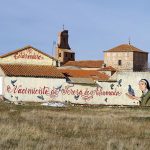
The residence of the Ahumada family in Gotarrendura (Avila, Spain) was one of the favorite places of entertainment for the 16th-century nobility. It was the dowry of Beatriz de Ahumada, Teresa’s mother, which Alonso de Cepeda, her father, completed by buying a dovecote. This dovecote left its mark on the soul of The Mother to the point that she called all her convents “Palomarcicos” (dovecotes) and her nuns “palomas” (doves). Saint Teresa inherited this property at the express wish of her mother, who knew her affection for the dovecote. Today, out of the whole property, only a limited section remains, with its orchard and its dovecote.
On Saturday, June 12, a theatrical visit to Saint Teresa’s dovecote took place in Gotarrendura. It was an imaginary visit by Teresa of Jesus to her property. The Saint gives a tour of her property to the nun accompanying her and takes the opportunity to relate her memories of her youth. The climax of the performance comes at a time when Saint Teresa, walking with her father, evokes the four ways of watering her garden and the degrees of prayer.
This performance was created by a group of teachers and students from the Catholic University of Avila (UCAV). It is the result of research work on “La Colombaia Teresiana” by Professor María Jesús Carravilla, as part of the commemoration of the 50th anniversary of the Doctorate of Saint Teresa. The preview took place on April 12, during the “Mujer excepcional” International Congress. The adaptation and staging were done by Mr Juan José Severo Huertas.
On the same day, the garden and fountain of Santa Teresa were inaugurated.
Dr. Patrick DiVietri is a member of the Secular Order of Discalced Carmelites, a Pastoral Counselor, and an ACPE Psychotherapist Member, a professor of Philosophy and Theology, a musician, a composer, an author, and a family man. He is the Executive Director of the Family Life Institute (Manassas, VA, USA). Above all else, he is a man whose life has centered on his desire to do the Will of God first and always. In that Will, his musical work too has been created for the love and glory of God and the benefit of those.
Dr. Patrick DiVietri is the author of the Cantata Carmelita. Poems and music composed by Dr. DiVietri, the Cantata Carmelita is meant to be a reflection upon various types of unity and their binding agent, love. Love is considered not only as a desire for union with the good but also as the power, which above all others forms integrity within a person, binding him to others and God. This personal integrity, which results from the acquisition of virtues, enables a man to have self-possession. Only then is he free to give himself to the beloved and to God and to dedicate himself to those things which are considered to be noble and worthy of man’s dignity.
The Cantata begins and ends with poems in which individuals speak to God about their love and desire to be united with Him. The first poem is about “a young man” who desires to be “like God” and attempts to stand alone against evil for the sake of the good. The second poem is about Teresa of Avila, a saint, who makes a similar stance, though not alone. These two are united by a common purpose: to stand against evil out of love for God and to encourage others to do so as well. To accomplish this goal, both decide to conform their entire lives to the will and love of God.
Founded on 31May 1946, our Carmel is celebrating this year our Diamond Jubilee of Foundation, 75 years of prayerful presence in the Archdiocese of Lipa (Batangas, Philippines). It is a very rare grace that our Founder was Bishop Alfredo Verzosa and that his Auxiliary Bishop was Bishop Alfredo Maria Obviar. Both bishops are now Servants of God on the road to Sainthood. Bishop Versoza wrote to Mother Theresa of Jesus: “I thank you most effusively, dear Mother, for your work in my diocese and for having founded in it the beloved Carmel of Lipa, the child of my eyes and the repose of my heart.”
Who would have thought of founding a Carmel in 1946 when Lipa was one of the most devastated areas during the war that had ended less than a year before? It needed the compelling faith of hidden saints. The founding group from Manila Carmel consisted of Mother Theresa of Jesus, Sr. Mary Cecilia of Jesus, Sr. Mary of St. Joseph, Sr. Mary Anne of Jesus, Sr. Alphonse of Mary, Sr. Mary Elizabeth of the Sacred Heart and Sr. Carmen of the Good Shepherd. The Titular Patroness of our Carmel is Our Lady, Mary Mediatrix of All Grace and the Secondary Patroness is our Holy Mother St. Teresa. Our Carmel’s Charism is God’s Merciful Love. It is with deeply grateful hearts that we thank God for our 75 years of Carmelite presence in Lipa. The growth of our monastery is a testimony of faithful love and service to Holy Mother the Church, as we give our lives for souls, especially for priests. We are now 22 nuns, with promising young vocations.
In closing, we prayerfully reflect on the words written by Mother Mary Cecilia of Jesus, our foundress, in 1970: “Lipa Carmel is the Carmel of God’s Merciful Love. The years that have passed have been the unfolding of God’s mystery, the condescension of Love and Mercy…Yes, God is the Maker of history. Sunlight and shadow show forth His glory. Here He has childlike souls whose weakness will make His power manifest. We press on to the goal. With expectant hearts we look up to our Holy Mother St. Teresa, top renew in us her double spirit so that like her, we may be valiant, generous and true daughters of the Church.”
The meeting of the Federation of Carmelite nuns of French-speaking Africa was held in Kinshasa from May 3 to May 20, 2021. The federation consists of 11 monasteries located in 6 countries (Cameroon, Burundi, R.D.C, Congo Brazza, Ivory Coast, Rwanda). Twenty-one nuns were able to travel, defying all obstacles (only the Carmel in Guitega, Burundi, could not travel due to travel restrictions).
The elections were held. Sister Aténaïz of the Holy Spirit of the Grand Bassam Carmel was re-elected for a second three-year term. Sister Françoise Aimée du Crucifié of Kigali monastery is her first councellor and Sister Thérèse de Jésus of Lubumbashi, RDC, the second. Sister Marie Irène de Jésus of Yaoundé was elected third counsellor and bursar. Sister Marie Clémentine de l’Enfant Jésus of Kananga, RDC, is the fourth counsellor. Sister Marie Claver of the Good Shepherd of Cyangugu Rwanda was elected substitute.
Father General Saverio Cannistrà and Fr. Bergara, Procurator of the Order, reached the Federal Assembly on the evening of May 4. Father General gave a lecture on “Formation of Discalced Carmelite nuns in the light of the new directives in The art of seeking the face of God“, and answered the questions of the nuns present. During this Assembly, the nuns were able to reflect together on formation with a view to drawing up their own Ratio.
On the eve of Father General’s return to Italy, the Friars and Sisters of the Commissariat organized a great evening of celebration in his honor: food, songs and dances of the country formed part of it.
After the departure of Father General, Fr. Bergara stayed for a week to give a session on the contemplative life lived in actual fact according to the spirit of Carmel beginning from the latest documents of the Magisterium. The present challenges facing each of the Carmelite communities gave rise to many questions and meetings.
The Nuns had the joy of a fraternal visit from Cardinal Fridolin AMBONGO, Archbishop of Kinshasa. He shared news of his diocese with them and told them again how beautiful the contemplative vocation can be.
Last Saturday, May 15, we received the news of the death of Father Domingo (Angel) Fernandez de Mendiola, OCD, at the age of 96, in the monastery of Vitoria-Gasteiz (Spain). He joined the Carmelite novitiate in Larrea (Spain) in 1939. Doctor of Dogmatics and History of the Church, author of a dozen works, director of the Institutum Historicum Teresianum (Rome), professor and rector of the Teresianum (Rome), several times Provincial of the Province of Navarre, he marked the Order and the Church particularly with his 25 missionary years in India: Professor and last European Rector of the Pontifical Seminary of St. Joseph in Mangalapuzha (Alwaye), the largest seminary to date, one of the promoters of the creation of the Pontifical Institute of Theology and Philosophy in 1972, the first president of the Pastoral Orientation Center (POC) in Kochi, which will become the seat of the Catholic Episcopal Conference of Kerala.
Cardinal George Alencherry expressed his condolences to our Father General and thanked him for all Fr Dominigo had given to the Church in India: “It is with sorrowful heart that I learned early this morning of the death of Fr. Domingo Fernandez OCD in Spain at the age of 96. Father Domingo led and presided over the formation of seminarians for about 25 years with the zeal of a great missionary, creating a community of priests deeply devoted to Jesus and committed to their faith. (…) The Discalced Carmelites contributed immensely to the formation of priests in Kerala. Erudite, kind and affectionate, Fr. Domingo was appreciated by all his students and teachers. He was humble, unperturbed, extremely courteous to all those who came into contact with him. The Church in India is deeply grateful to him.”
Let us thank God for this gift of our brother’s life to God.
Our brother was born on May 11, 1921 in Sittard (Netherlands). Today he lives in Rome at the Teresianum. His is a life dedicated to God by means of teaching that should be celebrated: Doctor in Moral Theology, Professor at the Teresianum, at the Urbaniana Pontifical University, former Dean of the Faculty of Moral Theology at the Lateran University, Consultor for the Congregation for the Doctrine of the Faith, Life Member of the Pro Vita Pontifical Academy.
As was fitting, Carmelite friars from various Roman communities, nuns and friends were companions at his feast. Unfortunately his family could not be present, because of travel restrictions due to covid. The Eucharistic celebration was presided over by His Eminence Cardinal Giovanni Battista Re, current Dean of the College of Cardinals. During his homily, the Cardinal recalled the political and ecclesial vicissitudes of the century in which our brother lived, his life as a religious and as a researcher, and concluded with an invitation to prayer, a return to the essentials of life, despite all the changes.
After the Eucharist, everyone came together (in compliance with health norms!) to share a fraternal meal. One hundred years, is quite something to celebrate!
Best wishes, Father Boniface, and may God fill the years to come with his grace.
As every year, the Interprovincial Council of India has organised, even at present, a second noviciate of 7 weeks in view of solemn vows. All the brothers preparing for solemn profession this year have come from all over India to take part: a total of 25 friars. It took place in Pushpadan, a Carmelite spirituality center which belongs to Manjummel Province in the city of Kozhikode. Previously, the second novitiate was organized by each province in turn. But in recent years, this place was finally chosen because it was more suitable.
Father Antony Ittikunnath is in charge of the program and is assisted by the priests in the community as well as many other qualified people from all the other provinces of India. Father Johannes Gorantla, the Definitor General responsible for India, visited the community on April 28 and gave a lecture about the Declaration on the Charism.
Despite the difficult situation of Covid in India, the provinces have not abandoned the course. The 7-week program usually ends with a retreat to prepare for the solemn profession. After the program, all the participating friars return to their respective provinces to make their solemn profession.
On April 16, 2021, the UNESCO Executive Council approved the candidacy of Thérèse of the Child Jesus for the 2022/2023 biennial, on the occasion of the 150th anniversary of her birth. It should also be noted, by the way, that 2023 will also be the year of the 100th anniversary of her beatification (29/04/1923). This application was submitted by the French State and the Lisieux Basilica. For the 2022/2023 biennial, UNESCO wants to “honor the memory of the people who have worked in the fields of peace, education, science, social sciences and communication”. Thérèse competed with 60 personalities from 47 states. Among her competitors were three other Catholics: Copernicus (Poland), Nerses (Armenia) and Mendel (Czech Republic).
In mid-April, Thérèse won the first stage! She is the only woman among the 4 nominations selected. She will therefore represent France at UNESCO! Belgium and Italy support this candidacy. UNESCO stated that “the celebration of this anniversary will contribute to giving greater visibility and justice to the women who have promoted, through their actions, the values of peace”. Given the celebrity of Thérèse of Lisieux in the Catholic community (the city of Lisieux is the second place of pilgrimage in France after Lourdes), the celebration of her anniversary can be an opportunity to emphasize the role of women within religions, in the fight against poverty and in promoting inclusion.
A French woman saint, with world influence, a Doctor of the Church: UNESCO could soon honor little Thérèse as a World Heritage Person. This is a surprising and extraordinary message that heaven is giving us in these times of the pandemic. However, it will not be until November 2021 that we will know if Thérèse will be officially honored by UNESCO.