The “Our Lady of Mt Carmel” Association of monasteries of Discalced Carmelite nuns of Peru met together for almost a week from the 20th to the 25th of May this present year.

On the 20th, 21st and 22nd of May, the course was held for Prioresses and delegates in two segments:

In the mornings, we had formation conferences, via online, with Fr Rafal Wilkowski OCD., Secretary of the General for the nuns, who developed very interesting topics every day:

  • First day: The service of authority in communities of Discalced Carmelite nuns.
  • Second day: Human formation
  • Third day: Community Project

We Sisters were left very happy and grateful to Father Rafal for having kindly agreed to give us these lectures and for the clarity and simplicity of his exposition. God reward you father.

In the evenings we were assisted by our Discalced Carmelite friars, Fr Alfredo Amesti ─Commissar in Peru, Fr Ángel Zapata ─Ecclesiastical Assistant, and Fr Pedro Zubieta ─Canonist, reading and reviewing in groups the texts of our future Statutes, which had been previously distributed for study in the communities, in order to be presented to the Assembly for approval.

On the 23rd, 24th and 25th of May was held the IX ORDINARY ASSEMBLY, with participation of the whole member monasteries (12), represented by their Prioresses and Delegates.

On the second day of the Assembly, elections were held with the following results:

President: M. Liliana de la Sagrada Eucaristía, from the monastery of San José of Arequipa

First Counsellor: M. Elena de la Reina del Carmelo from the Nazarenas monastery of

Discalced Carmelite nuns in Lima

Second Counsellor: M. María Guadalupe del Niño Jesús from the Piura monastery

Third Counsellor: M. María de Jesús from the monastery of san Vicente de Cañete

Fourth Counsellor: M. Juana Teresa de la Cruz from the Ayacucho monastery.

Substitute: M. Ketty de Jesús from the Nuestra Señora del Carmen monastery, also known as Carmen Alto de Lima.

And in accordance with the future Statutes that we have approved and which will be presented to the Holy Congregation for approval we elected:

Bursar: M. Edith de Jesús from the Nuestra Señora del Carmen monastery also known as Carmen Alto de Lima.

We ask your prayers so that the Lord and the Virgin of Carmen will accompany our journey for the good of our Association which will soon change its title to Federation, always remembering the words of our mother Saint Teresa of Jesus: “Now we are beginning, and let them strive to advance always from good to better “(F. 29: 32).

In order to offer a better service to the students who attend our pontifical Teresianum Faculty, with help from the General Curia some works of improvement have been carried out in classroom 1, dedicated to Fr Silverius of Saint Teresa, that can extend what is carried out in the Aula Magna.

Thus, all the benches of the classroom have been changed, replaced by others that include a socket for the use of computers in the classroom. The Presiding table has been refurbished and the audio installation has been improved and enhanced. In addition, there has been installed a professional video projector and two tele cameras with built-in microphones for live streaming and recording of events in the classroom, with HD quality. In addition, classroom 1 is now connected by audio and video to the Aula Magna, so that it can be used as an auxiliary space in cases where the latter is fully occupied.

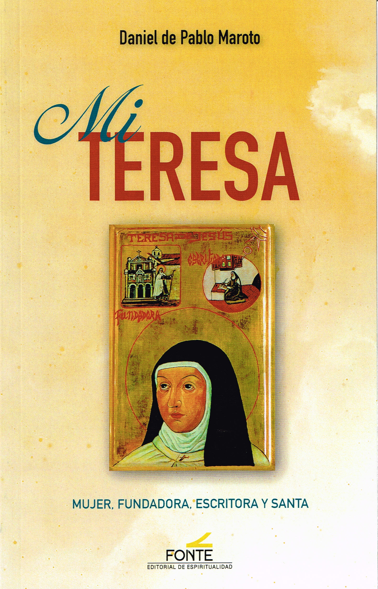
Fr. Daniel de Pablo Maroto presents to readers a new biography of Saint Teresa, from the FONTE GROUP publishing house of spirituality (Iberian Province, Spain). It is a second, edited and augmented edition of what the author already published in 2015 and carries the title of Mi Teresa [My Teresa], as an expression of the author’s personal contact with the saint during many years of study and reflection.

This new edition contains important novelties, such as the inclusion of various data resulting from the research carried out by various authors during the 5th centenary of the birth of Santa Teresa.

In addition to some original discoveries by the author that will undoubtedly generate a debate between the historians and biographers of the saint, the biography faces the question about the topicality of Teresa and wishes to reach out not only to believers, but also to those who approach, with a freedom of spirit and without prejudice, this exceptional witness to transcendence.

About to begin the celebration of its first ten years of existence, MIAS-Latina (Ibn Arabi Society Latina), a secular and independent cultural association, dedicated to spreading knowledge of the work of the great Sufi poet and mystic from Murcia, Ibn Arabi, as well as of other authors and related subjects, held its ninth International symposium at the University of mysticism in Avila, between the 10th and 12th of May. These are annual symposia that have usually been held, almost always, in spring, in the city of Murcia.

There have been other symposia, during the last years, in cities such as Seville or Barcelona, but this year, 2019, has a special meaning for MIAS-Latina, as we organize and celebrate with the collaboration of CITeS and its University of mysticism.

The symposium has been in preparation for just a year now and counted on the participation of 19 specialists, both in the work of Ibn Arabi and other related authors, because what is intended in the symposium is to discuss the relationships between the different forms of language, and very particularly poetry, and attempts to express mystical experience and knowledge. An experience as human as universal.

Poets such as Fernando Pessoa, Juan Ramón Jiménez, Clara Janés, Saint John of the Cross or Saint Teresa of Jesus, in addition to the great poets of the Persian Sufi tradition, or the Beguines such as Hadewijch of Antwerp, among others, were taken into consideration during the symposium. Likewise, although the centre of the content revolved around the Sufi and Christian Mystics, it was not wanted to lose sight of a broader perspective when speaking about Hindu poetry (for example, Râsa Lîlâ) or of the Primitive and Indian cultures (as in the inaugural conference).

During the course of the symposium, the annual awards of MIMAS-Latina were given to the Portuguese philosopher and writer Paulo Borges (2019 Taryumán Prize), to the musician and researcher Eduardo Paniagua (2019 Barzakh Prize) and the philologist and librarian Luisa Mora, representing the Islamic “Félix María Pareja” library of Madrid (2019 Hikma Prize).

Sometime during the Creation – shall we say around the fifth or sixth day? – God was passing the intersection of the 2nd Parallel North and the 16th Meridian East. I know of course that at that time the global reference points had not yet been quite so closely defined. And the Good Lord certainly didn’t need them to guide Him over the earth, which He had just created. But it’s just to help you understand precisely where He was at the time. For it was here, whether through tiredness from all the work of the previous few days or simply because He didn’t as yet have seven billion people to worry about, that He decided to stop and rest a while, and fell asleep. However, He hadn’t noticed that there was a hole in the bottom of the sack of His immagination, from which there issued rivers and waterfalls, mighty trees, precious stones and creatures of every shape and colour. And when He awoke, it was too late to put everything back in the sack again. In fact the monkeys, swinging through the lianas, were by now already playing with the sack from which they had just emerged. God smiled in amusement and decided that the monkeys had turned out really well. He called what he had created the “Forest” and decided that he would need someone to take care of all that beauty. So then he created the pygmies, one of the most gentle and peaceable peoples on earth. God gave them the keys to the forest and left that place, somewhat reluctantly, in order to start devoting himself to the problems of mankind, who soon after that had built their first cities.

All those wonderful things, just around 500 km away from where I was living, surely deserved a personal visit. And so we decided that a little trip to this part where God had rested awhile so many centuries before, might be the ideal spot for us also take a little break and relax a while, after the stresses and strains of the first term of the academic year.

First stop on our long journey was Bambio, close to the Lobaye river, one of our favourite stopping off points in the region. No sooner had we arrived than the family of Brother Régis, in addition to putting their whole house at our disposal, had offered us excellent locally produced coffee. The sun hadn’t yet set, and so we took the opportunity to have a good dip in the river. The next morning, before continuing our journey, we celebrated Mass in the village church. But of course in Bambio it is impossible to celebrate Mass except in a solemn manner, and all the people turn up in large numbers. Priests are rarely seen here, so you can imagine what it’s like if you arrive with a whole convent full of Brothers. The ‘continental breakfast’ provided in Bambio, needless to say, included manioc and fresh game, hunted the day before.

In the afternoon we arrived in Belemboké, a mission station serving only the pygmies on the edge of the great forest. The only non-pygmies present in the village were two African priests, Padre Anselm and Padre Serge, three Latin American sisters, Sister Melanie, Sister Alba Maria and sister Margarita, and the teacher at the primary school. The pygmies, as my brother missionaries explained to me, are the true inhabitants of Central Africa. It is here that they were truly placed by the good Lord, whereas the other inhabitants of the country are in fact members of the Bantu peoples, who arrived in Central Africa as a result of a series of migrations. The parish and the village in Belemboké            came into being at the same time in 1973, on the initiative of Padre Lambert, a brave French missionary. He had noticed that the pygmies very often lived in subjection to overlords belonging to other ethnic groups, almost like slaves. In creating a parish for the pygmies alone, this priest at the same time in fact enabled the birth of a pygmies-only village, as all around the church they began to build their typical little huts of woven branches, covered in leaves, in the shape of an igloo. And with all new respect to those who, somewhat hastily, maintain that evangelization was one of the causes of the extinction of indigenous cultures, in reality this priest gave the pygmies, along with the Gospels, their true liberty and dignity, preserving both their culture and their traditions. And as one of the most interesting aspects of pygmy culture, in a context in which polygamy was widely practised, he found that they observed a rigorous monogamy which married extremely well – and it is well worth pointing this out – with the Christian view of marriage. Needless to say, though, the initiative of Padre Lambert did not altogether please those who had thereby lost their free labour force, and he received a number of threats. But the man who intervened and came to his defence was Bokassa, the ‘famous’ ruler of what was then known as the Central African Empire. He declared that if anyone did any harm to this priest, it would be as though they had done the same thing to the Emperor himself. From then on these little lords of the forest were able to continue living happily and in peace, though of course they knew nothing of the umpteenth, and dubious, peace accord for Central Africa that had just been signed in Khartoum.

After spending the night among the huts of the pygmies, we set out for Bayanga, where we planned to visit the Dzanga-Sangha National Park. This park lies deep in the forest of the Congo River basin, in the furthest southwest extremity of the Central African Republic, wedged between Cameroon and Congo Brazzaville. The objective of our excursion was to locate a colony of elephants and observe them from close up. We travelled on foot through a stretch of dense forest. Our guide, assisted by a pygmy at the head of our group, gave us some instructions as to how to behave if we should come face to face with an elephant or a gorilla. As for the hippopotamus, he had no particular instructions to give us, but simply told us that it is better not to come face to face with them at all. In the end he asked us to remain silent to avoid attracting the attention of the animals. And my confreres and I immersed ourselves in a silence still stricter than we are required to observe in the monastery, in the evenings, after the prayer of Compline. A few metres further on, while crossing barefoot over a small stream, we saw huge footprints in the ground. Our guide was not kidding us – the elephants had indeed passed through here shortly before us. After almost an hour’s walking, we climbed up onto a viewing platform built specially for the purpose of watching these most magnificent of God’s creatures, which were accustomed to come here to a watercourse around midday to drink. It was an impressive spectacle, far exceeding our expectations. There were around a hundred elephants there. But according to our guide, within this one area of forest they have counted around 4000 elephants altogether. An amazing heritage that makes this little and uncontaminated corner of nature somewhere almost unique in the world, and one that certainly held our attention for several hours.

In the afternoon we headed back north. Once again we crossed through the tropical forest. To describe it as luxuriant would hardly do it justice. Our route followed a little trail of red earth, that seemed to timidly ask permission of the majestic trees and shrubs, with their great leaves, which towered above us with lofty pride like plumed sentinels, as though offended by our very presence. Finally we arrived in Nola, where we spent the night. Nola is a picturesque small town, situated at the confluence of the Kadeï and Mamberé rivers which together form the source of the great Sangha River, the undisputed kingdom of vast numbers of hippopotami. At the point where the two rivers meet there is a small island, covered in large trees and inhabited by monkeys, which was once the site of the town prison. In order to reach the ancient mission station, founded in 1939 and situated on the other side of the river, we had to drive our vehicle onto a barge, bobbing on the river. We arrived almost as the sun was setting and were welcomed by Sister Ines, an elderly Spanish nun who had prepared us a meal of antelope and shrimps for dinner.

Next morning, walking through the town, we were astonished by the sheer number of ‘bureaux d’achat’ selling gold and diamonds on every street corner. For in fact we were in one of the many zones in Central Africa where the ground beneath us is particularly rich in these precious minerals. And it is a painful thing, both to me and to my confreres, to ask ourselves the frustrating question as to why this country, which literally sleeps on gold and diamonds, should be condemned to live in such extreme poverty while others alone are able to profit from its riches.

At midday we arrived in Berberati, one of the largest cities in Central Africa. We were invited to lunch by the youngsters of the Centro Kizito, an initiative established to rescue children and young people who were victims or perpetrators of violence, many of them orphans and some of them former members of armed groups or youngsters who have spent terms of varying length in prison. Sister Elvira, an Italian missionary sister who doesn’t mince her words and cannot stand orphanages, is the originator of this community, which seeks to restore their dignity to dozens of children by helping them to learn a trade, agriculture, music, sport and above all the art of living together without hurting one another. “Sara mbi ga zo – Help me to become a man” is the demanding motto of this ambitious initiative that has been driven with such tenacious courage by Sister Elvira for several years now, with the help of several families and in the face of not a few difficulties. One of my confreres, after visiting the centre, proposed Sister Elvira as president of the Central African Republic, even if only for a single term. I doubt very much if Sister Elvira has any ambitions in this direction, but at any rate, just this year the president of the Italian Republic formally recognised her achievements by awarding her the honorary title of Commendatore of the Order of Merit of the Italian Republic.

In the Cathedral of Berberati we met the young Bishop Dennis Agbenyadzi, who is originally from Ghana and who entertained us by telling us a few of his own missionary experiences, in particular involving the eight years he spent as a parish priest among the pygmies of Belemboké. After this we headed still further north and halfway along our route, made a stop at the Touboutu Falls. Next we arrived in Carnot, another centre of the gold and diamond trade. We were welcomed by Padre André, an elderly missionary originally from Belgium. We visited his church of Notre Dame de la Mamberé which, though sadly now in a poor state of repair, stands like a gem of mediaeval art that has landed by chance like a meteorite in this spot.

Travelling onward towards Baoro, our penultimate stop and the place where we first opened our mission in 1973, we became immersed in a fascinating and animated debate about nature, history, beauty, and the emotions of a European and those of an African… De gustibus non est dispuntandum, as the ancients used to say. But I was not among the ancients here, but among the young, for the most part, and the argument became quite heated, to say the least. In the end, though, my opinions and my aesthetic canons were quite plainly in the minority. So I confessed myself defeated and we moved on to less contentious issues. In Baoro, as guests of our Carmelite confreres, we visited the catechists’ school, which had just been reopened. It was started originally many years ago by our confrere Padre Nicolò, the founder of our mission there, but closed again shortly after. Now it has been revived, thanks to the determination of Padre Odilon, who is dedicating himself with passion to the formation of the ten catechists living there with their families.

As we travelled the last few kilometres back to Bangui I thought back over the places and above all the people we had met during our journey: the missionaries, both men and women, who have fallen in love with this country and who, like hidden diamonds, are working quietly and without fuss for the Kingdom of God. To each of them I had put the inevitable question: “So how long have you been here then?” An indiscreet, even impertinent question, as if I were asking for the combination of a strongbox that didn’t belong to me. The missionary in question would smile and close his or her eyes – as though to show the need to look back over each year spent in that place – and then say the number, humbly yet proudly at the same time, as though it were a secret he or she would have preferred not to reveal, as though it were the number of carats of the most precious diamond, the secret of their own life, given for the Gospel and for this people.

Warmest greetings from Bangui

Padre Federico

On April 25, 2019, during the octave of Easter, Father Edwin Aleluia Aleixo Diniz, OCD died in Bambolim (Goa, India). He was a doctor in dogmatic theology and licentiate in Sacred Scripture and professor emeritus of the Teresianum. Born in Mercies (Goa) on April 8, 1944, professed in the Order on March 19, 1965 and was ordained a priest on April 9, 1972. He has returned to the Father’s house at the age of seventy-five years, fifty-four of them as a religious and forty-seven as a priest.

We remember him with gratitude and entrust him to the Lord. His life has been a gift to the Order of Discalced Carmelites and to the Church, particularly for his contribution to the Teresianum Pontifical faculty. We entrust his soul to the Divine Mercy so that he may rejoice forever in the fullness of heavenly bliss.

As perhaps many of our readers know, it is now possible to consult the articles of the Teresianum magazine online, from its foundation (with the title Ephemerides Carmeliticae) until the last issue of the year 2014, by means of the Dialnet platform and the Catalogue of the Library of the faculty, which can be accessed through the page www.teresianum.net. In short, access can also be made through the Atla platform. Articles can even be downloaded in PDF format.
As regards subsequent articles, it is also possible to access the years 2015 to 2019 through a subscription of €50 (VAT excluded). In the image that accompanies this news, all the necessary data can be controlled.

The Vítor Teresa exhibition, which could be seen last year in Alba de Tormes (Salamanca) and which brought together very significant works on the life of the religious Saint Teresa, will be able to be “kept track of” forever in Salamanca.

The importance of those works exhibited, which have returned to their owners, preventing perpetual maintenance in a joint manner but, in order to immortalize this coming together, the Salamanca Provincial Council has photographed a selection of them and will expose them in the La Salina Palace in Salamanca until the 5th of May.

Subsequently, with the objective that the initiative can continue to be shared, Vítor Teresa in Itinere, [Vítor Teresa ‘gadding about’] composed of large photographs in 24 panels, will become part of the catalogue of exhibitions that the Provincial Council offers, free of charge, to the Town councils of the province.

The original Vítor Teresa exhibition was mounted in the St John of the Cross monastery, promoted by the Discalced Carmelites friars of Alba de Tormes and financed by the Salamanca Provincial Council on the occasion of the Teresian Jubilee Year. From July to December 2018, more than 17,200 people visited the exhibition.

The initial design showed the figure of Teresa of Jesus from a religious perspective through the works of art exhibited and also proposed “a look at the saint in other aspects of her life, such as the great writer she was or even in her most personal facets.”

Contributing to the exhibition were the Discalced Carmelite Friars of Alba, the University of Salamanca, the House of Alba, the Salamanca Diocese, the Cathedral of Salamanca, the Pontifical University, the Provincial Museum of the Junta, the Rodríguez Fabrés Fundación, the Diocese of Ávila, the House of Pastrana, the Archconfraternity of the Rosary, the Alfonso IX Research Group, as well as companies and individuals from Alba.

Catalogue and vídeo:

http://www.lasalina.es/ebooks/Libros/978-84-7797-576-2.pdf

https://www.youtube.com/watch?v=HSRcFaGc-tY

On the 10th of April last – in the famous Church of the Gesù – the Jesuit Fathers of Rome organized and hosted a spectacle of light and sound that accompanied the prayerful reading of texts chosen from the Exclamations of St. Teresa. The production and interpretation were conducted by Silvia Lanzalone (music and sound), Silvia Schiavoni (translation and vocals) and Gianni Trovalusci (musical improvisations), and directed by Emanuela Nepitella.

The objective of the theatrical representation was to bring to the spectator, through Teresa’s own words, God’s love for her she experienced, as well as the Saint’s passionate response in welcoming it. The dramatic resources used, also tried to appeal to the heart of the listeners to realize within themselves this experience of divine Love offered free in Christ and welcomed with stupor and humility.

The show, sponsored among others by the Teresianum Pontifical faculty, was a public success and ended with a beautiful exegesis of the Exclamations by Mgr. Melchor Sánchez de Toca, a native of Toledo and Undersecretary of the Pontifical Council for Culture.

Monsignor Anders Arborelius, the first Swedish cardinal in history and first Carmelite Cardinal of the third millennium, visited the Sanctuary of Our Lady of the Snow in Adro on Sunday, April 7th, on the occasion of the celebrations of the 500 anniversary of the Marian apparition in Adro (1519-2019). Received by Fr. Gino Toppan, the Provincial of Venice, Fr Aldino Cazzago and the community of Carmelite friars, Cardinal Arborelius, or “Father Anders”, as he prefers to be called, presided over a busy mass in the Sanctuary cemetery.

During the celebration of the Eucharist, the image of Our Lady of the Snow was blessed, which is taken on a pilgrimage through the region of Franciacorta during the month of May.

The Holy Mass began with a little surprise: the greeting, in the mother tongue of the cardinal by the small Swedish community present in Franciacorta. Some students of the school, coordinated by the music teachers, encouraged the celebration with great joy. Despite some raindrops that frightened the most fearful, but not father Gino, the weather was finally good, to the delight of the devotees of Our Lady gathered in the sanctuary. In his homily, “Father Anders” stressed that Lent is a moment of joy, in which we walk with hope to holiness, following the model of Mary, companion in the pilgrimage of conversion; “With her,” the Cardinal concluded, “we can move toward holiness and spiritual renewal.”

In the afternoon, “Father Anders” visited the Discalced nuns in Cividino where, while at supper, he received a visit from the Bishop of Brescia, Mgr. Pierantonio Tremolada. On Monday the 8th, Monsignor Arborelius presided at the morning prayer of Our Lady of the Snow School. This visit has been a moment of joy and communion for Carmel, under the patronage of Our Lady (Br. Samuele Donà OCD).

https://www.carmeloveneto.it/joomla/adro/658-il-cardinale-carmelitano-arborelius-ad-adro-cronaca-ed-intervista?fbclid=IwAR1y3CpmPtm_ka7i4ZRfcgbuXE6nXdxWNBvjSN_MaXyMGjUdYXpTAvYYg1Q

In the Carmel of Our Lady of the Smile and Saint Therese, in Natal (Brazil), the first General assembly began on the 26th of March last of the Federation of Saint Teresa of los Andes of Discalced Carmelite nuns -Brazil-FeSTA, under the protection of Mary Mother, Queen and Beauty of Carmel. The meeting began with holy Mass celebrated by Mgr. Heitor de Araújo Sales, Archbishop Emeritus of the Archdiocese, assisted by Canon José Mário, and the Discalced Carmelites, Fr. João Bontem and Fr. Luis Fernando, religious assistant. The theme of the assembly was: What type of people must we be?

Throughout this Assembly, the 25 years of the existence of the Association (19/09/2019) were commemorated, in which all the federated Carmels, represented by their respective Prioresses and delegates, participated.

During the meeting the following were elected:

Federal President: Sister Danuze de Jesús, ocd-Carmel of Cariacica

1st Counselor: Sister Teresa Benedicta de la Cruz, ocd-Carmel of Propriá

2nd Counselor: Sister Mariana del Sagrado Corazón, ocd-Carmel of Camaragibe

3rd Counselor: Sister Maria Teresa de la Eucaristía, ocd-Carmel of Salvador

4th Counselor: Sister Maria Elisabete de la Santísima Trinidad -Carmel of St Therese

Treasurer of the Federation: Sister Marian del Sagrado Corazón, ocd -Carmel of Camaragibe

During the assembly, the Carmels of Cachoeiro de Itapemitim, Banaeiras and Jacarepaguá also entered the Federation.

In ending the meeting, with eyes and heart directed to the Virgin mother of Carmel and our Father Saint Joseph, the Federal President consecrated this administration to them.


OCDS members in Malaysia and the Philippines held their triennial meetings from from the 25th to the 28th of April last.

In Malaysia, our brothers and sisters of the Secular order gathered in Kuala Lumpur to reflect on the subject: Working for better training, living love in the community. Around 80 members of the Kuala Lumpur communities were present, accompanied by Fr. John Chua, OCD, Delegate General in Taiwan-Singapore. During the meeting, new members of the OCDS Council for Malaysia were elected.

For their part, the OCDS of the Philippines met in Tagaytay. Members of the 46 communities of the Philippines were present, along with brothers and sisters of the OCDS in Vietnam, accompanied by Frs Reynaldo Sotelo, OCD, Provincial, and Benedict Piango, OCD, Provincial delegate for the Secular Order. In this case, the theme of the meeting revolved around what has constituted the centre of reflection of the communities during the last three years: Secular Carmelites living the love of Christ in modern times.

May the Lord continue blessing our Secular Order in the lands of Malaysia, the Philippines and Vietnam, who live their vocation as members of the Teresian family in a sometimes difficult and even hostile environment.

At the end of last March, Fr. General, Saverio Cannistrà, began a pastoral visit to the brothers and sisters of Lebanon. Until the 14th of April, he visited all the convents and monasteries present in the semiprovince, to dialogue with the religious friars and nuns present in them, as well as the members of the OCDS. He also participated in some liturgical celebrations along with the entire Teresian family in Lebanon, such as the monthly devotion to the Child Jesus of Prague.

After a digression in Rome, he returned to the Middle East to participate in the procession of Our Lady of Mount Carmel in Haifa, which this year celebrates its centenary. This is the reason he wrote a message that can be read on our website. The visit ended with a trip to Egypt to meet with the members of the General delegation established there.

Between February 24th and March 1st, a goodly number of friars from the Paris Province met in the Trappist Abbey of Soligny to make a spiritual retreat together, according to the desire expressed in the 2017 Provincial Chapter. This desire became a reality in the place where a young man named Lucien Bunel made discernment retreats before discovering Carmel and entering under the name of Jacques de Jesus, a prominent figure in our Paris Province.

During the retreat, the religious followed several meditations,  in the form of Lectio, on Biblical characters: Adam, Abraham, Jacob, Peter and Judas.

Between the 10th and 14th of March last, the traditional Spirituality Week was held at the Teresianum Pontifical Faculty, which this year reached its 60th edition, with a notable influx of the public. The topic chosen for this year was: “The spirituality of friendship with God and with one another. I have called you friends” (Jn 15:15).

It was opened by a lecture given by Fr. General, Saverio Cannistrà, OCD, on friendship in Saint Teresa. In the following days, topics were addressed such as the possibility of a free friendship, friendship in the consecrated life, in the cinema, in the person of Elizabeth of the Trinity and relationships among young people and their way of living friendship in the age of social networks.

The week closed with a round table about the Church as a home and school of Friendship.

The presentations were joined with moments of liturgical celebration, as well as the possibility of participating in a time of prayer, with exposition of the Blessed Sacrament, half an hour before each session. The reflections on Friendship had a “practical application” in the meetings between the participants, very lively and well-attended.

On the faculty’s YouTube channel (Pontificia Facoltà Teresianum), you can see all the lectures of the Week. It is also possible to access the same through the website of the Teresianum: www.teresianum.net.