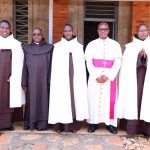
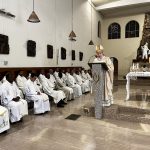
The 14th General Assembly of the Philippine Federation of Discalced Carmelite Nuns held last November 8-12, 2022 in Iloilo City, coincided with the launching of the centennial celebration of Jaro Carmel, the first Carmelite community in the country. Here, Carmel began on November 9, 1923 when the four French Carmelites from Hue (Vietnam) responded to the invitation of Bishop James P. McCloskey, Bishop of Jaro.

The centennial celebration was launched with a concelebrated mass presided by Archbishop Jose Romeo Lazo.  In his homily, Fr. Chris Surinono, OCD, Definitor General invited the nuns to “feel with the Church, in the Church and for the Church and to learn from St. Therese of the Child Jesus the healing power of prayer.”

This assembly heightened our awareness of the need for vocation promotion.  Fr. Danilo Lim, OCD, Provincial and Religious Assistant, presented some guide questions on the use of information technology and its role in vocation promotion, on our need for an integral human formation.  The nuns also met Fr. Chris Surinono, OCD, Definitor General, who spoke to them on ‘Fraternal Life According to St. Teresa’.


All questions related to the WYD2023 and the International meeting of Carmelite Youth should be sent to jmj2023@carmelitas.pt. Likewise, all the information we have regarding the WYD2023 and the International meeting will be communicated by the same email and will be available at http://jmj2023.carmelitas.pt/.


Information regarding the International meeting of Carmelite Youth

Place: Fátima, Portugal

Date: 31st of July 2023; from 10 am to 8 pm (it may change)


Establishing contact

Each group should send an email for jmj2023@carmelitas.pt, stating their interest to take part in the meeting, presenting the group (country, type of Carmelite community [sisters, friars, seculars, parish, college, ecclesial movement, etc.], and the group responsible) and should provide a participants’ estimative.


Registration for the International meeting of Carmelite Youth

Step nº 1:

  • If accommodation for the night of July the 30th is needed:

The accommodation will be the same as the remaining days of the WYD[1]. In order to guarantee accommodation, each group should make their WYD’s registration as part of the macrogroup called ODC2023 and chose the package A1+(30 jul) or A3+(30 jul);


  • If accommodation for the night of July the 30th is not needed:

Go to step nº 2.


Step nº 2: Registration for the International meeting of Carmelite Youth:

Between the end of 2022 and the beginning of 2023, an online registration form will be available. Each group will formalize their registration and the process will end with the payment of the cost of participation.


General information for the International meeting of Carmelite Youth:

  • Each group should guarantee transportation to arrive to Fátima and to return to Lisbon (or other location) in order to participate in the International meeting of Carmelite Youth.
  • Meals (lunch and dinner) are included in the price of the participants package.
  • In due time, the program of the meeting will be presented. Nonetheless, all the participants will be invited for several moments: Eucharist, prayers moments, workshops, tour of Fátima, etc…


WYD2023 Information

Registration Process

  • Each group must registered within the Carmelite macrogroup “OCD2023”.
  • Each group, even though should be registered within the Carmelite macrogroup, is able to choose the package that most fits its needs.


Days in Dioceses

[1] Since we do not have enough accommodations for the participants we expect attend the meeting, we, with the WYD organization, have arranged for the meeting participants to check in in the WYD accommodations one day before the official WYD opening day, so that they may spend the night and travel to Fátima.


Saturday October 15th, the Carmelites of Pater Noster, on the top of Mount Olives, celebrated the feast of saint Teresa of Avila.

The celebration, held by Most Reverend Latin Patriarch of Jerusalem Pierbattista Pizzaballa, has signaled also the inauguration of the 150th anniversary of the foundation of Carmel, established on 1873 by the French Carmelites (the anniversary will be officially celebrated next year, in 2023). For this occasion, the lay people and guests have had the possibility of visiting the Carmelite cloister, a beautiful place normally accessible only to the nuns, where they have been warmly greeted by the discalced Carmelites and volunteers after the holy mass.


Saturday October 11th 2022, in the spiritual center of Mary Queen of Carmel of Gitega, three discalced Carmelite friars, have made their solemn profession: these are friar Anatole of the Divine Mercy, Emmanuel of the Holy Trinity and Marius of the Eucharist. All three of them have done their formation of Carmelite second novitiate in Kinshasa, in the RDC, from July to September 2022. They prepared themselves with spiritual exercises preached by the Rector of the Marian Sanctuary of Mugera, Rev. Venant Mpozako.

The eucharist celebration in which the solemn profession took place was headed by Mons. Blaise Nzeyimana, bischop of Ruyigi and representative of the Episcopal Conference of Burundi of the Institutes of Consecrated Life and Societies of Apostolic life. Mons. Blaise underlined the joy of celebrating the 400th anniversary of canonization of Saint Teresa of Jesus, on march 12th 1622 and the 52nd anniversary of her proclamation as the first female Church Doctor. He also expressed his recognition on behalf of the bishops of the spiritual apostolate of the discalced Carmelites of Burundi and Ruanda, inviting them to be faithful to their charisma. This is the desire of all the Cristian community of Burundi and Ruanda, theme of prayer and blessing of the bishops.


Friday October 14th, the Teresianum celebrated the inauguration of the new academic year. The eucharistic celebration was held by S.Emza. Cardinal Kurt Koch, director of the Dicasterium for the promotion of the unity of Christians.

After this first liturgical moment, the academic act took place, divided in a first moment in which fr. Christof Betschart, OCD, preside of the Pontificial University, presented his briefing of the academic year 2021-2022. The second moment of the academic act was the presentation held by his Emza. Cardinal Kurt Koch, regarding the topic “The prayer as the soul of the theology. Regarding the relation between theological reflection and spiritual praxis”.


The inauguration was ended with refreshments in the cloister of the Teresianum.

Beginning of the web site of the University: https://www.teresianum.net

Some weeks before, the web site of the university has been enriched with a new resource: the institutional repositorium. The goal is that of preserving in one online space the scientific production of the University and of its members. The repositorium es accessible on the official web: https://repository.teresianum.net  and is continuously supplied with new attachments.

Along with the scientific and divulgatory works of the professors of the university, the platform gathers some of our principal magazines, completely consultable online, in particular the Teresianum magazine and the Fiamma Viva. Another important section of the repositorium is the one of the doctoral dissertations discussed in the university, made available.


The Saint Josef Commiserate of Congo celebrated from Monday 26th till Thursday 29th of September. It was chaired by father General Miguel Marquez, along with two definitors in charge of Africa and Madagascar, fathers Jean-Baptiste Pagabeleguem and Philbert Namphande.

During the inaugural session, the father Commiserate Albert praised the efforts accomplished by the friars in the last years after the establishment of the Congo Commiserate. Our Father General, afterwards, expressed his joy of finding himself in Congo for the first time and stated that he was here in order to listen, learn and get to know the reality and challenges of the Congo Carmelites. This first day has been dedicated to the presentation of our eight communities. The second day we shared all of what we listened in the previous presentations. Wednesday September 28th, we listened the report of the commiserate bursar of the economic situation of the Congo Commiserate and then that of the initial formation. At the ending of the Plenary Council, father General encouraged us to a deeper communication and cooperation among the communities as well as with the nuns and secular order.

Father General, along with both Definitors and father Commiserate paid a visit on Wednesday September 28th to the Archibisop Fridolin cardinal Ambongo, Archbisop of Metropolitan Kinshasa, and the Archbishop Ettore Balestrero, Apostolic Nuncio of the RDC.


In Alba de Tormes, the Teresian Jubilar Year was solemnly inaugurated in the presence of a great multitude. It will last till October 15th 2023. The prior bishop, Mons. Carlos López, had the honor of opening the holy door. Father Miguel Ángel González read the papal decree.

Ad Avila, the jubilar year was opened with a Holy Mass in the cathedral at 11:00 a.m. The previous day, Friday 14th in the Basilica of saint Teresa, the statute of the saint was solemnly transferred to the Cathedral. From there after Saturday’s eucharist, was carried in a procession thru the streets of Avila along with the image of the Madonna of charity, till returning to the Basilica. From there in the evening, one of the most heartfelt moments took place: the farewell of saint Teresa to our Lady. This moment wasn’t held since 2019 due to the pandemic.


On October 6th, the University of Salamanca commemorated the centenary of the concession of the Doctorate honoris causa of saint Teresa of Jesus. A commemorated celebration was organized regarding the “most important woman of Spanish history for her international influence and her intellectual capacity”. The celebration began with a gathering of academics around 70 doctors PHD of the university and 20 discalced Carmelite friars. During the celebration it was remembered that on October 6th 1922 Teresa Cepeda and Ahumada was honored along with the Spanish scholars for her shared culture, literary qualities, spirituality and reformistic values.


Starting on October 15th the digital project of “Digicarmel” has been open to the public (www.digicarmel.com): we discover it with P. Angelo Lanfranchi, General house of the Order archivist.

Fr. Angelo, what is Digicarmel?

Digicarmel is much more than a simple web page: it’s an online database created to manage all of the actual and historic information of the entire Order.


Why was Digicarmel created?

Carmel has a long and rich history, with ecclesiastical expressions and spiritual dimensions, apostolic, cultural and artistic of an incredible complexity. To preserve and to share this history and our treasures of life and spirituality is a duty that the wide extension of the Carmelite family and the large number of events that happen year after year make it ever more difficult to handle.

Acknowledging this challenge, we have thought of a new way of work that allows us to make use of the new technological means to organize the information in an versatile, dynamic, unified and share friendly way.


What advantages are available in the use of Digicarmel?

Digicarmel is a flexible and solid platform, capable of registrations, joining and making immediately available information and material that have been already produced and treated commonly in each house and province of the Order, archives, magazines and Carmelite publishing houses, other organisms and research… Gathering all of this material in one place will multiply the efficiency and utility of the work undertaken of all in research of the information, avoiding useless dispersion of resources.


How is the complex information organized in Digicarmel?

The principal area, the “heart” of all the database, is a digital version of the work until now present in Conspectus, and Acta Ordinis and previous historical publications that had the goal of preserving and sharing the principal facts relative to the Order, its persons, houses, circumscriptions and other corelated realities and initiatives.

This section is the backbone of our database. In it are reunited the Digital Carmelite Library (BCD Bibliotheca Carmelitana Digitalis), a complete and proper Carmelite library that reunites in a digital format, freely researchable, many books and articles of Carmelite topics in many languages. Till this day 5 magazines in Italian, Spanish and Portuguese have been entirely incorporated in the BCD with more than 2,500 articles available, along with 80 monographies regarding the institutional history of the Order, among those are the nearly entire publication of the Istituto Storico Teresiano (HT). The library is in continuous growth thanks to the cooperation with Carmelite publishing houses and magazines.

The BCD allows you to find in just one platform material that to this day were difficult to access and to make research on them thru the OCR technology of a specific word within the text of all the documents available within our library.

The third section of Digicarmel, still as a work in progress, is the Archivum Carmelitanum Digitale (ACD), a true and proper digital archive of the Order were each carmelite archive would be able to share on line -if so desired- specific material. In the Generalate’s archive we have begun recently a rich project of digitalizing of a section of the mission’s archive, that in a few months shall enter as a part of the ACD and will allow to know much more original documents about our rich missionary history from the sixteenth century on forward. We hope that other Carmelite archives may soon use this instrument in the service of the Order, so as to better preserve and share the charisma made history.

Let’s remember that the software is capable of handling even the images archive: one of our next projects shall be to make a catalogue and publication of the rich photographic stock preserved in the Generalate’s archive, and a virtual museum, that in principle may embrace the entire artistic patrimony of the Order.

Digicarmel finds itself in a developing process and thus can’t be considered as a “closed” archive. Given the great amount of information, it isn’t a database “complete” of all the institutional history of the Order, but it is now sufficiently mature in order to make it available to Carmelite public in general, while we continue to enrich its diverse sections. We value the feedback of the users in order to make better this resource in the service of our Carmelite family.


Who can be interested in Digicarmel?

The people that maybe be interest are double: for those who grant information and for those who search for it. In this sense Digicarmel is of great interest for researchers, publication houses, magazines and Carmelite archives that wish to insert their own material in the database to better make known their own documentation, but it is also indispensable for all who want to know in a more deeper way Carmel in its history, charisma, persons and institutions.

For contact with those responsible of the project with whatever question o proposal of participation, you can write to the mail: digicarmel@ocdcuria.org.

Saturday October 1st , the entire Carmelite family of the Paris province held a reunion in Lisieux for the 10th consecutive year. In the context of the general pastoral visitation of the father General, fr. Miguel Marquez Calle and fr. Roberto Maria Pirastu, definitor, participated in the meeting.

Around 160 persons, among friars, secular Carmelites and nuns of the Carmelite spirituality, reunited around Saint Therese and were welcomed by the Discalced Carmelite nuns of Lisieux. Father General spoke of the importance of the doctorate of Therese in “science of love”: “The doctorate of Therese allows us to state that her doctrine contains a word about God and about the human being that is beautiful not only for the believers, but also for modern day society (…) The wisdom of Therese can help us to rediscover the Gospel, to overcome our situation of spiritual stagnation, to live the Word of Jesus like a liberating strength”.

Along with Sunday’s holy mass presided by Mons. Habert, bishop of Bayeux-Lisiuex, and the procession of the relics, the most important moments were the prayer time and the encounter with father General with the secular Carmelites and with all the friars.


From the 4th to 11th of September, the diocese of Tumaco and the Tumaco Social Pastoral Ministry organized the Week for Peace, whose theme this year was «On the path of truth, a country of hope and dignity». The launch took place in the presence of the bishop of Tumaco, Monsignor Orlando Olave, the staff of the Social Ministry, the media and many artists. The opening of the Week for Peace was marked by a procession with banners For Life and For Peace.

On the occasion of the opening of the Week of Peace, Monsignor Orlando Olave blessed a statue of St. Therese of the Child Jesus placed in the grounds of the Carmelite parish, of which he is the titular. The statue commemorates the 150th anniversary of the birth of Therese and her recognition by UNESCO as an important figure for humanity, as an example of a woman who promoted the values of peace.

On September 8, the «Gallery of Memory» exhibition was held in the square of the parish of Saint Therese of the Child Jesus, under the responsibility of the Tumaco House of Memory. This place is aiming to build up the collective memory of all those who have been protagonists or witnesses of the social struggles and contemporary history of our country. The families, companions and friends of all these moving forces were invited to the Gallery. We remember them to remember and to remind us that the events that are bloodying our country must not be repeated.


Next October 22, the Association “Cuore Amico Fraternità Onlus” (www.cuoreamico.org) of Brescia, Italy, will confer the 32nd Cuore Amico Award to Father Cesare Busecchi, OCD, of the Veneto Province, in recognition of his long missionary work in Madagascar. Father Cesare asked to go to there in 1987. His first missionary experience was in the forest, where he experienced the generous welcome of the population and… the wildlife! He was then appointed parish priest in Itaosy, on the outskirts of Antananarivo, the capital of Madagascar: he was responsible for 9 churches for a population of 120,000 inhabitants, of which 40,000 were Catholics. Here, Father Cesare was confronted with the misery of those who had come from the countryside to the city in search of a better future.

80% of the population lives below the poverty line and, after Covid, the social situation has worsened. In particular, the number of children living on the streets in the capital has increased exponentially. It is precisely these children who will benefit from the Cuore Amico Award. Father Cesare’s dream is to help children and families who sleep in the tunnels of the capital. He already owns land where he would like to build a house for isolated children, small houses for families, a school, and somewhere to help these people grow crops.


From the 1st to the 10th of September, ten confreres from the German and Austrian provinces left for Andalusia to walk in the footsteps of St. John of the Cross, under the guidance of Fr. Ulrich Dobhan, according to the German Province program for ongoing formation. Therefore, all the excursions were preceded by lectures by Father Ulrich. We were also able to celebrate the Eucharist in the places where John of the Cross lived.

We started our itinerary from the Úbeda monastery, from there we went to Beas, Granada, Baeza, visiting the nuns and friars. We stayed for a long time in the Carmel of Los Mártires and then went to La Peñuela (La Carolina). We celebrated the Office in the Hermitage of the Saint, at the «Asparagus Bridge», which had emerged from the dam due to drought.

The second important stop on our trip was Seville. We visited the cathedral, our Nuns in the Barrio of Santa Cruz, the Friars of Santo Ángel, with whom we shared a dinner and admired the museum. In Córdoba we visited the Mezquita-Cathedral, the old Jewish quarter with the monastery of John of the Cross, the current monastery of the friars and the Hermits. Another trip took us to the Carmelite nuns of Antequerra, where we visited a one-of-a-kind Museum of Carmel. Our trip ended in the city of Ronda, rich in history.


The meeting of the Discalced Carmelite nuns of the Federation of the Holy Spirit took place once again in the monastery of the Carmelite friars in Przemyśl. A group of sisters worked on the new Ratio, a document that helps in initial and ongoing formation. This nucleus was formed by postal vote by the Sisters of the Federation. It is composed of nuns from the convents of Przemyśl, Rzeszów, Dys, Tarnów, Katowice and Dietva in Slovakia. The meeting was also attended by the President of the Federation, Sr. Teresa, the Head of Formation of the Federation, Sr. Cecylia, and the Assistant of the Federation, Fr. Krzysztof Górski.

Sister Lidia Wrona, a Carmelite Missionary, was invited to participate in the working days. She shared her experience of working on the Ratio of her Congregation and invited us to listen first of all to the Holy Spirit to let ourselves be guided by him and follow the path that the Church shows us. The program included personal prayer, moments of reflection and sharing, but also joyful meetings with the community of the Friars of Przemysl.


On the 7th August, Fr. Leonel Ceniceros, Provincial of Mexico, Fr. Milton Moulton, Commissioner of Chile, Fr. Robin Calle, Delegate of Ecuador, and Fr. Martín Martínez of the Generalate, officially constituted the CICLA Reflection Group. It will be composed of 19 friars named by their respective Superiors. Twelve brothers were able to attend the session, while seven were unable to participate.

During this session, together with the constitution of the group, we recalled its general objective: to be a consultative group which will help the Major Superiors to reflect on questions involving decision-making. Its more specific tasks are the preparation of formation sessions such as the “Spirituality Encounter”, the “Alacar Encounter” (OCD and OCarm), the formation of formators, etc. In addition, it will also work to encourage collaboration and promotion of our spiritual centers. The coordinator and secretary of the group were also appointed. The next meeting will take place in November.