Carmelites came into existence towards the end of the 12th century from an indefinite, not well-known group of lay people, pilgrims and crusaders who, tired of war or desirous of waiting for the final coming of the Lord which, according the apocalyptic mentality of the time, was to occur in Jerusalem. They withdrew to the mountain of Carmel, where they embraced the hermit life style in vogue at the time, in opposition to and reform of the monastic movement. These first Carmelites devoted themselves to prayer and meditation on the Word of God.

Before being structuring into a group, which would take place with the Rule, these initial Carmelites were free, independent hermits, who looked for perfection through solitude, in which they attempted to fight against the devil – the combat with the devil, proper to desert spirituality – and against the enemies of a truly Christian person: the passions.

Later on, in a second stage, between 1206-1214 they asked Albert Avrogardo, Patriarch of Jerusalem who was living in St Jean d’Acre, to give them a Rule, a formula for life, by which to govern themselves. This Rule defines the Carmelite ideal as living “a life of allegiance to Jesus Christ, pure in heart and steadfast in conscience”.

From 1220, the lack of security in the Holy Land caused the Carmelites to begin their migration to Europe, establishing themselves in Cyprus, Sicily, France and England. In 1291, with the fall of St Jean d’Acre, the Carmelites were no longer present on Mount Carmel.

The mitigation of the Rule, adapting it to the new demands of religious life by Pope Innocent IV in 1247, was the point of departure in adapting the Carmelite Order from its hermit origins to a mendicant lifestyle, allowing Carmelites to found their monasteries in cities and devote themselves to preaching and confessing like the other mendicants. However, it was not until the 2nd Council of Lyons that they were officially considered as mendicants, together with the Dominicans, Franciscans and the Hermits of Saint Augustine.

Established in Europe, and looking for signs of identity by which people could recognize them, they developed devotion to the prophet Elijah, presenting him in his double aspect, as a prototype of the hermit dedicated entirely to contemplation and, on the other hand, as a model of mixed life bringing together action and contemplation.

At the same time, they developed devotion to Mary, which identified them as the Order of the Virgin from the time they were established in Europe, when the title by which the Order is official known became widespread: The Brothers of the Blessed Virgin Mary of Mount Carmel.

From late medieval times, the Carmelites who wished to live in allegiance to Jesus Christ were characterized by: contemplation, the foundation of Carmelite life and apostolate; prayer and together with it meditation, recollection and silence; asceticism, which implies sobriety of life; poverty, which implies dependence on others and a humble life; the apostolate, both in their churches and outside them.

01_Storia del Carmelo Scalzo

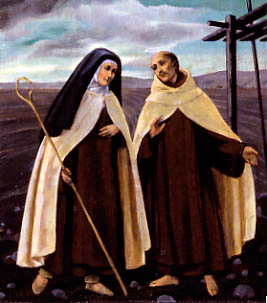
The Discalced Carmel acknowledges Saint Teresa as its mother and foundress. It is the only Order which has a woman as its foundress and, distinct from the other Orders which have male and female branches, the nuns were established before the friars.

We are not going into the old discussion about the charism of the reformer and the charism of the founder. Mother Teresa’s desire was “to wish to preserve the continuity of Carmel”. What is new is not the past in itself, but progress, looking to the future, which leads us to think that Saint Teresa “wanted to give birth to a new style of religious life”, and she does so always in fidelity to the Church.

What we have just said is an affirmation that was to pass into the Constitutions where we define ourselves as “a renewed form of an ancient Order which entails both fidelity to the spirit and traditions of Carmel and a continual striving after renewal.” Tradition and desire for renewal are two attitudes bequeathed to the Discalced Carmel by its mother and foundress, Saint Teresa.

In 1599, Saint Teresa had a vision of hell which moved her to live in greater perfection. In the seven years from then until Fr Rubeo, the General of the Order, paid a visit in 1566, the Teresian ideal was developing. The notion of founding began to predominate over that of reforming. There remained in her a connection with the past, a search for the primitive rule, a desire to go to the sources of what it meant to be Carmelite, “our parents from whom we come”. What was new in her was the “personal desire to choose” something, which when lived interiorly by her, would be transmitted to the group or family begun by her.

02_Storia del Carmelo Scalzo

In Saint Teresa there was a growth which ranged from her desire to be reformed in herself or reforming her Order, which motivated the foundation of St Joseph’s in Avila in 1562, to an ecclesial preoccupation: unity in the Church, the old Christianity and finally an apostolic preoccupation to discover their mission, the new areas opening for the Church in America, the New World.

The end result of this whole process was to be the development of the idea of foundation that occupies and fills the rest of her life, 1567-1582, and the birth of the discalced friars, which happened through St. John of the Cross and Fr Antonio of Jesus in Duruelo, 28 November 1568. This event carried on not only her style of life, but also her passion or concern for the Church and for the salvation of souls, her apostolic and missionary ideal.

Spiritualita

Carmelite Spirituality

By Carmelite spirituality we understand a way of sensing and living the Gospel from certain premises that were born from the experience of the “great prophets” of the Discalced Carmelite family: Teresa of Jesus, John of the Cross, Therese of the Child Jesus, Edith Stein. It is an experience of God which leads to discovering God within oneself and to giving to life a meaning based on the theological virtues; it is a Christological experience leading to the historical Christ of the Gospel; the experience of Church, such as belonging to it and preoccupation for its good.

The General Chapter of 1985 endorsed the call of Pope John Paul II, that the Gospel, (and by extension the great spiritual masters), might become the source of culture, insofar as they encourage in the person sensitivity for the authentic values of liberty, justice and peace; that our horizons would also be expanded in the perception and taste for religious values, leading us to the experience of the divine, which is where we can satisfy the desire of our hearts.

Accepting this invitation, the Chapter members courageously emphasized a series of values proper to our patrimony, which should inform the life and the activity of the Order, ‘the specific ministry’ of the Discalced Carmelite:

Experiencing God and the desire for communion with him, as a witness and a response to the religious dimension of man; the saving experience in Jesus of a humanity deeply needing purification and liberation; the fraternity of a Teresian community as a characteristic sign of the social and relational aspirations of the person of today, always in search of communication and friendship; the theological and Christological view of man; contemplation of the world from Christ crucified and risen, present and operating in history, as an attitude of creative hope for people committed to a better world; the life of prayer as an experience of God’s transcendence revealed in Christ Jesus; asceticism as detachment from what is superfluous and availability for human beings; encouraging in each person the ability to reflect – Teresa’s critical spirit, fostering social coexistence, Teresa’s style of fraternity.